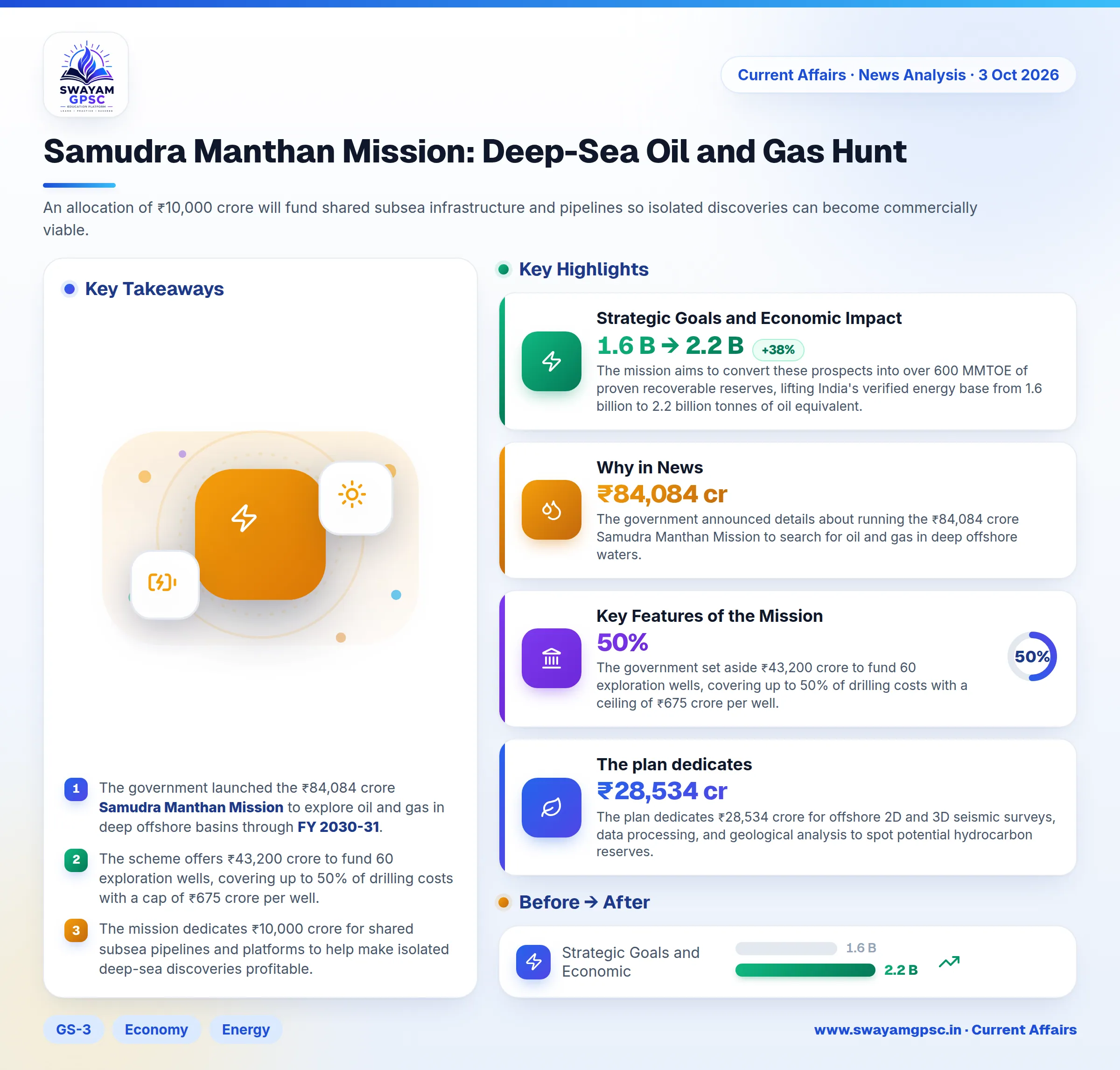
Samudra Manthan Mission: Deep-Sea Oil and Gas Hunt
#GS-3 #Economy #Energy #Infrastructure #Science & Technology #Current Events #National #Hydrocarbons #Oil and Gas Exploration
Key takeaways
- The government launched the ₹84,084 crore Samudra Manthan Mission to explore oil and gas in deep offshore basins through FY 2030-31.
- The scheme offers ₹43,200 crore to fund 60 exploration wells, covering up to 50% of drilling costs with a cap of ₹675 crore per well.
- The mission dedicates ₹10,000 crore for shared subsea pipelines and platforms to help make isolated deep-sea discoveries profitable.
- India aims to discover over 600 MMTOE of proven recoverable reserves and raise annual domestic production to 80 MMTOE.
- Successful domestic output from this scheme could reduce India's oil import bill by nearly ₹1 lakh crore annually.
Why in News
- The government announced details about running the ₹84,084 crore Samudra Manthan Mission to search for oil and gas in deep offshore waters.
- This project focuses on major offshore areas including the Mahanadi, Andaman-Nicobar, Krishna-Godavari, Cauvery, and Kutch basins to boost local energy production.
About the Samudra Manthan Mission
- The Samudra Manthan Mission, also known as the National Offshore Exploration Scheme, is a Central Sector initiative under the Ministry of Petroleum and Natural Gas running until FY 2030-31.
- This mission wants to lower financial risks in offshore drilling, find over 600 MMTOE of recoverable reserves, raise annual domestic production to 80 MMTOE, and cut foreign oil imports.
Key Features of the Mission
- The government set aside ₹43,200 crore to fund 60 exploration wells, covering up to 50% of drilling costs with a ceiling of ₹675 crore per well.
- The plan dedicates ₹28,534 crore for offshore 2D and 3D seismic surveys, data processing, and geological analysis to spot potential hydrocarbon reserves.
- An allocation of ₹10,000 crore will fund shared subsea infrastructure and pipelines so isolated discoveries can become commercially viable.
- The initiative gives top priority to deep and ultra-deep drilling across the Mahanadi, Andaman-Nicobar, Krishna-Godavari, Cauvery, and Kutch-Mumbai basins.
- The plan provides ₹2,000 crore to develop domestic equipment manufacturing under Make in India, along with ₹350 crore for monitoring and regulatory support.
India Energy Needs and Upstream Policy
- India is the world's third-largest oil consumer and spends nearly $144 billion or about ₹13 lakh crore each year on crude imports.
- Legacy fields like Mumbai High face a natural output drop of 6% to 7% every year, which makes new discoveries essential.
- India replaced older licensing policies like NELP with modern frameworks like the Hydrocarbon Exploration and Licensing Policy (HELP, 2016), open acreage bidding, revenue-sharing contracts, and the National Data Repository (NDR).
- The government opened nearly 99% of offshore areas previously locked under defense restrictions, releasing over 1 million sq. km of the Exclusive Economic Zone for commercial drilling.
Key Geographical Focus Areas
- In the Mahanadi basin, the first appraisal well MN-DWN18-1-HD began drilling in July 2026 as part of a four-well project in areas where 94% of acreage was once restricted.
- The Mahanadi basin also serves as the primary testing area for the ₹10,000 crore shared infrastructure model.
- The Andaman-Nicobar basin holds an estimated resource base of 371 MMTOE, with ONGC and Oil India planning ultra-deep drilling down to 5,000 meters.
- The ANDW-7 well in the East Andaman Back-Arc proved the presence of an active thermogenic petroleum system similar to active fields in North Sumatra and Myanmar.
- The mission pushes into ultra-deep areas of the Krishna-Godavari and Cauvery basins, supported by technical partnerships between ONGC and ExxonMobil.
- In the western offshore belt near Kutch and Mumbai, companies will use common shared infrastructure to cut high pipeline and production costs.
Strategic Goals and Economic Impact
- India's offshore basins hold an estimated geological potential exceeding 5,600 MMTOE at depths up to 3,000 meters, but these are unproven reserves.
- The mission aims to convert these prospects into over 600 MMTOE of proven recoverable reserves, lifting India's verified energy base from 1.6 billion to 2.2 billion tonnes of oil equivalent.
- The plan targets raising domestic oil and gas output from around 62 MMTOE to 80 MMTOE each year.
- Successful production could reduce crude import costs by nearly ₹1 lakh crore or about $11-12 billion every year, helping India's trade balance.
Challenges
- Drilling in deep waters up to 3,000 meters and ultra-deep waters up to 5,000 meters requires expensive specialized drillships without any guarantee of finding commercial oil.
- Isolated discoveries in frontier areas often remain unused because building dedicated pipelines and platforms for small fields costs too much money.
- The Bay of Bengal and Andaman Seas face strong cyclones, intense underwater currents, and high-pressure high-temperature reservoir conditions that disrupt operations.
- Moving from initial chemical gas traces to commercially viable production requires extensive testing and very high financial investments.
Way Forward
- India should use the ₹10,000 crore infrastructure corpus to build common subsea collection hubs so multiple small fields can share pipelines.
- Public sector companies must expand technical tie-ups with global leaders like ExxonMobil, BP, and TotalEnergies to manage deep-sea drilling risks.
- The Ministry of Environment, Forest and Climate Change (MoEFCC) needs to create fast single-window clearance desks to prevent costly rig waiting times.
- The government should use the ₹2,000 crore manufacturing fund to build domestic subsea valves, manifolds, and vessels under the Make in India program.
Conclusion
- The ₹84,084 crore Samudra Manthan mission shifts India's exploration strategy toward frontier deepwater basins by combining drilling subsidies with shared platforms.
- Turning initial deep-sea discoveries in the Mahanadi and Andaman basins into real production will safeguard India's energy security and trim its heavy import bill.