Pharmaceutical Price Regulation in India
#GS-2 #Governance & Social Justice #Health #Good Governance #Current Events #National #Pharmaceutical Regulation #National Pharmaceutical Pricing Authority
Key takeaways
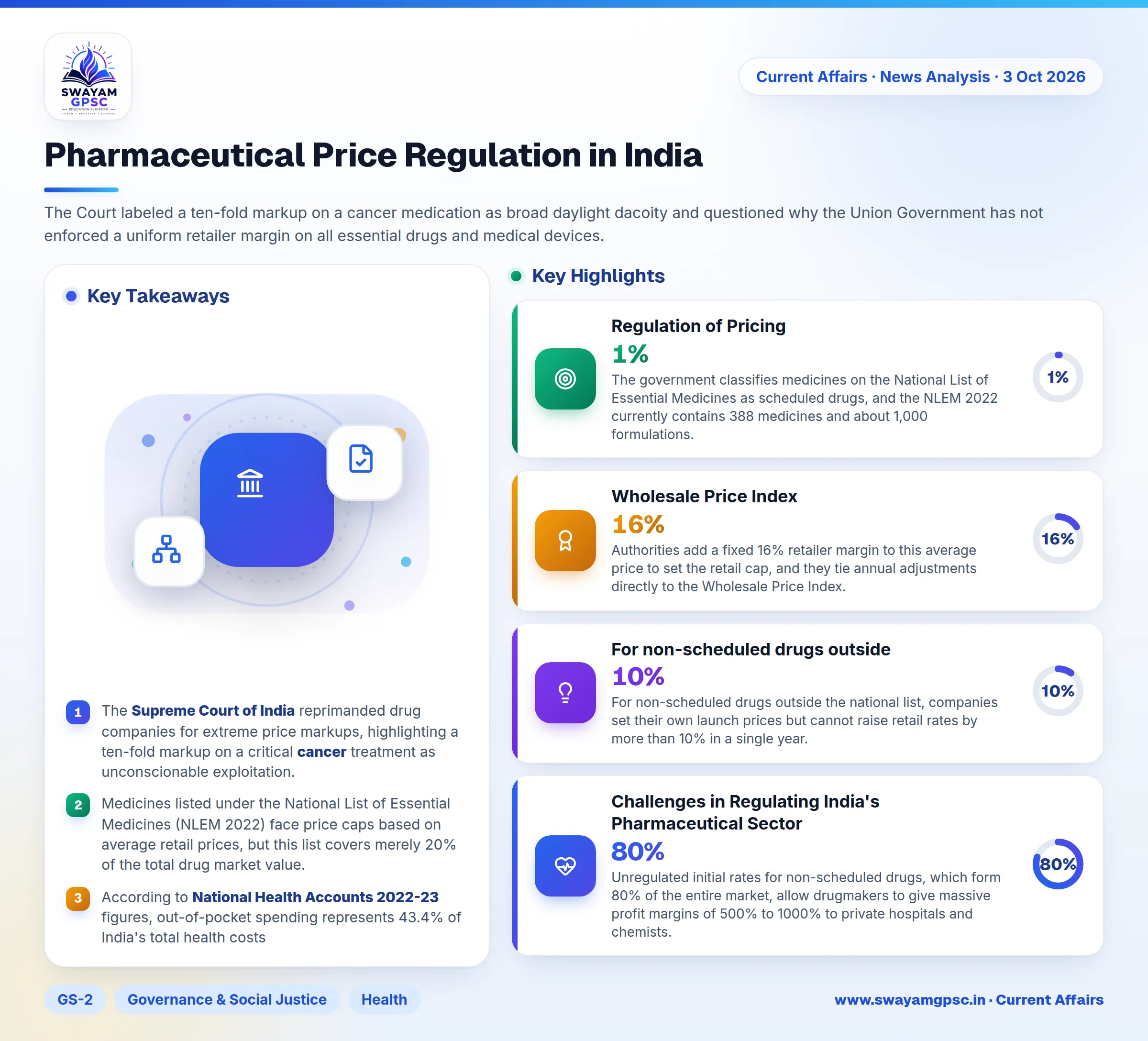
- The Supreme Court of India reprimanded drug companies for extreme price markups, highlighting a ten-fold markup on a critical cancer treatment as unconscionable exploitation.
- Medicines listed under the National List of Essential Medicines (NLEM 2022) face price caps based on average retail prices, but this list covers merely 20% of the total drug market value.
- According to National Health Accounts 2022-23 figures, out-of-pocket spending represents 43.4% of India's total health costs, with NSSO 75th Round data showing that drug purchases comprise nearly 70% of that burden.
- The National Pharmaceutical Pricing Authority used trade margin rationalisation to slash retail costs on 42 anti-cancer medicines alongside stents and knee implants.
- The Pradhan Mantri Bhartiya Janaushadhi Pariyojana cuts medicine expenses by offering generic formulations through specialized outlets at discounts between 50% to 80%.
Why in News
- The Supreme Court of India criticized the massive markup between the wholesale cost and the Maximum Retail Price of essential life-saving drugs.
- The Court labeled a ten-fold markup on a cancer medication as broad daylight dacoity and questioned why the Union Government has not enforced a uniform retailer margin on all essential drugs and medical devices.
Regulation of Pricing
- Under the Essential Commodities Act, 1955, the government treats medicines as essential items and controls their manufacture, distribution, and cost.
- The government issued the Drugs (Prices Control) Order, 2013 under the Essential Commodities Act, 1955 to establish the primary legal rules for medicine price regulation.
- The National Pharmaceutical Pricing Authority, working under the Department of Pharmaceuticals within the Ministry of Chemicals and Fertilizers, regulates drug rates, implements the Drugs (Prices Control) Order, 2013, and recovers unlawful overcharges from drugmakers.
- The government classifies medicines on the National List of Essential Medicines as scheduled drugs, and the NLEM 2022 currently contains 388 medicines and about 1,000 formulations.
- To fix ceiling prices for scheduled drugs, the National Pharmaceutical Pricing Authority calculates the simple average of the Price to Retailer for brands with at least a 1% market share.
- Authorities add a fixed 16% retailer margin to this average price to set the retail cap, and they tie annual adjustments directly to the Wholesale Price Index.
- For non-scheduled drugs outside the national list, companies set their own launch prices but cannot raise retail rates by more than 10% in a single year.
- Because initial launch prices face no limits, drug companies offer huge trade margins between production cost and retail rates to push private hospitals, chemists, and distributors to recommend their specific brands.
Regulation of Quality and Manufacturing
- The Drugs and Cosmetics Act, 1940 governs the import, production, distribution, and sale of pharmaceuticals and cosmetics across the country.
- Operating under the Ministry of Health and Family Welfare, the Central Drugs Standard Control Organisation serves as the national regulator that approves new drugs, oversees clinical trials, and establishes medicine standards.
Challenges in Regulating India's Pharmaceutical Sector
- Unregulated initial rates for non-scheduled drugs, which form 80% of the entire market, allow drugmakers to give massive profit margins of 500% to 1000% to private hospitals and chemists.
- Patients lack medical knowledge to question prescriptions or ask for cheap generic alternatives, leaving them vulnerable to expensive branded drugs.
- In private corporate hospitals, patients act as captive buyers because hospital policies force them to purchase medicines exclusively from in-house pharmacies at top retail prices.
- High drug costs drive medical poverty, with National Health Accounts 2022-23 data revealing that out-of-pocket spending forms 43.4% of India's total health spending.
- Data from the NSSO 75th Round highlights that purchases of medicines make up about 70% of all direct out-of-pocket health costs for families.
- Divided oversight between the central Central Drugs Standard Control Organisation and state drug authorities causes inconsistent inspection and lets substandard or contaminated drugs slip through.
- The World Health Organisation flagged toxic Indian cough syrups tainted with diethylene glycol and ethylene glycol after their links to around 300 child deaths overseas exposed quality gaps.
- The price ceiling list covers only around 20% of the total domestic drug market by revenue, leaving most advanced therapies and rare disease treatments without price caps.
- Allowing companies unchecked freedom to set arbitrary retail prices unrelated to true production costs conflicts with the Right to Health under Article 21 of the Constitution.
Government Initiatives for Affordable and Quality Drugs
- Through Trade Margin Rationalisation, the National Pharmaceutical Pricing Authority capped distributor margins on 42 anti-cancer medicines, cardiac stents, knee implants, and oxygen machines.
- The government established the Pradhan Mantri Bhartiya Janaushadhi Pariyojana to distribute quality generic pharmaceuticals at 50% to 80% lower prices through Jan Aushadhi Kendras.
- Under the National Health Mission, the Free Drugs Service Initiative supplies essential medications without charge across primary health centers and public district hospitals.
- The National Pharmaceutical Pricing Authority created the Pharma Sahi Daam mobile application so citizens can search medicine price caps, discover generic alternatives, and report overcharging.
- Authorities upgraded Schedule M standards to require all pharmaceutical small and medium enterprises to follow World Health Organization Good Manufacturing Practices.
Way Forward
- The government should place a clear legal cap on trade margins throughout the whole medical supply chain to stop excessive private hospital markups.
- India needs to run its planned Bulk Drug Parks with cheaper power, waste treatment support, and tax benefits so local raw material producers can match foreign competition.
- Drug firms need to expand sales into newer regions beyond the traditional American and European markets while using trade deals to protect against unexpected export hurdles.
- Authorities must firmly implement the National Medical Commission guidelines that require doctors to write prescriptions using generic chemical names instead of commercial brand names.
- India needs a unified national drug regulatory system that brings state and central regulators together under a single standard to ensure strict quality checks across all factories.
Frequently Asked Questions
- The Drugs (Prices Control) Order, 2013 operates under the Essential Commodities Act, 1955 as the primary legal rulebook to control drug costs in the country.
- The National Pharmaceutical Pricing Authority establishes ceiling rates, tracks price compliance, implements price orders, and recovers excess charges from firms.
- For listed essential drugs, authorities calculate the ceiling cost by averaging the retail price of qualifying brands and adding a standard retail margin.
- The Pradhan Mantri Bhartiya Janaushadhi Pariyojana runs dedicated generic pharmacy stores to supply reliable, low-cost medicines that cut household health expenses.
- Updated Schedule M rules demand that drug manufacturers follow good manufacturing practices to maintain medicine quality, consumer safety, and product consistency.