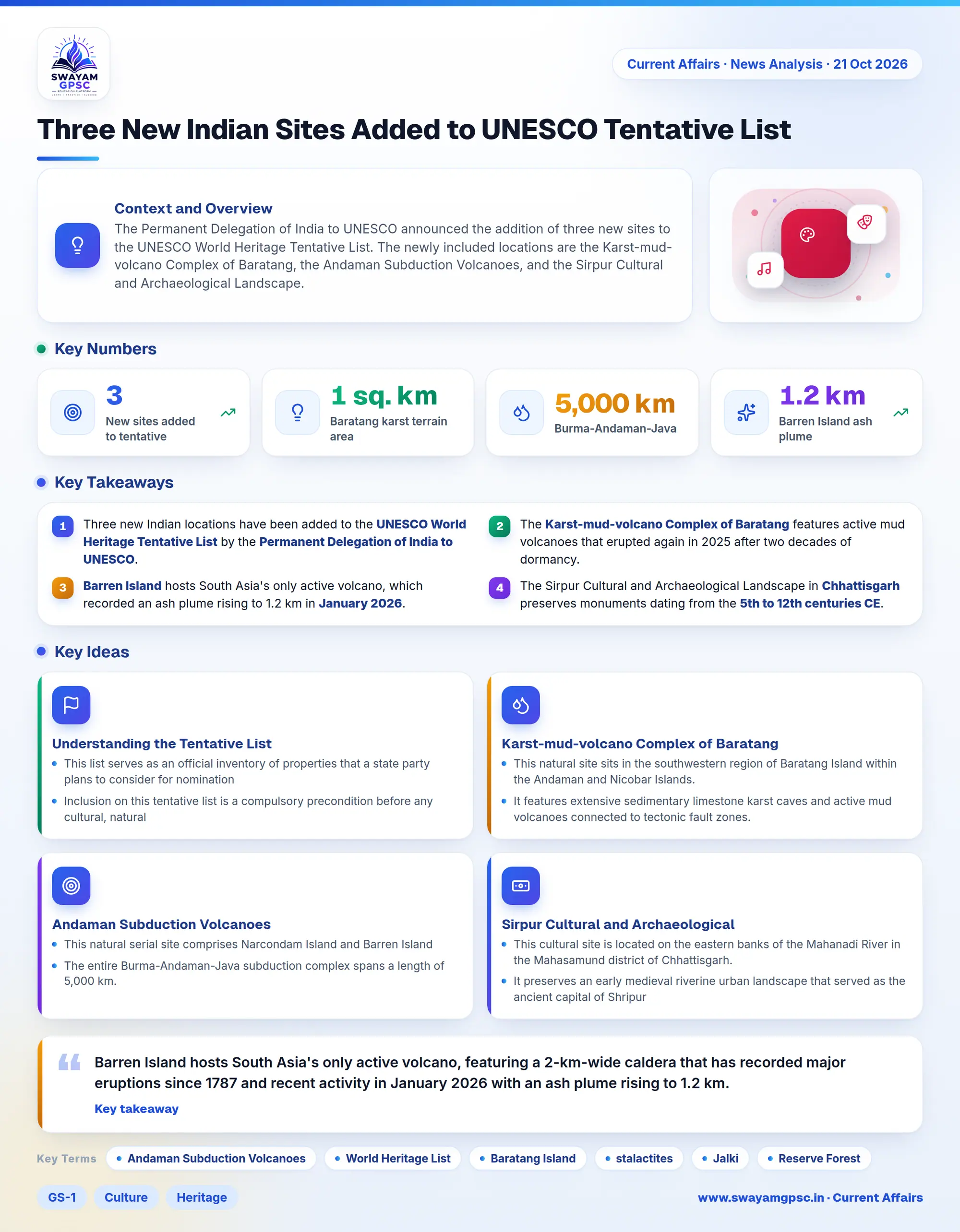
Three New Indian Sites Added to UNESCO Tentative List
#GS-1 #Culture #Heritage #Geography #Environment #Current Events #National
Key takeaways
- Three new Indian locations have been added to the UNESCO World Heritage Tentative List by the Permanent Delegation of India to UNESCO.
- The Karst-mud-volcano Complex of Baratang features active mud volcanoes that erupted again in 2025 after two decades of dormancy.
- Barren Island hosts South Asia's only active volcano, which recorded an ash plume rising to 1.2 km in January 2026.
- The Sirpur Cultural and Archaeological Landscape in Chhattisgarh preserves monuments dating from the 5th to 12th centuries CE.
Context and Overview
- The Permanent Delegation of India to UNESCO announced the addition of three new sites to the UNESCO World Heritage Tentative List.
- The newly included locations are the Karst-mud-volcano Complex of Baratang, the Andaman Subduction Volcanoes, and the Sirpur Cultural and Archaeological Landscape.
Understanding the Tentative List
- This list serves as an official inventory of properties that a state party plans to consider for nomination to the World Heritage List in future years.
- Inclusion on this tentative list is a compulsory precondition before any cultural, natural, or mixed heritage property can undergo formal evaluation for inscription under the UNESCO World Heritage Convention.
Karst-mud-volcano Complex of Baratang
- This natural site sits in the southwestern region of Baratang Island within the Andaman and Nicobar Islands.
- It features extensive sedimentary limestone karst caves and active mud volcanoes connected to tectonic fault zones.
- The rugged 1 sq. km karst terrain formed over millions of years from compacted marine organisms, displaying jagged outcrops, deep caverns, and speleothems like stalactites and stalagmites.
- The site exhibits non-magmatic mud volcanism known locally as Jalki, which emits cool slurries of mud, water, methane, and hydrogen sulphide driven by over-pressured shale layers.
- Four clusters of vents located in the Reserve Forest near Jarawa Creek erupted again in 2025 after remaining dormant for two decades.
- Geological features are governed by tectonic fault zones formed by the subduction of the Indian Plate beneath the Burma microplate.
Andaman Subduction Volcanoes
- This natural serial site comprises Narcondam Island and Barren Island, representing the only Quaternary-period subduction volcanoes in the inner volcanic arc chain.
- The entire Burma-Andaman-Java subduction complex spans a length of 5,000 km.
- Narcondam Island sits closer to transitional crust and features dacite, andesite, and rhyolite rocks, while Barren Island lies above oceanic crust with basalt lavas.
- Barren Island hosts South Asia's only active volcano, featuring a 2-km-wide caldera that has recorded major eruptions since 1787 and recent activity in January 2026 with an ash plume rising to 1.2 km.
- The site demonstrates primary ecological succession on Barren Island due to recurring eruptions, contrasted with long-term ecological succession over 18,000 to 20,000 years on Narcondam Island.
- Narcondam Island is densely forested and harbors endemic species such as the Narcondam hornbill and Narcondam shrew.
Sirpur Cultural and Archaeological Landscape
- This cultural site is located on the eastern banks of the Mahanadi River in the Mahasamund district of Chhattisgarh.
- It preserves an early medieval riverine urban landscape that served as the ancient capital of Shripur under the Sharabhapuriya and Panduvamshi dynasties.
- The area features monumental remains dating from the 5th to 12th centuries CE, integrating Hindu temples like the Laxman Temple and Gandheshwar Temple with Buddhist viharas.
- Structures were built using locally quarried stromatolite rocks formed over a billion years by cyanobacteria within the Proterozoic Chhattisgarh Basin.
- The site retains large-scale urban and mercantile structures, including the Rajmahal complex and bathing ghats along the river trade corridor.
- The surrounding buffer zone hosts indigenous Gond and Baiga communities adjacent to the Barnawapara Wildlife Sanctuary.