Ten Years of the UDAN Scheme: Achievements and Future
#GS-2 #Governance & Social Justice #GS-3 #Economy #Infrastructure #Current Events #National
Key takeaways
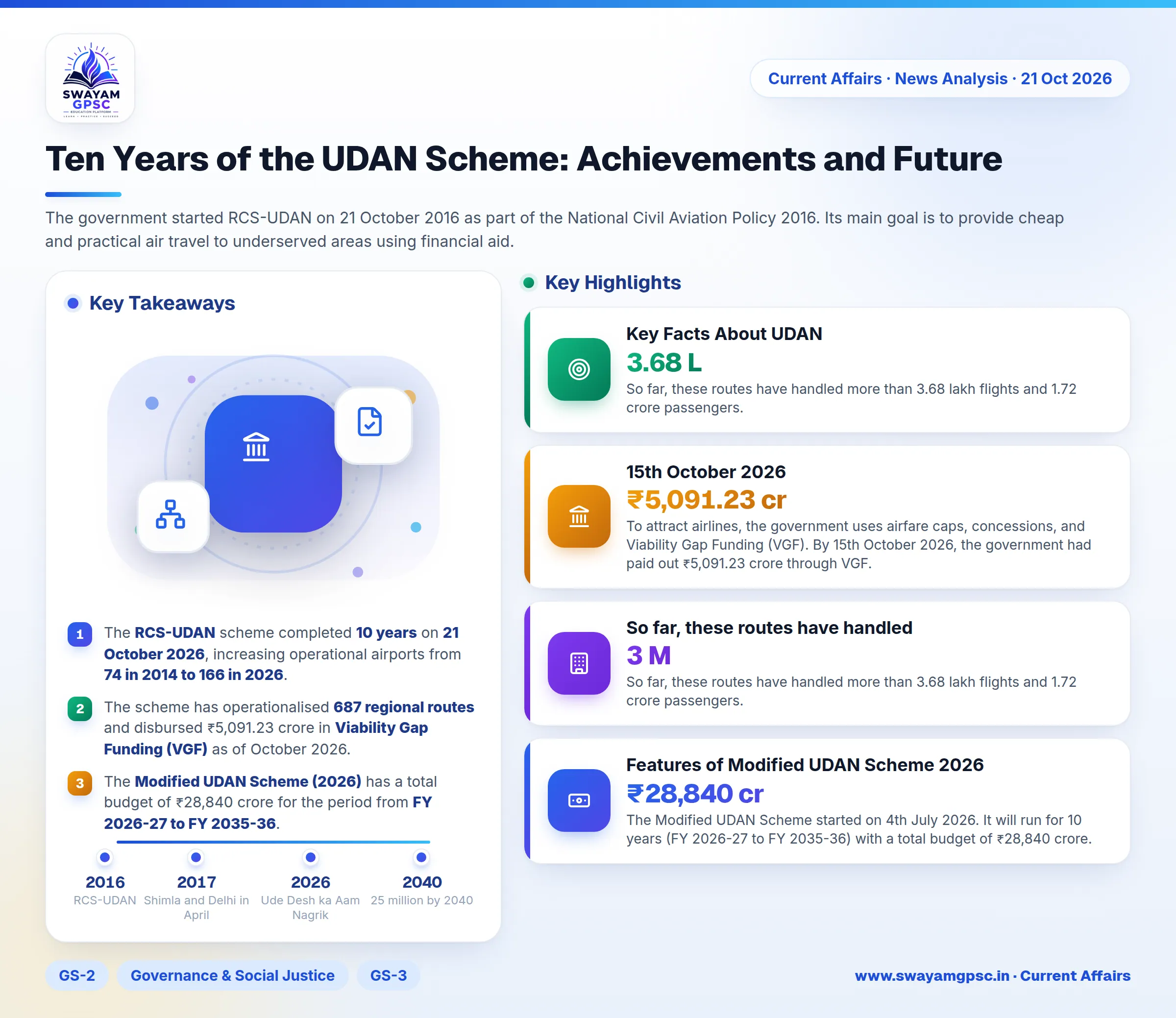
- The RCS-UDAN scheme completed 10 years on 21 October 2026, increasing operational airports from 74 in 2014 to 166 in 2026.
- The scheme has operationalised 687 regional routes and disbursed ₹5,091.23 crore in Viability Gap Funding (VGF) as of October 2026.
- The Modified UDAN Scheme (2026) has a total budget of ₹28,840 crore for the period from FY 2026-27 to FY 2035-36.
- Employment in the civil aviation sector grew from 3 million in 2014 to 7.7 million in 2026, with a goal of 25 million by 2040.
Why in News
- The Regional Connectivity Scheme (RCS)-UDAN (Ude Desh ka Aam Nagrik) completed 10 years on 21st October 2026.
- This milestone celebrates a decade of making flights affordable for people in regions that previously had little or no air service.
- The government also introduced Modified UDAN in July 2026. This new version focuses on sustainable aviation, better infrastructure, and making aircraft within India.
Key Facts About UDAN
- The government started RCS-UDAN on 21 October 2016 as part of the National Civil Aviation Policy 2016. Its main goal is to provide cheap and practical air travel to underserved areas using financial aid.
- The very first flight under this scheme took off between Shimla and Delhi in April 2017.
- Over ten years, India became the world's third-largest domestic aviation market. The number of working airports grew from 74 in 2014 to 166 in 2026.
- The scheme successfully started 687 regional routes and 95 aerodromes. This includes 17 heliports and 2 water aerodromes.
- So far, these routes have handled more than 3.68 lakh flights and 1.72 crore passengers.
- To attract airlines, the government uses airfare caps, concessions, and Viability Gap Funding (VGF). By 15th October 2026, the government had paid out ₹5,091.23 crore through VGF.
- Job opportunities in civil aviation jumped from 3 million in 2014 to 7.7 million in 2026. Experts believe this could reach 25 million by 2040.
- In the North-Eastern region, the government started 90 priority RCS routes to overcome the difficult hilly terrain.
- Out of 52 identified aerodromes (including heliports and water airports) in the North-East, 12 are now operational.
- By opening regional airports, UDAN has helped people reach markets, hospitals, and tourist spots more easily. This has boosted the economy in remote areas.
Features of Modified UDAN Scheme 2026
- The Modified UDAN Scheme started on 4th July 2026. It will run for 10 years (FY 2026-27 to FY 2035-36) with a total budget of ₹28,840 crore.
- The scheme focuses on four main areas: cheap travel, sustainable aviation, building infrastructure, and creating Indian-made aircraft under Atmanirbhar Bharat.
- The government will spend ₹12,159 crore over eight years to develop 100 airports from existing unused airstrips.
- A budget of ₹2,577 crore is set aside to provide three years of operation and maintenance support for about 441 aerodromes.
- The plan includes building 200 modern helipads. Each helipad will cost around ₹15 crore, totaling ₹3,661 crore over eight years.
- To help airlines on regional routes, ₹10,043 crore is allocated for VGF over ten years. This funding is available for up to five years per route.
- To boost local aviation, the government will spend an additional ₹400 crore to buy two HAL Dhruv helicopters for Pawan Hans and two HAL Dornier aircraft for Alliance Air.
Three-Pronged Approach under Modified UDAN
- The new phase of UDAN focuses on three goals: better partnerships between the Centre and States/UTs, improving aviation infrastructure, and expanding regional flights.
- The Union Government, the Airports Authority of India (AAI), and various States/UTs have signed 21 MoUs. This ensures they work together to build airports based on local needs.
- The government launched a Challenge Mode Portal. This allows States and UTs to suggest specific airstrips and helipads that need development or upgrades.
Conclusion
- For ten years, UDAN has made air travel accessible and helped remote regions grow economically.
- The Modified UDAN Scheme will now build on this success. It aims to fix infrastructure gaps, support local aircraft making, and ensure regional flights remain sustainable.