Tele-MANAS Helpline and Global Mental Health Findings
#GS-2 #Governance & Social Justice #Health #GS-3 #Science & Technology #ICT #Current Events #National #Economy
Key takeaways
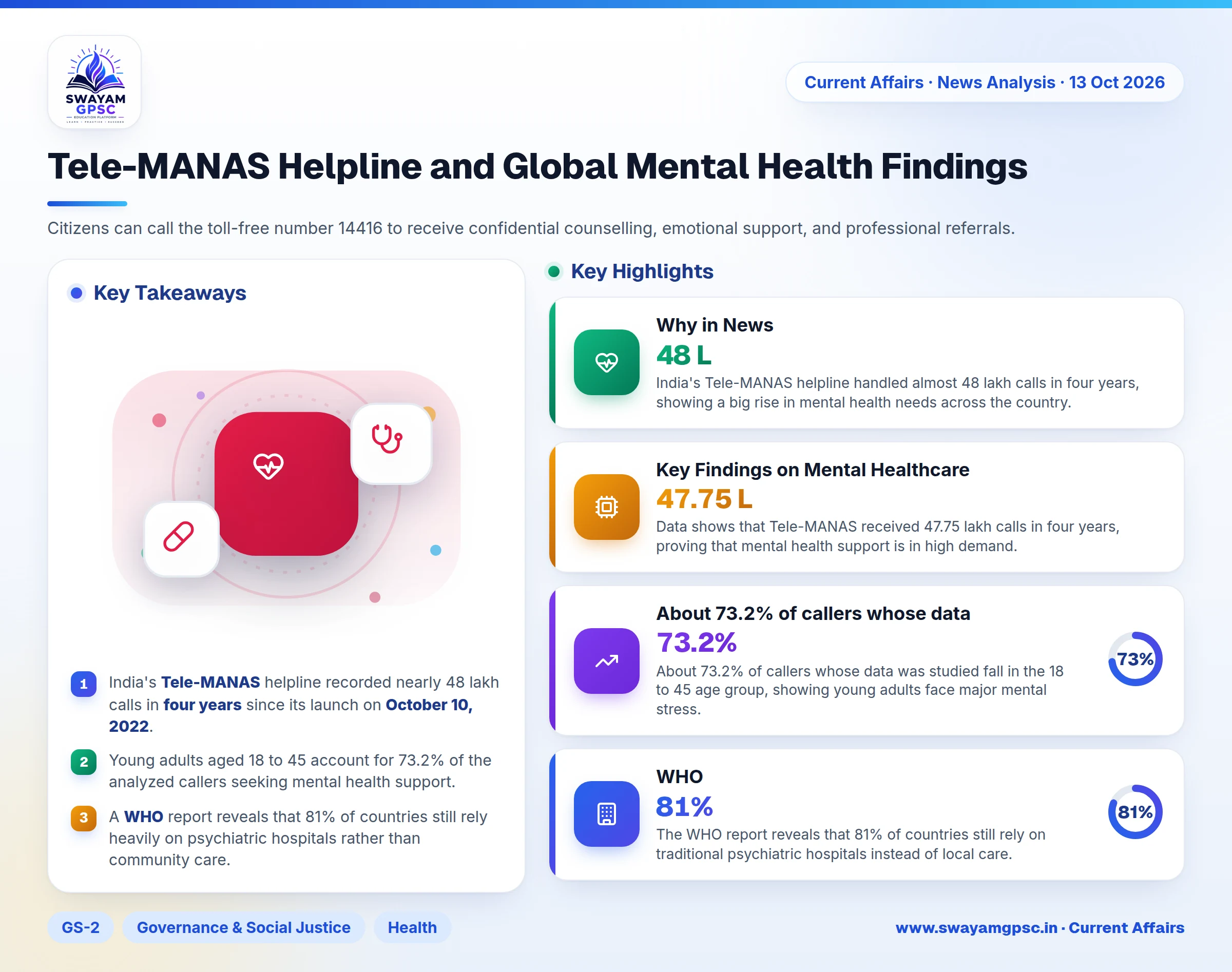
- India's Tele-MANAS helpline recorded nearly 48 lakh calls in four years since its launch on October 10, 2022.
- Young adults aged 18 to 45 account for 73.2% of the analyzed callers seeking mental health support.
- A WHO report reveals that 81% of countries still rely heavily on psychiatric hospitals rather than community care.
- Global data shows that 28% of psychiatric inpatients stay in hospitals for more than six months.
Why in News
- India's Tele-MANAS helpline handled almost 48 lakh calls in four years, showing a big rise in mental health needs across the country.
- A new WHO report points out that countries around the world still lack proper community-based mental health services.
About Tele-MANAS
- Tele-MANAS stands for Tele Mental Health Assistance and Networking Across States and is India's free, round-the-clock mental health service.
- The government launched this service on October 10, 2022, under the National Tele Mental Health Programme of the Ministry of Health and Family Welfare.
- Citizens can call the toll-free number 14416 to receive confidential counselling, emotional support, and professional referrals.
- The main goal is to make mental healthcare easy to reach and affordable, especially for people living in remote areas.
Key Findings on Mental Healthcare
- Data shows that Tele-MANAS received 47.75 lakh calls in four years, proving that mental health support is in high demand.
- About 73.2% of callers whose data was studied fall in the 18 to 45 age group, showing young adults face major mental stress.
- The WHO report reveals that 81% of countries still rely on traditional psychiatric hospitals instead of local care.
- Only 9% of nations have successfully moved their mental health systems to community-based care models.
- In the WHO South-East Asia Region, 63% of countries are just starting this transition, and none have finished it.
- Worldwide, 28% of patients stay in psychiatric hospitals for more than six months, and 16% stay for over a year.
- Roughly 47% of global spending on mental health goes directly to big psychiatric hospitals, leaving little money for local care.
Implications
- The heavy use of the helpline proves that students and working adults want early counselling and emotional support.
- Relying too much on big mental hospitals means patients need local rehabilitation and follow-up support near their homes.
- Connecting mental health services with Ayushman Arogya Mandirs can help spot problems early and improve rural treatment.