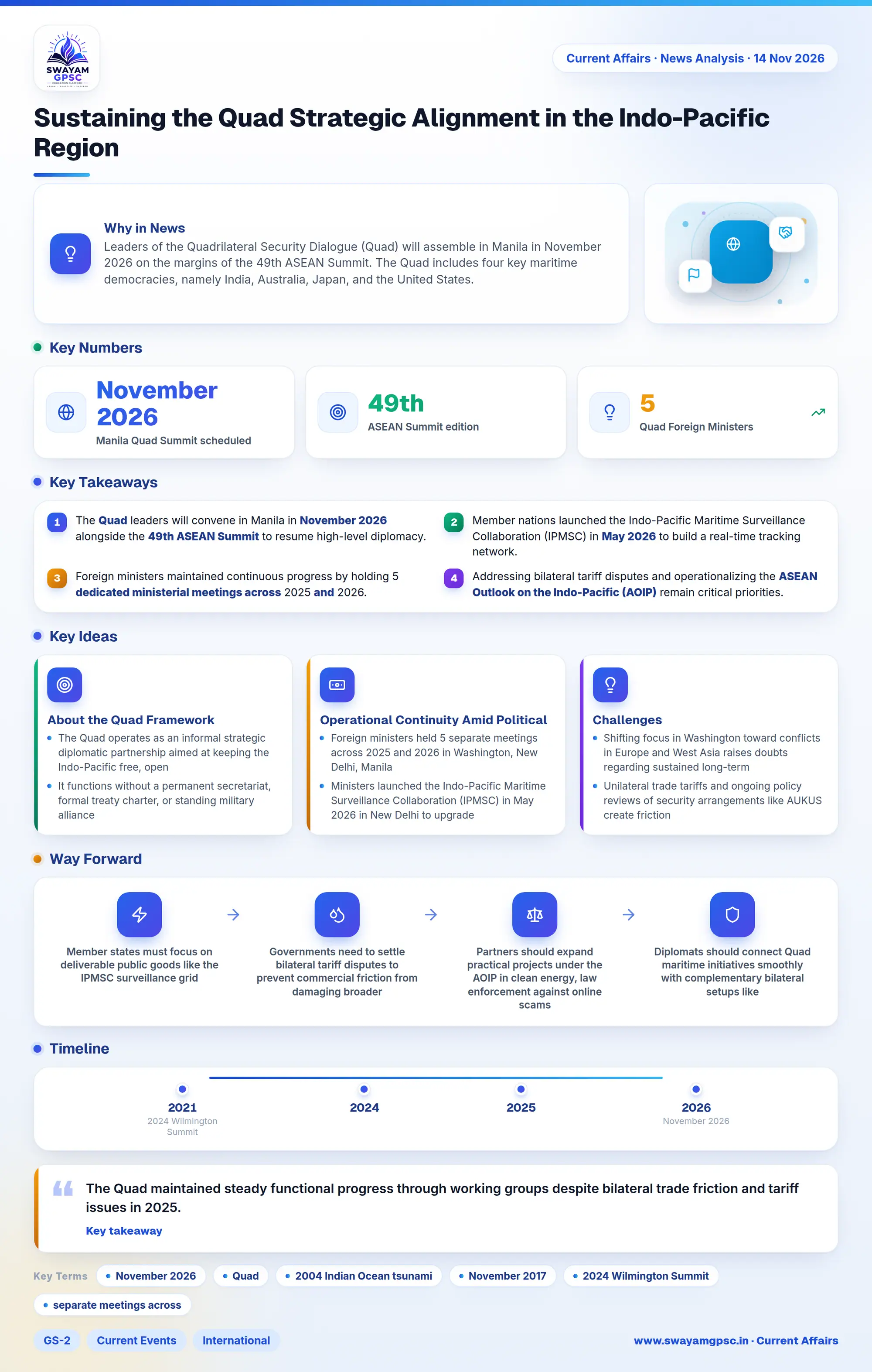
Sustaining the Quad Strategic Alignment in the Indo-Pacific Region
#GS-2 #Current Events #International #Quad #Indo-Pacific Security #ASEAN #India Foreign Policy
Key takeaways
- The Quad leaders will convene in Manila in November 2026 alongside the 49th ASEAN Summit to resume high-level diplomacy.
- Member nations launched the Indo-Pacific Maritime Surveillance Collaboration (IPMSC) in May 2026 to build a real-time tracking network.
- Foreign ministers maintained continuous progress by holding 5 dedicated ministerial meetings across 2025 and 2026.
- Addressing bilateral tariff disputes and operationalizing the ASEAN Outlook on the Indo-Pacific (AOIP) remain critical priorities.
Why in News
- Leaders of the Quadrilateral Security Dialogue (Quad) will assemble in Manila in November 2026 on the margins of the 49th ASEAN Summit.
- The Quad includes four key maritime democracies, namely India, Australia, Japan, and the United States.
- This meeting will restore high-level political engagement following a brief pause in leader-level summits during 2025.
About the Quad Framework
- The Quad operates as an informal strategic diplomatic partnership aimed at keeping the Indo-Pacific free, open, inclusive, and resilient.
- It functions without a permanent secretariat, formal treaty charter, or standing military alliance, relying instead on regular diplomatic channels.
- The origin of the partnership traces back to joint relief efforts following the 2004 Indian Ocean tsunami, leading to an initial exploratory meeting in 2007.
- The grouping was formally revived in November 2017 in Manila amid growing regional maritime assertiveness.
- Diplomatic engagement was upgraded to the head-of-state level in 2021, leading to key meetings like the 2024 Wilmington Summit.
Operational Continuity Amid Political Challenges
- The Quad maintained steady functional progress through working groups despite bilateral trade friction and tariff issues in 2025.
- Foreign ministers held 5 separate meetings across 2025 and 2026 in Washington, New Delhi, Manila, and Atlanta to maintain momentum.
- Ministers launched the Indo-Pacific Maritime Surveillance Collaboration (IPMSC) in May 2026 in New Delhi to upgrade tracking systems.
- The IPMSC builds on the existing Indo-Pacific Partnership for Maritime Domain Awareness (IPMDA) by combining satellite and surface data into a shared tracking system.
- Member states introduced the Quad Critical Minerals Initiative Framework while supporting undersea telecommunications cables and Open RAN 5G/6G standards.
- The partnership released a dedicated Joint Statement on Cooperation with ASEAN in July 2026 to align actions with the ASEAN Outlook on the Indo-Pacific (AOIP).
Challenges
- Shifting focus in Washington toward conflicts in Europe and West Asia raises doubts regarding sustained long-term commitment to the region.
- Unilateral trade tariffs and ongoing policy reviews of security arrangements like AUKUS create friction among partners.
- Member nations maintain different geographic priorities and varying levels of comfort regarding direct confrontation with Beijing.
- For example, India manages land border tensions along the Line of Actual Control (LAC), whereas Japan and the US focus on the Taiwan Strait.
- Regional powers are building alternative security ties, including the Japan-Australia-India (JAI) trilateral and Japan's One Cooperative Effort Among Nations (OCEAN) framework.
- Southeast Asian nations worry that the Quad might overshadow existing ASEAN-led regional mechanisms or force regional split choices.
Strategic Significance of the Manila Summit
- Hosting the gathering in the Philippines sends a strong diplomatic signal against unilateral attempts to alter the maritime status quo.
- Organizing the meeting alongside the ASEAN Summit confirms support for regional institutions and addresses local skepticism.
- The summit offers the US administration an early opportunity to clarify its Indo-Pacific strategy and reassure regional allies.
Way Forward
- Member states must focus on deliverable public goods like the IPMSC surveillance grid, trusted artificial intelligence funding, and port infrastructure.
- Governments need to settle bilateral tariff disputes to prevent commercial friction from damaging broader strategic trust.
- Partners should expand practical projects under the AOIP in clean energy, law enforcement against online scams, and disaster response.
- Diplomats should connect Quad maritime initiatives smoothly with complementary bilateral setups like India-Philippines defense cooperation.
Conclusion
- The upcoming summit in Manila provides a clear path toward rebuilding leader-level momentum after recent geopolitical shifts.
- Securing the future of the grouping requires addressing trade issues while maintaining steady commitment from all four partners.
- Focusing on ASEAN centrality and practical public goods will ensure the arrangement remains an effective regional stabilizer.