Surge in Global Bond Yields and Implications for India
#GS-3 #Economy #Banking #Monetary Policy #Banking Sector & NBFCs #Government Securities #Bond Market
Key takeaways
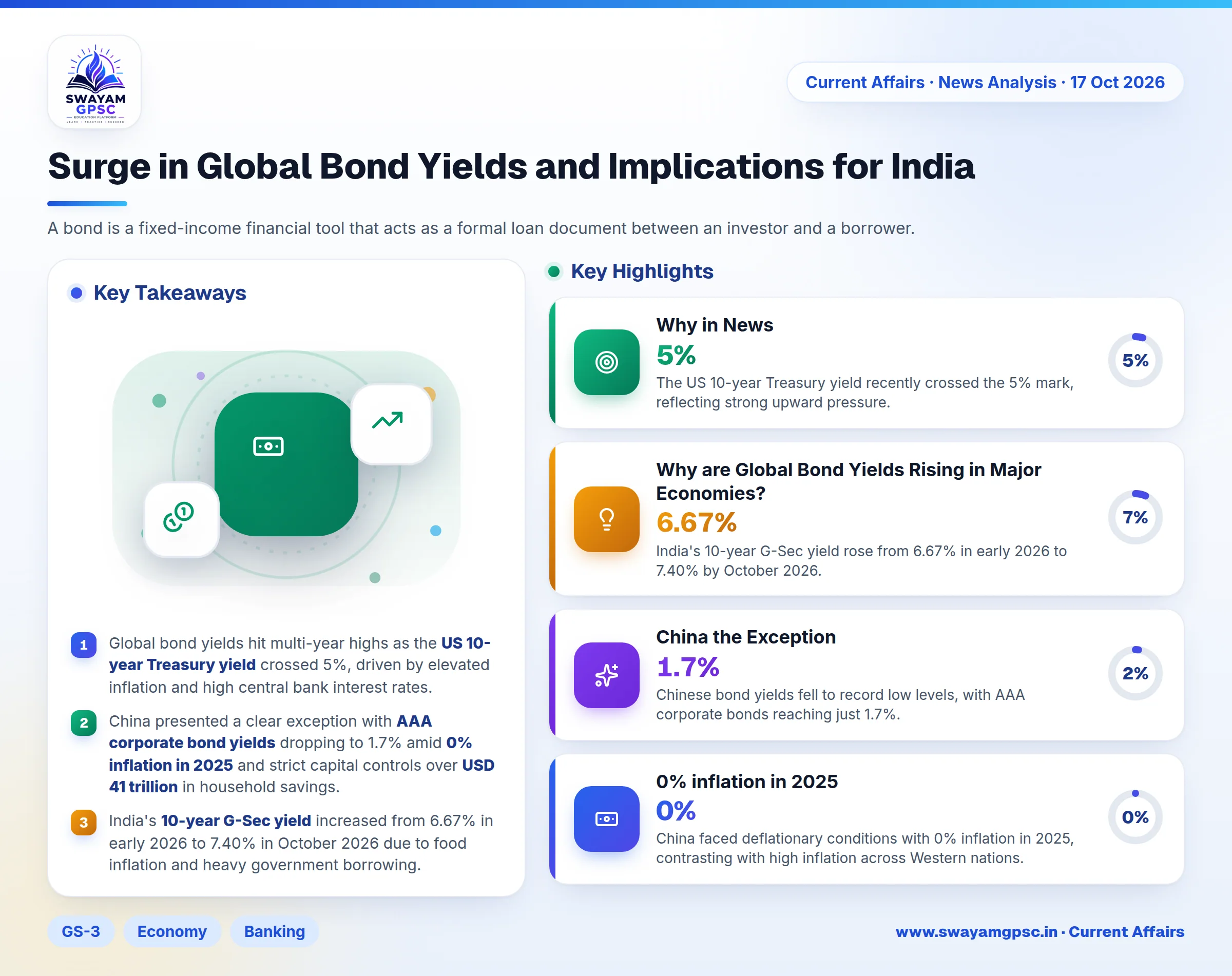
- Global bond yields hit multi-year highs as the US 10-year Treasury yield crossed 5%, driven by elevated inflation and high central bank interest rates.
- China presented a clear exception with AAA corporate bond yields dropping to 1.7% amid 0% inflation in 2025 and strict capital controls over USD 41 trillion in household savings.
- India's 10-year G-Sec yield increased from 6.67% in early 2026 to 7.40% in October 2026 due to food inflation and heavy government borrowing.
- The Reserve Bank of India (RBI) controls yields using Open Market Operations (OMOs) and Operation Twist by buying and selling government debt.
- Higher global yields risk causing Foreign Portfolio Investment (FPI) outflows from India, weakening the rupee and raising domestic borrowing costs.
Why in News
- Global financial markets show a sharp split as bond yields in major advanced economies hit multi-year high points.
- The US 10-year Treasury yield recently crossed the 5% mark, reflecting strong upward pressure.
- In contrast, Chinese bond yields fell to historic record lows, highlighting different post-pandemic economic conditions.
- This contrast stems from differences in economic recovery paths, inflation trends, and structural shifts across countries.
What are Bond Yields?
- A bond is a fixed-income financial tool that acts as a formal loan document between an investor and a borrower.
- Governments or corporations issue bonds to raise capital, backed by legal promises to repay the principal amount.
- Bonds issued by sovereign governments carry official guarantees and count among the safest financial investments.
- In India, sovereign bonds are called Government Securities (G-Secs), while the US terms them Treasuries and the UK calls them Gilts.
- Every bond has three core parts: a Face Value, a fixed Tenure, and periodic Coupon Payments.
- The bond yield represents the actual annualized percentage return an investor earns from holding the security.
- While coupon payments remain fixed at issuance, market yields change continuously based on trading prices.
- Bond prices and bond yields share a strict inverse relationship in secondary market trading.
- Higher market demand drives bond prices up, which automatically pushes the effective bond yield down.
- When market demand drops and investors sell, falling bond prices drive effective yields higher.
- A Yield Curve graphs interest rates of bonds with equal credit quality across different maturity dates.
- Normal yield curves slope upward because long-term bonds offer higher yields to cover long-term risks.
- An Inverted Yield Curve happens when short-term interest yields rise above long-term yields.
- Economists view an inverted yield curve as a highly reliable signal of an upcoming economic recession.
Management of Bond Yield in India
- The Reserve Bank of India (RBI) manages government debt and actively controls bond yields to ensure economic stability.
- Under Open Market Operations (OMOs), the RBI buys G-Secs to inject money into the financial system.
- Buying securities increases bond demand, drives prices up, lowers yields, and makes borrowing cheaper across markets.
- To reduce excess market liquidity and control inflation, the RBI sells G-Secs back into the market.
- Selling securities increases bond supply, lowers prices, pushes yields higher, and increases borrowing costs.
- Through Operation Twist, the RBI buys long-term G-Secs while selling short-term ones to flatten the yield curve.
- The central bank also adjusts core policy tools like the Repo Rate, CRR, and SLR to guide market interest rates.
Why are Global Bond Yields Rising in Major Economies?
- High inflation driven by elevated energy prices and supply bottlenecks reduces the purchasing power of fixed bond returns.
- To offset inflation losses, fixed-income investors demand higher yields before purchasing government debt.
- Central banks like the US Federal Reserve raised key policy rates and kept them high to tame inflation.
- High central bank policy rates directly increase benchmark yields on sovereign government debt.
- Governments are running large fiscal deficits and issuing more bonds to cover expanding spending needs.
- An increased supply of government bonds lowers market prices and drives yield rates upward.
- India's 10-year G-Sec yield rose from 6.67% in early 2026 to 7.40% by October 2026.
- Persistent food inflation, lower expectations of RBI rate cuts, and heavy government borrowing drove Indian yields higher.
China the Exception
- Chinese bond yields fell to record low levels, with AAA corporate bonds reaching just 1.7%.
- China faced deflationary conditions with 0% inflation in 2025, contrasting with high inflation across Western nations.
- The People's Bank of China (PBOC) kept interest rates low and added liquidity to support slow economic growth.
- A severe downturn in China's property market and stock market volatility reduced traditional domestic investment options.
- Strict capital controls prevent China's USD 41 trillion household savings pool from moving into higher-yielding foreign assets.
- Trapped domestic capital flooded into safe government bonds, raising bond prices and pushing yields down to historical lows.
Macroeconomic Implications of Global Bond Yields Rising
- Higher yields increase government debt servicing costs, straining national budgets and creating fiscal pressure.
- Increased debt spending leaves less government money available for healthcare, education, and infrastructure projects.
- High borrowing costs reduce corporate investment and consumer spending, slowing down broader economic growth.
- Rising foreign yields prompt Foreign Portfolio Investment (FPI) outflows from Indian stock and bond markets.
- Capital outflows put downward pressure on the Indian Rupee (INR) against the US Dollar.
- A weaker rupee makes imported goods like crude oil more expensive, widening India's Current Account Deficit (CAD).
- To control capital flight and inflation, the RBI may keep domestic interest rates high, raising overall borrowing costs.