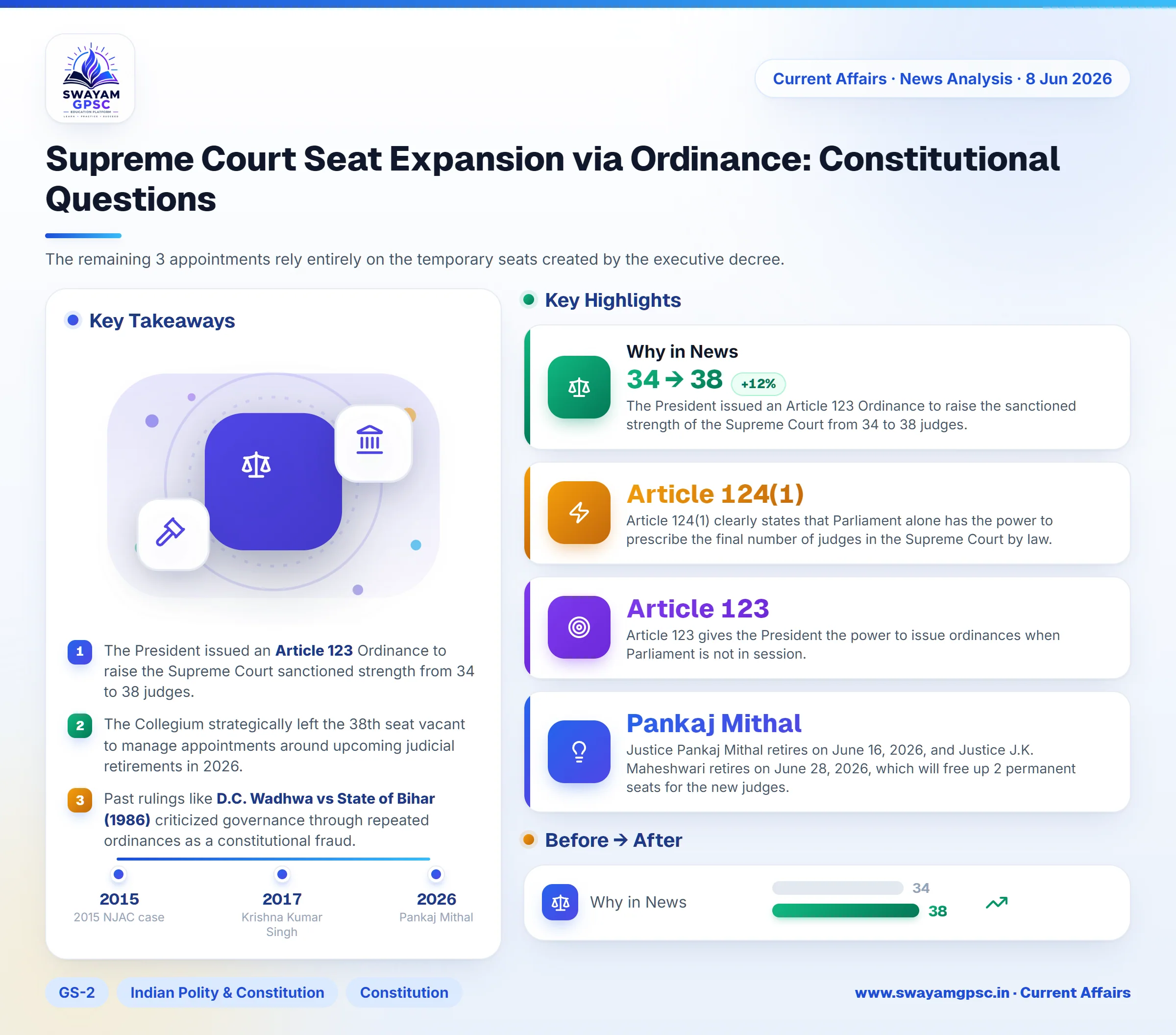
Supreme Court Seat Expansion via Ordinance: Constitutional Questions
#GS-2 #Indian Polity & Constitution #Constitution #Judiciary #Governance & Social Justice #Good Governance #Current Events #National
Key takeaways
- The President issued an Article 123 Ordinance to raise the Supreme Court sanctioned strength from 34 to 38 judges.
- The Collegium strategically left the 38th seat vacant to manage appointments around upcoming judicial retirements in 2026.
- Past rulings like D.C. Wadhwa vs State of Bihar (1986) criticized governance through repeated ordinances as a constitutional fraud.
- Experts warn that judges holding temporary ordinance seats create a conflict of interest when deciding cases involving the Union Government.
Why in News
- The President issued an Article 123 Ordinance to raise the sanctioned strength of the Supreme Court from 34 to 38 judges.
- This decision has sparked a significant constitutional debate regarding the separation of powers and the correct process for expanding the court.
About the Ordinance and Appointments
- Following the Presidential Ordinance in May, 5 new judges took the oath of office to begin their tenure.
- 2 of these appointments filled existing lawful vacancies within the original 34-judge baseline.
- The remaining 3 appointments rely entirely on the temporary seats created by the executive decree.
Constitutional Provisions Involved
- Article 124(1) clearly states that Parliament alone has the power to prescribe the final number of judges in the Supreme Court by law.
- Article 123 gives the President the power to issue ordinances when Parliament is not in session.
- An ordinance has the same force as an Act, but it expires 6 weeks after Parliament reassembles unless replaced by a Bill or disapproved by a resolution.
The Strategic Math of the Collegium
- The Supreme Court currently has 37 active judges, and the Collegium intentionally left the 38th seat vacant.
- Justice Pankaj Mithal retires on June 16, 2026, and Justice J.K. Maheshwari retires on June 28, 2026, which will free up 2 permanent seats for the new judges.
- Justice V. Mohana was appointed directly from the Bar and sits in a vulnerable position on a temporary seat.
- Justice Mohana cannot move to a permanent seat until Justice Sanjay Karol retires on August 22, 2026.
- The Collegium is betting that a replacement Act will pass during the monsoon session before the ordinance lapses on August 22.
Challenges
- Using an ordinance to expand the court goes against past warnings by the Supreme Court against bypassing the legislature.
- In D.C. Wadhwa vs State of Bihar (1986), the court ruled that governing through repeated ordinances is a fraud on the Constitution, a view supported by the 2017 Krishna Kumar Singh judgment.
- Judges holding temporary seats created by the executive face a conflict of interest when deciding cases involving the government.
- The ruling majority must pass the Bill to regularize these jobs, which compromises the court's neutral image when the Union Government appears as a litigant.
- If Parliament rejects the Bill, the legal status of an active judge sitting on an expired post becomes completely untested.
- Past decisions like Gokaraju Rangaraju (1981) protect rulings under the de facto doctrine, but a lapse leaves a judge on a post the law no longer recognizes.
- In the 2015 NJAC case, the court protected its primary role in appointments, but it has now left its bench strength dependent on the executive.
Way Forward
- Parliament must prioritize passing the replacement Bill early in the monsoon session to fix this constitutional gap.
- Authorities should introduce a clear legal rule stating that future changes to the Supreme Court size must happen through regular parliamentary amendments.
- The Collegium should adopt an internal rule to stop appointing judges to temporary seats until they are made permanent by law.
- Judges on temporary seats should step away from high-profile constitutional cases involving the government until their positions are fully secure.