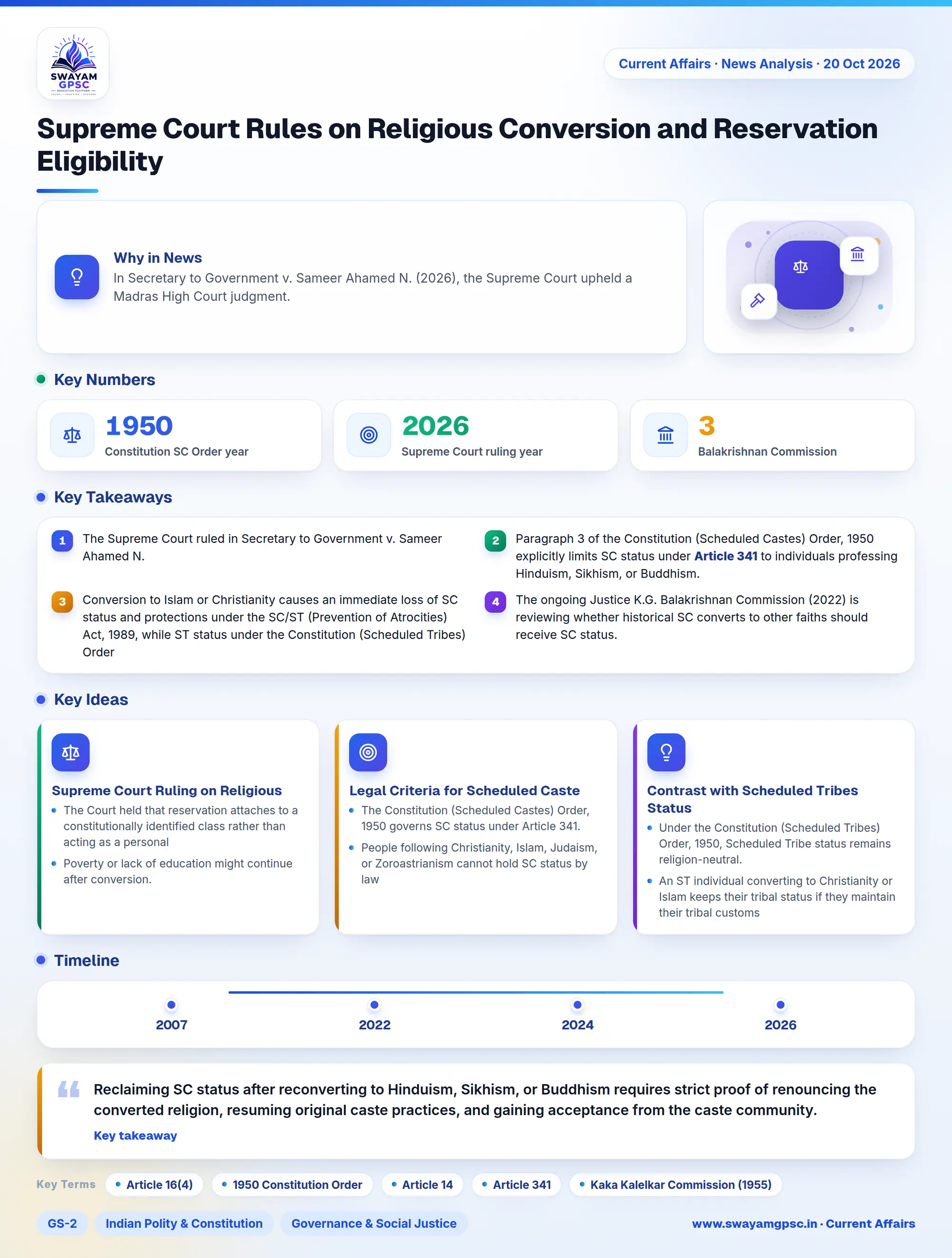
Supreme Court Rules on Religious Conversion and Reservation Eligibility
#GS-2 #Indian Polity & Constitution #Governance & Social Justice #Constitution #Vulnerable Sections #Quick Facts For Prelims #Issues Related to SCs & STs
Key takeaways
- The Supreme Court ruled in Secretary to Government v. Sameer Ahamed N. (2026) that reservation benefits under Article 16(4) cannot transfer automatically upon religious conversion based solely on past social backwardness.
- Paragraph 3 of the Constitution (Scheduled Castes) Order, 1950 explicitly limits SC status under Article 341 to individuals professing Hinduism, Sikhism, or Buddhism.
- Conversion to Islam or Christianity causes an immediate loss of SC status and protections under the SC/ST (Prevention of Atrocities) Act, 1989, while ST status under the Constitution (Scheduled Tribes) Order, 1950 remains religion-neutral.
- The ongoing Justice K.G. Balakrishnan Commission (2022) is reviewing whether historical SC converts to other faiths should receive SC status.
Why in News
- In Secretary to Government v. Sameer Ahamed N. (2026), the Supreme Court upheld a Madras High Court judgment. This judgment struck down a 2024 Tamil Nadu Government Order (GO) that permitted individuals converting from Hinduism to Islam to claim reservation automatically under the Backward Class (Muslim) quota.
- The Supreme Court ruled that individuals cannot claim affirmative action under Article 16(4) based only on backwardness before conversion. Pre-conversion social backwardness does not carry forward automatically into a new religion.
Supreme Court Ruling on Religious Conversion
- The Court held that reservation attaches to a constitutionally identified class rather than acting as a personal, transferable right.
- Poverty or lack of education might continue after conversion. However, historical social backwardness from the Hindu caste system cannot transfer automatically to a new faith.
- Under the 1950 Constitution Order, converting to religions such as Islam or Christianity causes an immediate loss of Scheduled Caste (SC) status.
- Islam and Christianity base their theological teachings on equality without a uniform caste hierarchy. Because of this, conversion cannot act as a pathway to carry past caste status into a new religious identity.
- The Court clarified that private religious bodies like a Jamath lack authority to certify a person's statutory backward-class or SC entitlement.
- If a person reconverts to the Hindu social order, reclaiming reservation requires an independent evaluation by a competent statutory authority to verify if the original caste identity has revived.
- Muslims and Christians can still access BC or OBC reservations if they independently meet the required eligibility criteria.
- The Court rejected the argument that the executive order was valid because it relied on a 2024 Tamil Nadu Backward Classes Commission recommendation, noting that expert recommendations are not formal laws.
- Any executive order that violates Article 14, Article 15(4), or Article 16(4) remains open to judicial review.
Legal Criteria for Scheduled Caste Status
- The Constitution (Scheduled Castes) Order, 1950 governs SC status under Article 341. Paragraph 3 states that no person professing a religion different from Hinduism, Sikhism, or Buddhism can be deemed a member of a Scheduled Caste.
- People following Christianity, Islam, Judaism, or Zoroastrianism cannot hold SC status by law, regardless of past historical disadvantages.
- Under Article 341, the President of India issues the initial SC list. After publication, only Parliament can add or remove communities using legislation.
- SC status depends on state boundaries. A community listed as an SC in one state might fall under OBC or General categories in another.
- Converting to any religion outside Hinduism, Sikhism, or Buddhism leads to the immediate and complete loss of SC status from the moment of conversion.
- The Court explained that professing a religion means practicing it publicly. Since Islam and Christianity reject the caste system, one cannot publicly practice them while holding SC status.
- Converts lose legal protections under special laws such as the SC/ST (Prevention of Atrocities) Act, 1989.
- Reclaiming SC status after reconverting to Hinduism, Sikhism, or Buddhism requires strict proof of renouncing the converted religion, resuming original caste practices, and gaining acceptance from the caste community.
- Even after losing legal SC status, converts often face ongoing ground-level social discrimination, highlighting a gap between religious equality doctrines and social realities.
- In C.M. Arumugam v. S. Rajgopal (1976), the Court recognized caste as a social reality, requiring proof of continued discrimination and community acceptance to regain SC status upon reconversion.
- In Soosai v. Union of India (1985), the Court denied SC status to Dalit Christians because of a lack of clear empirical evidence showing caste discrimination after conversion.
- In Chinthada Anand v. State of Andhra Pradesh (2026), the Supreme Court confirmed that converting to Christianity results in an immediate loss of SC status, removing protection under the SC/ST Atrocities Act.
- The Kaka Kalelkar Commission (1955) and the Mandal Commission (1980) acknowledged that caste discrimination exists in non-Hindu religions, paving the way for OBC reservations for certain Christian and Muslim groups.
- The Justice Ranganath Mishra Commission (2007) recommended decoupling SC status completely from religion, making it religion-neutral like ST status.
- The Justice K.G. Balakrishnan Commission (2022) is a three-member panel examining whether SC status should extend to historical SC members who converted to faiths other than Hinduism, Buddhism, or Sikhism.
Contrast with Scheduled Tribes Status
- Under the Constitution (Scheduled Tribes) Order, 1950, Scheduled Tribe status remains religion-neutral.
- An ST individual converting to Christianity or Islam keeps their tribal status if they maintain their tribal customs, identity, and community acceptance. They lose tribal status only if they abandon their tribal identity completely post-conversion.