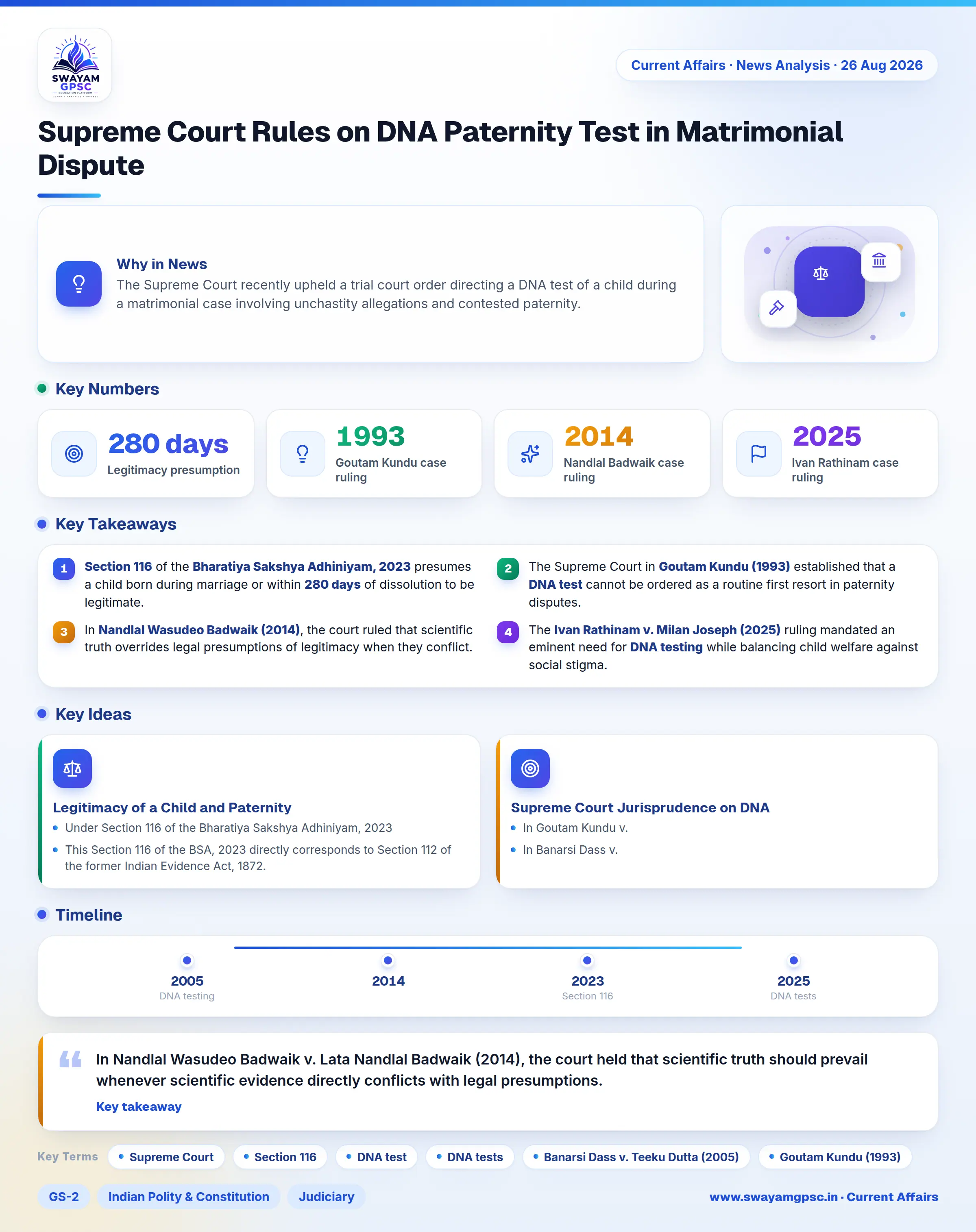
Supreme Court Rules on DNA Paternity Test in Matrimonial Dispute
#GS-2 #Indian Polity & Constitution #Judiciary #Current Events #National
Key takeaways
- Section 116 of the Bharatiya Sakshya Adhiniyam, 2023 presumes a child born during marriage or within 280 days of dissolution to be legitimate.
- The Supreme Court in Goutam Kundu (1993) established that a DNA test cannot be ordered as a routine first resort in paternity disputes.
- In Nandlal Wasudeo Badwaik (2014), the court ruled that scientific truth overrides legal presumptions of legitimacy when they conflict.
- The Ivan Rathinam v. Milan Joseph (2025) ruling mandated an eminent need for DNA testing while balancing child welfare against social stigma.
Why in News
- The Supreme Court recently upheld a trial court order directing a DNA test of a child during a matrimonial case involving unchastity allegations and contested paternity.
Legitimacy of a Child and Paternity Test
- Under Section 116 of the Bharatiya Sakshya Adhiniyam, 2023, a child born during a valid marriage or within 280 days after its dissolution is legally presumed to be legitimate.
- This Section 116 of the BSA, 2023 directly corresponds to Section 112 of the former Indian Evidence Act, 1872.
- Courts cannot order a DNA test routinely on mere paternity claims unless an exceptional situation arises where existing evidence proves insufficient.
Supreme Court Jurisprudence on DNA Testing
- In Goutam Kundu v. State of West Bengal (1993), the court established that DNA tests cannot be a first resort and require a strong primary proof of non-access between spouses.
- In Banarsi Dass v. Teeku Dutta (2005), the court ruled that DNA testing should not be ordered routinely and must remain restricted to rare exceptional matters.
- In Nandlal Wasudeo Badwaik v. Lata Nandlal Badwaik (2014), the court held that scientific truth should prevail whenever scientific evidence directly conflicts with legal presumptions.
- In Rohit Shekhar v. Narayan Dutt Tiwari (2014), the court allowed a DNA test by prioritizing the biological identity rights of the child over personal privacy concerns.
- In Ivan Rathinam v. Milan Joseph (2025), the court emphasized that DNA tests require an eminent need while balancing social stigma, privacy, and the child's welfare.