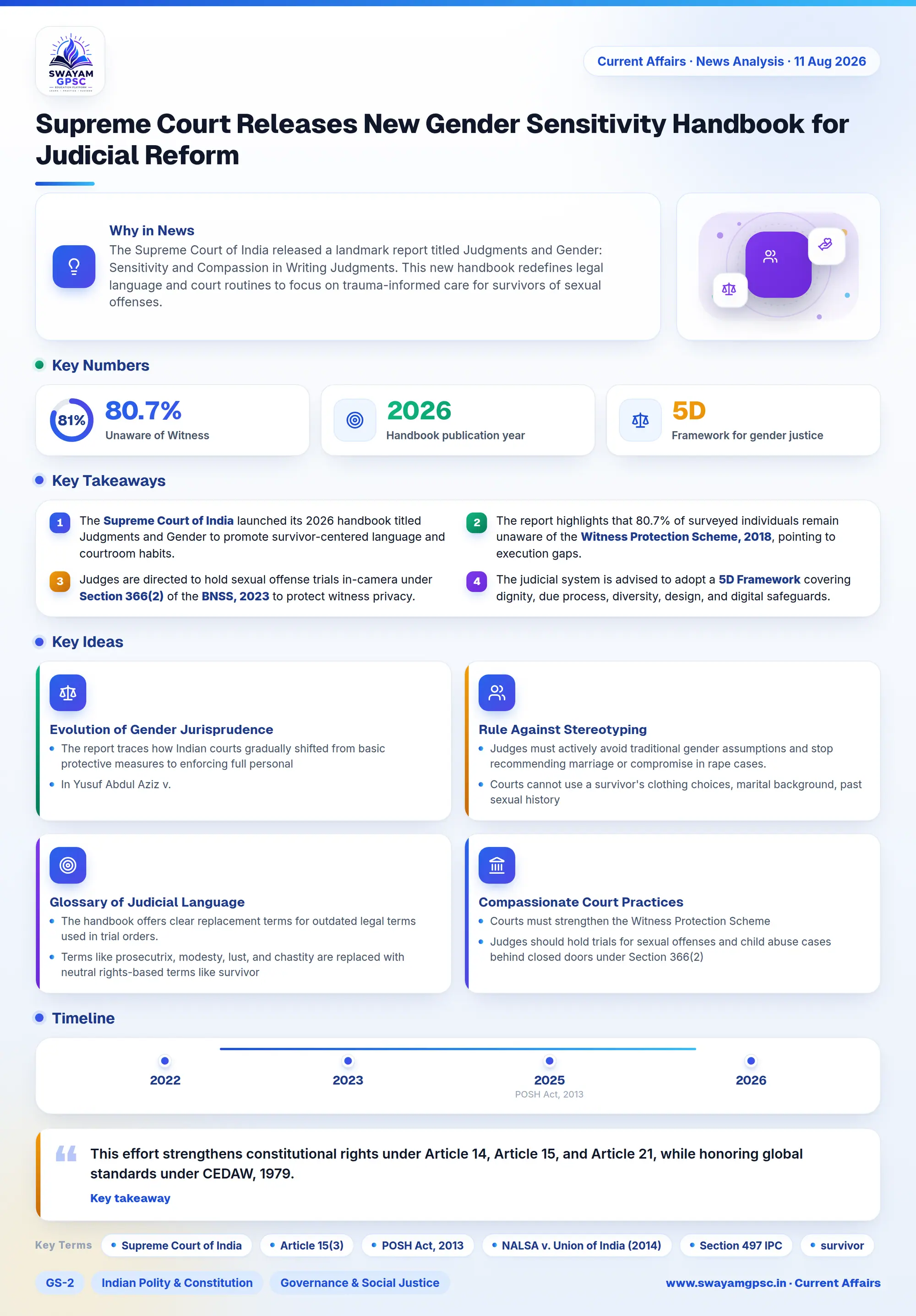
Supreme Court Releases New Gender Sensitivity Handbook for Judicial Reform
#GS-2 #Indian Polity & Constitution #Governance & Social Justice #Judiciary #Vulnerable Sections #Women #Gender Equality #Judgements & Cases #Public Policy
Key takeaways
- The Supreme Court of India launched its 2026 handbook titled Judgments and Gender to promote survivor-centered language and courtroom habits.
- The report highlights that 80.7% of surveyed individuals remain unaware of the Witness Protection Scheme, 2018, pointing to execution gaps.
- Judges are directed to hold sexual offense trials in-camera under Section 366(2) of the BNSS, 2023 to protect witness privacy.
- The judicial system is advised to adopt a 5D Framework covering dignity, due process, diversity, design, and digital safeguards.
Why in News
- The Supreme Court of India released a landmark report titled Judgments and Gender: Sensitivity and Compassion in Writing Judgments.
- This new handbook redefines legal language and court routines to focus on trauma-informed care for survivors of sexual offenses.
- The 2026 handbook builds directly on the 2023 Handbook on Combating Gender Stereotypes by moving beyond words to practical courtroom actions.
Evolution of Gender Jurisprudence in India
- The report traces how Indian courts gradually shifted from basic protective measures to enforcing full personal dignity and choice.
- In Yusuf Abdul Aziz v. State of Bombay (1954), the court supported special protective rules for women under Article 15(3).
- In State of Punjab v. Gurmit Singh (1996), the court endorsed private trials and cautioned against doubting survivor statements without extra proof.
- In Vishaka v. State of Rajasthan (1997), the court created workplace safety guidelines that birthed the POSH Act, 2013.
- In NALSA v. Union of India (2014), the court legally recognized transgender rights, identity, and personal dignity.
- In Joseph Shine v. Union of India (2019), the court struck down Section 497 IPC on adultery because it violated equality.
- In Aparna Bhat v. State of Madhya Pradesh (2021), the court forbade judges from pushing compromise or marriage on sexual assault survivors.
- In State of Jharkhand v. Shailendra Kumar Rai (2022), the court completely banned the intrusive two-finger test during rape investigations.
- In X v. Principal Secretary, Health, Delhi (2023), the court protected the reproductive rights and autonomy of unmarried women.
- In Vaneeta Patnaik v. Nirmal Kanti Chakrabarti (2025), the court recognized a hostile work environment as continuous harassment under the POSH Act, 2013.
Rule Against Stereotyping
- Judges must actively avoid traditional gender assumptions and stop recommending marriage or compromise in rape cases.
- Courts cannot use a survivor's clothing choices, marital background, past sexual history, or private lifestyle to evaluate consent or honesty.
- This rule enforces statutory protections under Section 146 of the Indian Evidence Act, 1872 and Section 48 of the Bharatiya Sakshya Adhiniyam, 2023.
Glossary of Judicial Language
- The handbook offers clear replacement terms for outdated legal terms used in trial orders.
- Terms like prosecutrix, modesty, lust, and chastity are replaced with neutral rights-based terms like survivor, sexual assault, and bodily autonomy violated.
- The report introduces inclusive terminology for LGBTQIA+ individuals, including the framework known as SOGIESC.
Compassionate Court Practices Recommended
- Courts must strengthen the Witness Protection Scheme, 2018 and assign free legal counsel starting right at the FIR stage.
- Judges should hold trials for sexual offenses and child abuse cases behind closed doors under Section 366(2) of the BNSS, 2023.
- Courts must use screens or video links for young witnesses, offer trained support persons, and complete POCSO trials within fixed timeframes.
- Judges should treat witnesses with proper dignity like respected guests, avoiding unnecessary delays and endless trial reschedules.
- Courts should offer pre-trial counseling to lower stress and shield victims from fresh trauma inside the courtroom.
Significance
- This effort strengthens constitutional rights under Article 14, Article 15, and Article 21, while honoring global standards under CEDAW, 1979.
- Replacing harsh language protects victims from secondary trauma, encouraging more people to report sexual crimes without fear.
- The handbook pushes court institutions away from pure legal fighting toward a system that respects trauma survivors.
- This practical guide aligns smoothly with modern criminal codes including BNSS, 2023, Bharatiya Sakshya Adhiniyam, 2023, POCSO Act, 2012, and POSH Act, 2013.
Challenges
- These guidelines are purely recommendatory, meaning actual reform relies entirely on personal judicial training and willingness.
- Applying a single terminology guide is difficult in trial courts across India because proceedings take place in many local languages.
- A survey revealed that 80.7% of respondents did not know about the Witness Protection Scheme, highlighting weak enforcement on the ground.
- Judicial sensitization requires continuous effort because societal language and moral views change constantly.
- Judges grow up inside wider society, so legal training alone cannot remove deep-seated bias without overall social change.
Mains Value Addition: 5D Framework for a Gender-Just Judiciary
- Dignity requires using respectful, neutral, and non-stereotypical terms in all written decisions.
- Due Process means keeping a fair balance between protecting the survivor and granting the accused a fair trial.
- Diversity demands sensitivity toward differences in gender, sexual identity, physical disability, caste, and local language.
- Design calls for built-in vulnerable witness centers, video technology, dedicated waiting spaces, and quick legal aid.
- Digital Safeguards stop artificial intelligence and digital courtroom software from repeating old gender prejudices.
Conclusion
- Building true gender justice requires transforming the entire court environment rather than simply writing better laws.
- This handbook helps make constitutional equality a practical daily experience by replacing old stereotypes with survivor-centered care.