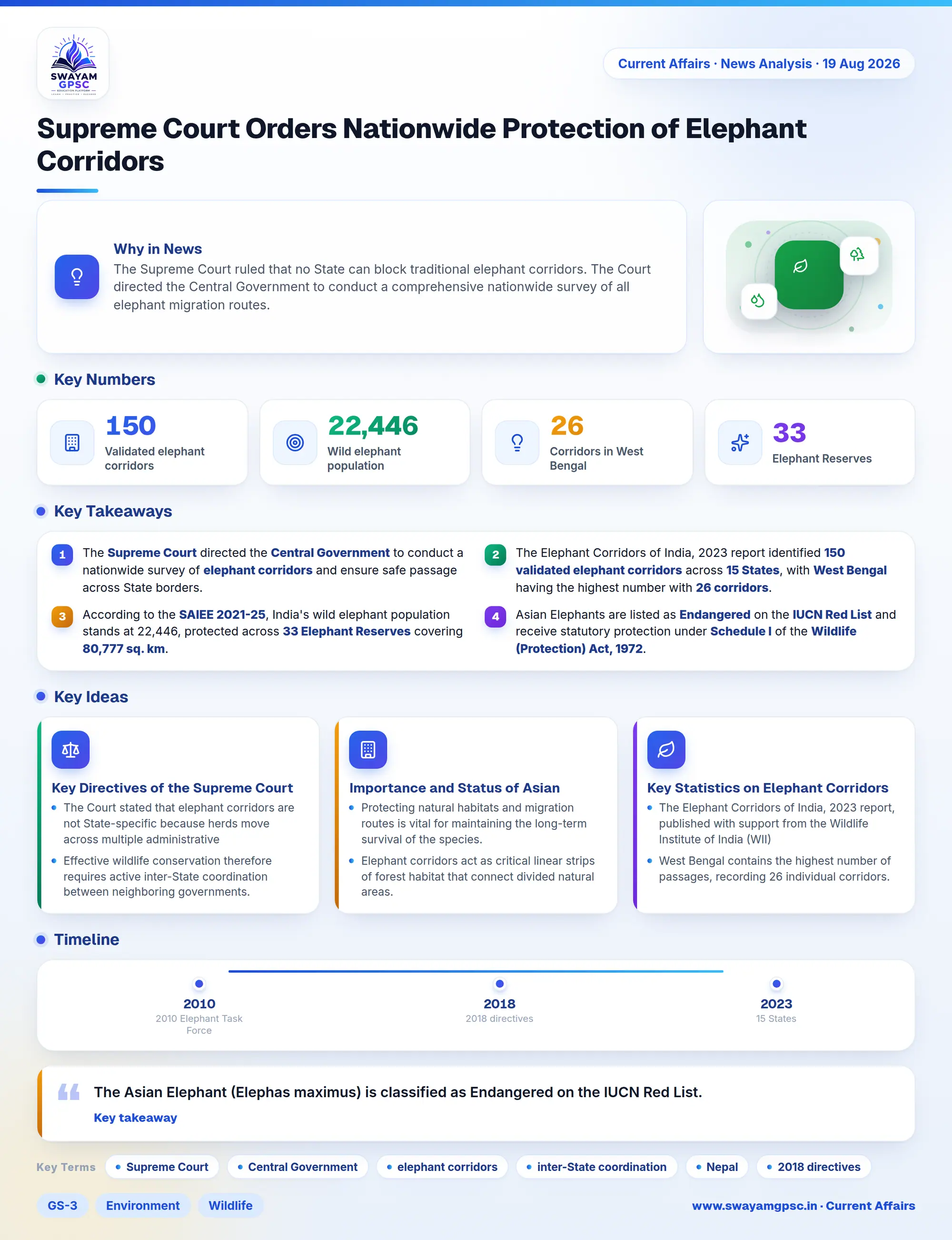
Supreme Court Orders Nationwide Protection of Elephant Corridors
#GS-3 #Environment #Wildlife #Biodiversity #GS-2 #Judiciary #National #Conservation
Key takeaways
- The Supreme Court directed the Central Government to conduct a nationwide survey of elephant corridors and ensure safe passage across State borders.
- The Elephant Corridors of India, 2023 report identified 150 validated elephant corridors across 15 States, with West Bengal having the highest number with 26 corridors.
- According to the SAIEE 2021-25, India's wild elephant population stands at 22,446, protected across 33 Elephant Reserves covering 80,777 sq. km.
- Asian Elephants are listed as Endangered on the IUCN Red List and receive statutory protection under Schedule I of the Wildlife (Protection) Act, 1972.
Why in News
- The Supreme Court ruled that no State can block traditional elephant corridors.
- The Court directed the Central Government to conduct a comprehensive nationwide survey of all elephant migration routes.
- This decision ensures that elephant herds retain their natural right of passage across State boundaries without local obstruction.
Key Directives of the Supreme Court
- The Court stated that elephant corridors are not State-specific because herds move across multiple administrative boundaries naturally.
- Effective wildlife conservation therefore requires active inter-State coordination between neighboring governments.
- The judgment highlighted natural movements spanning from Nepal through West Bengal to Jharkhand, as well as from Yamuna Nagar in Haryana to Uttarakhand and Himachal Pradesh.
- The Court ordered strict adherence to its 2018 directives that banned barbaric practices like installing metal spikes and throwing fireballs to scare away elephants.
- It reaffirmed that Asian Elephants hold Schedule I status under the Wildlife (Protection) Act, 1972, providing them the highest level of legal protection.
Importance and Status of Asian Elephants
- The Asian Elephant (Elephas maximus) is classified as Endangered on the IUCN Red List.
- Protecting natural habitats and migration routes is vital for maintaining the long-term survival of the species.
- Elephant corridors act as critical linear strips of forest habitat that connect divided natural areas.
- These pathways enable safe animal movement, preserve genetic diversity, and lower human-elephant conflicts by keeping herds away from human settlements.
Key Statistics on Elephant Corridors and Population
- The Elephant Corridors of India, 2023 report, published with support from the Wildlife Institute of India (WII), mapped 150 validated elephant corridors across 15 States.
- West Bengal contains the highest number of passages, recording 26 individual corridors.
- The overall network features 19 inter-State corridors alongside 6 international transboundary corridors connecting India and Nepal.
- The Synchronous All India Population Estimation of Elephants (SAIEE) 2021-25 estimates the total wild elephant population in the country at 22,446.
- These animals find refuge in 33 Elephant Reserves spanning 80,777 sq. km across 14 major elephant-range States, supplemented by the 150 corridors.
- The 2010 Elephant Task Force had recommended declaring entire reserve areas as Ecologically Sensitive under the Environment (Protection) Act, 1986, impacting 46,000 sq km of land to restrict mining, while also proposing 10 elephant landscapes covering 1.1 lakh sq km for sustainable land management.