Supreme Court Eases Three-Year Practice Rule for Judicial Services
#GS-2 #Indian Polity & Constitution #Judiciary #Current Events #National
Key takeaways
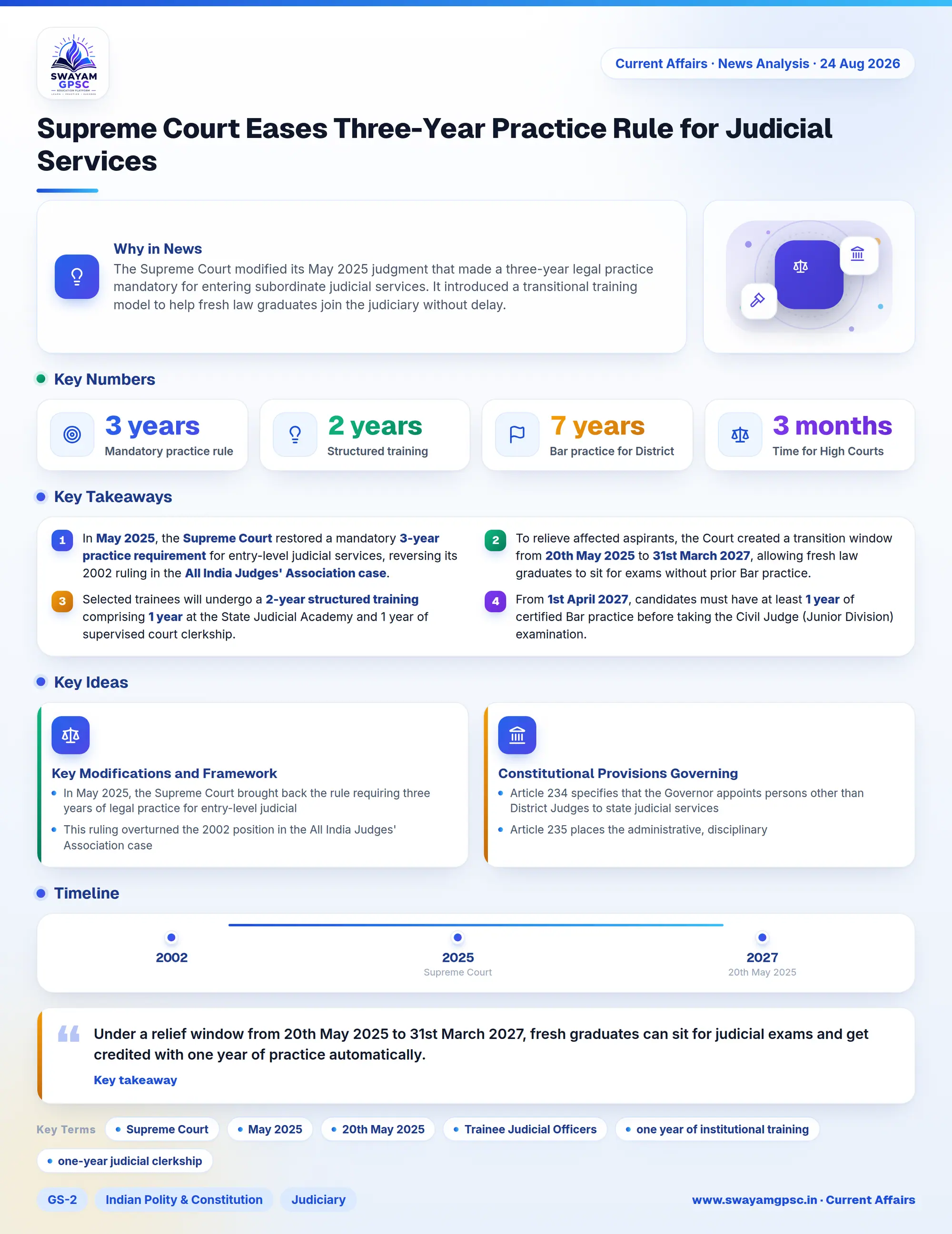
- In May 2025, the Supreme Court restored a mandatory 3-year practice requirement for entry-level judicial services, reversing its 2002 ruling in the All India Judges' Association case.
- To relieve affected aspirants, the Court created a transition window from 20th May 2025 to 31st March 2027, allowing fresh law graduates to sit for exams without prior Bar practice.
- Selected trainees will undergo a 2-year structured training comprising 1 year at the State Judicial Academy and 1 year of supervised court clerkship.
- From 1st April 2027, candidates must have at least 1 year of certified Bar practice before taking the Civil Judge (Junior Division) examination.
- High Courts and State Governments must update their judicial service rules within 3 months, and the new framework will operate for 5 years before empirical review.
Why in News
- The Supreme Court modified its May 2025 judgment that made a three-year legal practice mandatory for entering subordinate judicial services. It introduced a transitional training model to help fresh law graduates join the judiciary without delay.
Key Modifications and Framework for Judicial Recruitment
- In May 2025, the Supreme Court brought back the rule requiring three years of legal practice for entry-level judicial officers.
- This ruling overturned the 2002 position in the All India Judges' Association case, which let fresh law graduates take judicial exams without court experience.
- The Court acknowledged that reintroducing this rule created hardship for candidates who had already prepared under the old norms.
- Under a relief window from 20th May 2025 to 31st March 2027, fresh graduates can sit for judicial exams and get credited with one year of practice automatically.
- Selected candidates will first work as Trainee Judicial Officers and receive half the salary of a Judicial Magistrate First Class (JMFC) during training.
- Candidates will undergo one year of institutional training at the State Judicial Academy, which will count as one year of Bar practice.
- Trainees must also complete a one-year judicial clerkship split between a District Judge and a High Court Judge, fulfilling another one year of practice.
- Candidates will gain full judicial rank, full pay, and service benefits only after completing and clearing the two-year training programme.
- Starting 1st April 2027, candidates for the Civil Judge examination must hold at least one year of certified court practice.
- After selection under the long-term rule, trainees will complete the two-year structured training to fulfill the remaining practice requirement.
- All High Courts and State Governments must update their judicial service rules within three months, and the scheme will run for five years before review.
- The Court noted that Civil Judges handle vital rights from their first day, so understanding courtroom procedure is essential for them.
Constitutional Provisions Governing Subordinate Judiciary
- Article 234 specifies that the Governor appoints persons other than District Judges to state judicial services after consulting the State Public Service Commission and the High Court.
- Article 235 places the administrative, disciplinary, and operational control of all subordinate courts directly under the respective High Court.
- Article 233 authorizes the Governor to appoint, post, and promote District Judges in consultation with the High Court.
- Under Article 233, an advocate needs at least 7 years of practice and a recommendation from the High Court to become a District Judge directly.