Living Planet Report 2026: Key Findings and India's Conservation Model
#GS-3 #Environment #Biodiversity #Climate Change #Conservation #GS-2 #Governance & Social Justice #Regulatory Bodies #Current Events #International #National #Important International Institutions #Government Policies & Interventions
Key takeaways
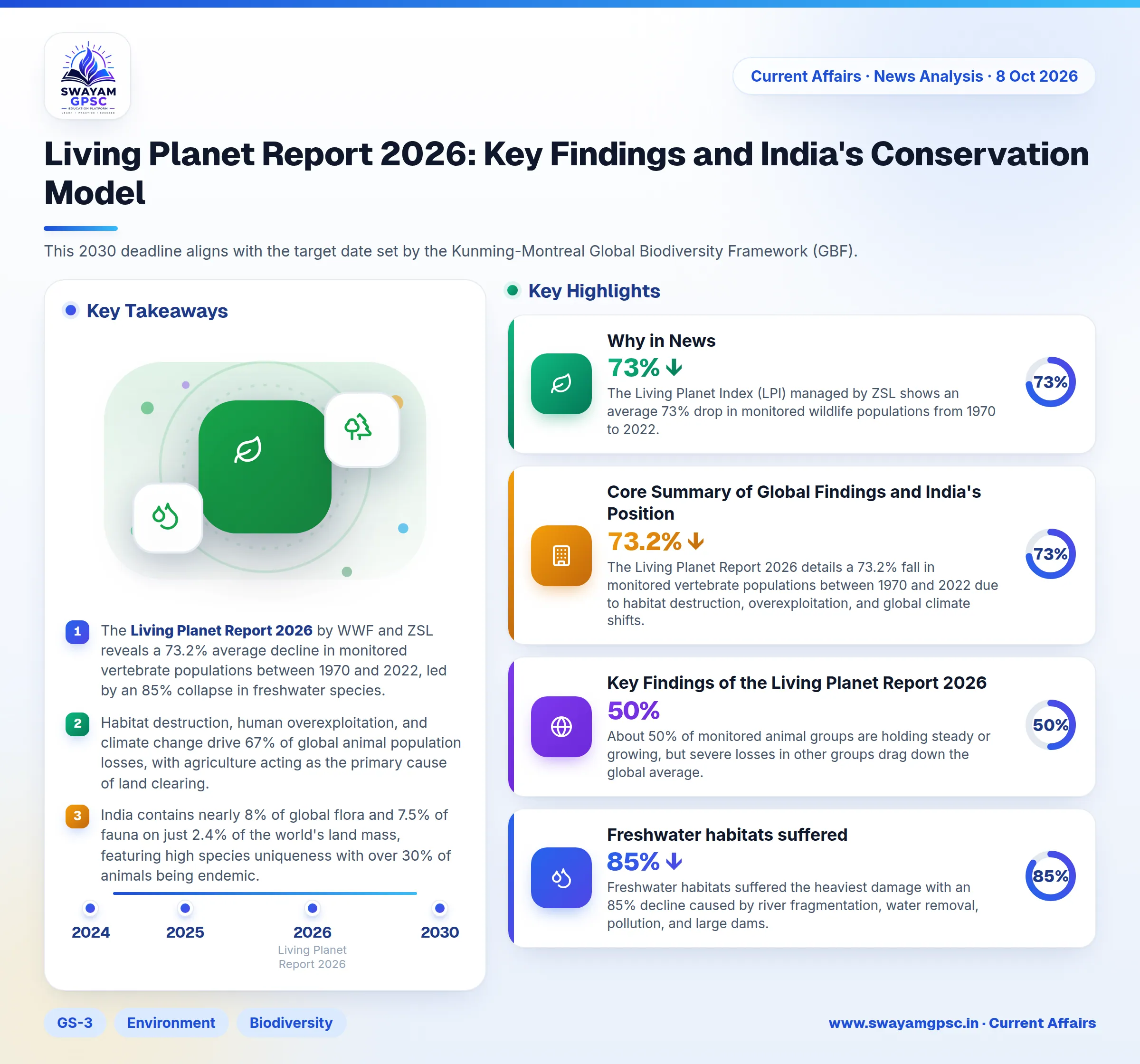
- The Living Planet Report 2026 by WWF and ZSL reveals a 73.2% average decline in monitored vertebrate populations between 1970 and 2022, led by an 85% collapse in freshwater species.
- Habitat destruction, human overexploitation, and climate change drive 67% of global animal population losses, with agriculture acting as the primary cause of land clearing.
- India contains nearly 8% of global flora and 7.5% of fauna on just 2.4% of the world's land mass, featuring high species uniqueness with over 30% of animals being endemic.
- Targeted programs boosted India's wild tiger population to 3,682 in 2022 (over 75% of global wild tigers) and expanded Asiatic lions in Gujarat from 674 in 2020 to 891 in 2025.
- Global environmentally harmful funding reached USD 7.3 trillion in 2023, highlighting the need to close the USD 1.3 trillion annual biodiversity financing gap.
Why in News
- The World Wide Fund for Nature (WWF) and the Zoological Society of London (ZSL) released the Living Planet Report 2026.
- This report comes out every two years and carries the subtitle 'The Science of Hope'.
- The Living Planet Index (LPI) managed by ZSL shows an average 73% drop in monitored wildlife populations from 1970 to 2022.
- The report warns that key global systems like energy, food, and finance must reach positive turning points before 2030.
- This 2030 deadline aligns with the target date set by the Kunming-Montreal Global Biodiversity Framework (GBF).
Core Summary of Global Findings and India's Position
- The Living Planet Report 2026 details a 73.2% fall in monitored vertebrate populations between 1970 and 2022 due to habitat destruction, overexploitation, and global climate shifts.
- India shows that nations can reverse wildlife loss through targeted science, public participation, strategic funding, and clear governance.
- India's successful efforts with species like tigers, lions, vultures, and Nilgiri tahrs directly support SDG 14 for aquatic life and SDG 15 for land ecosystems.
Key Findings of the Living Planet Report 2026
- The global LPI tracked a 73.2% relative drop in vertebrate abundance between 1970 and 2022, which means an annual decline rate of about 2.5%.
- This index measures relative changes in population size rather than counting total individual animals or extinct species.
- About 50% of monitored animal groups are holding steady or growing, but severe losses in other groups drag down the global average.
- Freshwater habitats suffered the heaviest damage with an 85% decline caused by river fragmentation, water removal, pollution, and large dams.
- Land ecosystems saw a 69% decline mainly because of farmland expansion and forest clearing.
- Marine ecosystems experienced a 59% drop due to overfishing, plastic trash, and ocean warming.
- The Latin America and Caribbean region saw the sharpest regional drop at 95%, while Africa lost 80%, the Asia-Pacific lost 49%, North America dropped 28%, and Europe-Central Asia fell 23%.
- Smaller percentage drops in North America and Europe do not mean pristine habitats, as heavy losses happened there well before the 1970 baseline year.
- Roughly 50% of global economic output, worth about USD 58 trillion in 2023, relies moderately or heavily on natural systems.
- Habitat loss causes 30% of biodiversity damage, overexploitation accounts for 23%, and climate change contributes 14%.
- Agriculture stands as the main driver of habitat loss, while energy consumption powers global climate change.
- Focused conservation programs have brought back specific species, including green turtles, bluefin tuna, southern African elephants, and wild tigers.
- The report highlights early positive momentum across energy, food, and financial systems that could accelerate wider sustainable choices.
- Transformation moves through three stages: enabling, accelerating, and stabilizing.
- Energy is moving into the accelerating phase, but food and finance remain stuck in the enabling phase and need faster reforms before 2030.
- Solar technology now delivers the cheapest new electricity in most nations, helping clean sources meet all added global electricity demand in 2025.
- Fossil fuels fell below 60% of global power generation in 2025 for the first time since the 1940s.
- Electric vehicles reached over 25% of global new car sales in 2024, with India becoming a prominent innovation center.
- Food and financial sectors show positive shifts through science-based supply targets, the EU Deforestation Regulation, Denmark's proposed farm carbon tax, and national food commitments.
- The report also tracks the Red List Index (RLI) for extinction risk and the Biodiversity Intactness Index (BII) for original habitat retention.
Status of India's Biodiversity and Conservation Data
- India holds only 2.4% of the world's land area, yet it supports nearly 8% of global plant species and 7.5% of global animal species.
- The country ranks among the world's 17 megadiverse nations and contains parts of 4 out of 36 global biodiversity hotspots.
- India shows high species uniqueness, with about 28% of plants and over 30% of animals living nowhere else on Earth.
- The IUCN Red List evaluated 7,516 Indian animal species and listed 1,012 of them as threatened.
- This current international evaluation covers just 7.2% of India's documented animal species.
- India introduced the National Red List Assessment Initiative (2025-2030) during the IUCN World Conservation Congress in Abu Dhabi in 2025.
- This project will create home-grown National Red Data Books for local plants and animals by 2030 to fix knowledge gaps.
Species Recovery Successes in India
- Tamil Nadu launched Project Nilgiri Tahr with the Wildlife Institute of India (WII) and the IUCN to safeguard its state animal.
- Joint field counts, radio-collaring, and mapping lifted the tahr population from 1,303 in 2025 to 1,364 in 2026.
- India banned the veterinary use of diclofenac, which helped halt the catastrophic drop in vulture populations.
- Breeding programs at the Jatayu Conservation Breeding Centre in Haryana, run with the Bombay Natural History Society (BNHS), helped restore numbers.
- Habitat protection in the Segur Plateau and Mudumalai Tiger Reserve raised Madhya Pradesh's vulture count from 8,397 in 2019 to 12,981 in 2025.
- Scientific tracking and community support helped wild Asiatic lions in Gujarat grow from 674 in 2020 to 891 in 2025.
- Assam stabilized Greater One-Horned Rhinoceros numbers in sanctuaries like Pobitora through grassland management and weed clearing.
- Tamil Nadu created India's first Dugong Reserve over 448 sq km in Palk Bay, using financial compensation to protect local fishing income.
- A 2026 assessment by WII counted 270 dugongs, with 158 in Palk Bay and 112 in the Gulf of Mannar.
- India launched Project Tiger in 1973, building populations up to 3,682 in the 2022 census.
- India now houses over 75% of all wild tigers remaining on Earth.
- India initiated Project Cheetah as the world's first intercontinental transfer of large wild carnivores to rebuild native ecology.
- A 2024 study counted 718 snow leopards in India, aided by women pastoralists managing conservation zones in Kibber, Himachal Pradesh.
- Meghalaya created an action plan across 14 focus areas to protect movement paths for the clouded leopard.
- Tamil Nadu set up the Endangered Species Conservation Fund to help neglected animals like the mahseer, striped hyena, Madras hedgehog, lion-tailed macaque, and hornbill.
- Global programs like the USD 200 million Phoenix Species Project by Re:wild and the Bezos Earth Fund supply vital funding for lesser-known wildlife.
Persistent Challenges for India's Wildlife
- Roads, railways, and canals slice through protected reserves, blocking animal movements and causing accidents like train hits on elephants.
- Growing animal numbers within shrinking sanctuaries lead wildlife into farmland, causing crop loss, livestock harm, and human conflict.
- Invasive plants like Lantana camara and Prosopis juliflora choke native forests and reduce wild food sources for plant-eating animals.
- Illegal hunting of large animals has dropped, but organized networks still traffic species like pangolins, star tortoises, and rare birds.
- Unpredictable monsoons, wild forest fires, and rising seas alter wildlife habitats and threaten coastal animals like the Sundarbans tigers.
Measures Needed for Effective Wildlife Conservation
- Include animal movement corridors in national development planning like PM Gati Shakti.
- Release money from State CAMPA funds and the Integrated Development of Wildlife Habitats (IDWH) scheme to finance regional conservation.
- Set up dedicated budget lines under the National Wildlife Action Plan (NWAP 2017-2031) to safeguard underfunded species like the Great Indian Bustard, Dugong, and Caracal.
- Apply Section 36C and Section 36D of the Wild Life (Protection) Amendment Act, 2022 to create local Conservation and Community Reserves.
- Connect these legal tools with Community Forest Resource (CFR) rights under the FRA, 2006 so local communities become official co-managers.
- Expand modern tracking tools like M-STrIPES and electronic monitoring into territorial forest spaces outside core tiger reserves.
- Train frontline staff through the Wildlife Institute of India (WII) in crime analysis, digital mapping, and invasive plant removal.
- Update the National Biodiversity Strategy and Action Plan (NBSAP) to meet Target 3 of the KMGBF, aiming for 30% protected land and water by 2030.
- Fill domestic funding gaps using international resources like the Global Biodiversity Framework Fund (GBFF) and corporate CSR funds under the Companies Act, 2013.
- Institutionalize the National One Health Mission (NOHM) across environment, health, and animal husbandry departments to catch disease outbreaks early.
- Shift economic flows away from harmful practices, noting that global flows put USD 7.3 trillion into nature-destroying activities in 2023 versus USD 220 billion for restoration.
- Close the world's annual biodiversity funding gap, which currently stands at USD 1.3 trillion.
Conclusion
- India's wildlife successes demonstrate that economic development does not automatically destroy natural systems.
- Combining strong political backing, field science, lasting budgets, and local community leadership allows damaged habitats to rebuild.
- These environmental victories directly advance SDG 14 for underwater life and SDG 15 for land ecosystems.