Nobel Prize in Chemistry 2026: Non-Linear Effects and Autocatalysis
#GS-3 #Science & Technology #Current Events #National #International #Quick Facts For Prelims #Scientific Innovations & Discoveries
Key takeaways
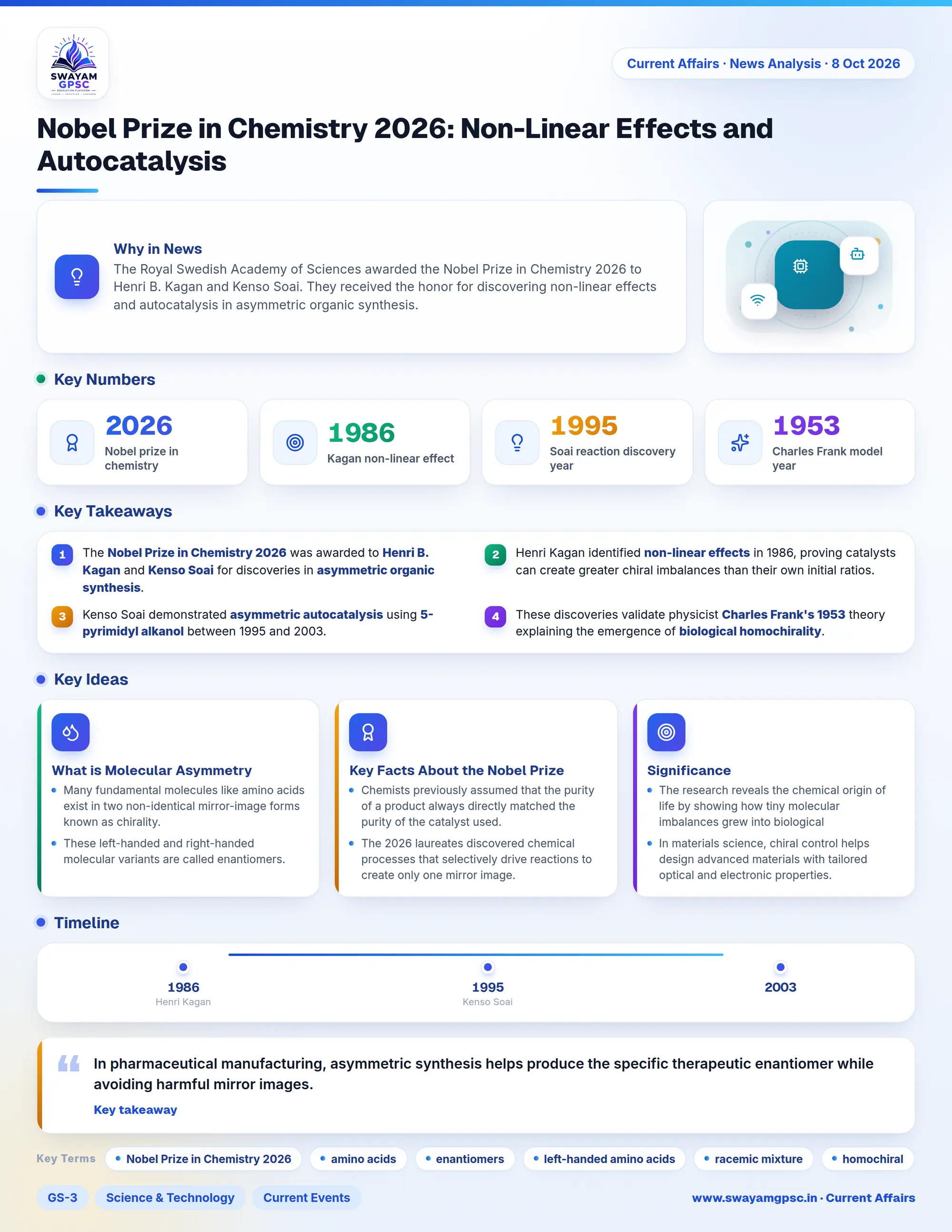
- The Nobel Prize in Chemistry 2026 was awarded to Henri B. Kagan and Kenso Soai for discoveries in asymmetric organic synthesis.
- Henri Kagan identified non-linear effects in 1986, proving catalysts can create greater chiral imbalances than their own initial ratios.
- Kenso Soai demonstrated asymmetric autocatalysis using 5-pyrimidyl alkanol between 1995 and 2003.
- These discoveries validate physicist Charles Frank's 1953 theory explaining the emergence of biological homochirality.
- This research enables precise enantioselective synthesis for pharmaceuticals, agrochemicals, fragrances, and advanced materials.
Why in News
- The Royal Swedish Academy of Sciences awarded the Nobel Prize in Chemistry 2026 to Henri B. Kagan and Kenso Soai.
- They received the honor for discovering non-linear effects and autocatalysis in asymmetric organic synthesis.
- Their work explains how chemical reactions can amplify small molecular asymmetries, solving a century-old mystery about how life selected specific molecular structures.
What is Molecular Asymmetry or Chirality?
- Many fundamental molecules like amino acids exist in two non-identical mirror-image forms known as chirality.
- These left-handed and right-handed molecular variants are called enantiomers.
- Living organisms overwhelmingly use only one molecular form, such as human cells using exclusively left-handed amino acids.
- Standard laboratory synthesis produces equal amounts of both mirror images, known as a racemic mixture.
- Scientists spent decades trying to understand how biological life evolved to become strictly homochiral.
Key Facts About the Nobel Prize in Chemistry 2026
- Chemists previously assumed that the purity of a product always directly matched the purity of the catalyst used.
- The 2026 laureates discovered chemical processes that selectively drive reactions to create only one mirror image.
- In 1986, Henri Kagan discovered that chiral catalysts produce a much greater chiral imbalance than expected.
- Kagan showed that opposite-handed catalyst pairs are less active, letting the majority form dominate through a non-linear effect.
- This non-linear effect helped explain how chiral amplification leads to biological homochirality.
- Between 1995 and 2003, Kenso Soai demonstrated that autocatalysis can dramatically amplify a tiny initial chiral imbalance.
- Soai discovered a chiral 5-pyrimidyl alkanol in 1995 that catalyses its own formation.
- Soai proved in 2003 that a self-amplifying snowball effect drives chemical mixtures toward extremely high enantiomeric purity.
- Their combined work provided experimental proof for the 1953 theoretical model proposed by physicist Charles Frank.
Significance
- In pharmaceutical manufacturing, asymmetric synthesis helps produce the specific therapeutic enantiomer while avoiding harmful mirror images.
- The research reveals the chemical origin of life by showing how tiny molecular imbalances grew into biological homochirality.
- In materials science, chiral control helps design advanced materials with tailored optical and electronic properties.
- In agrochemicals and fragrances, enantioselective synthesis improves the efficiency and performance of pesticides and specialized chemicals.