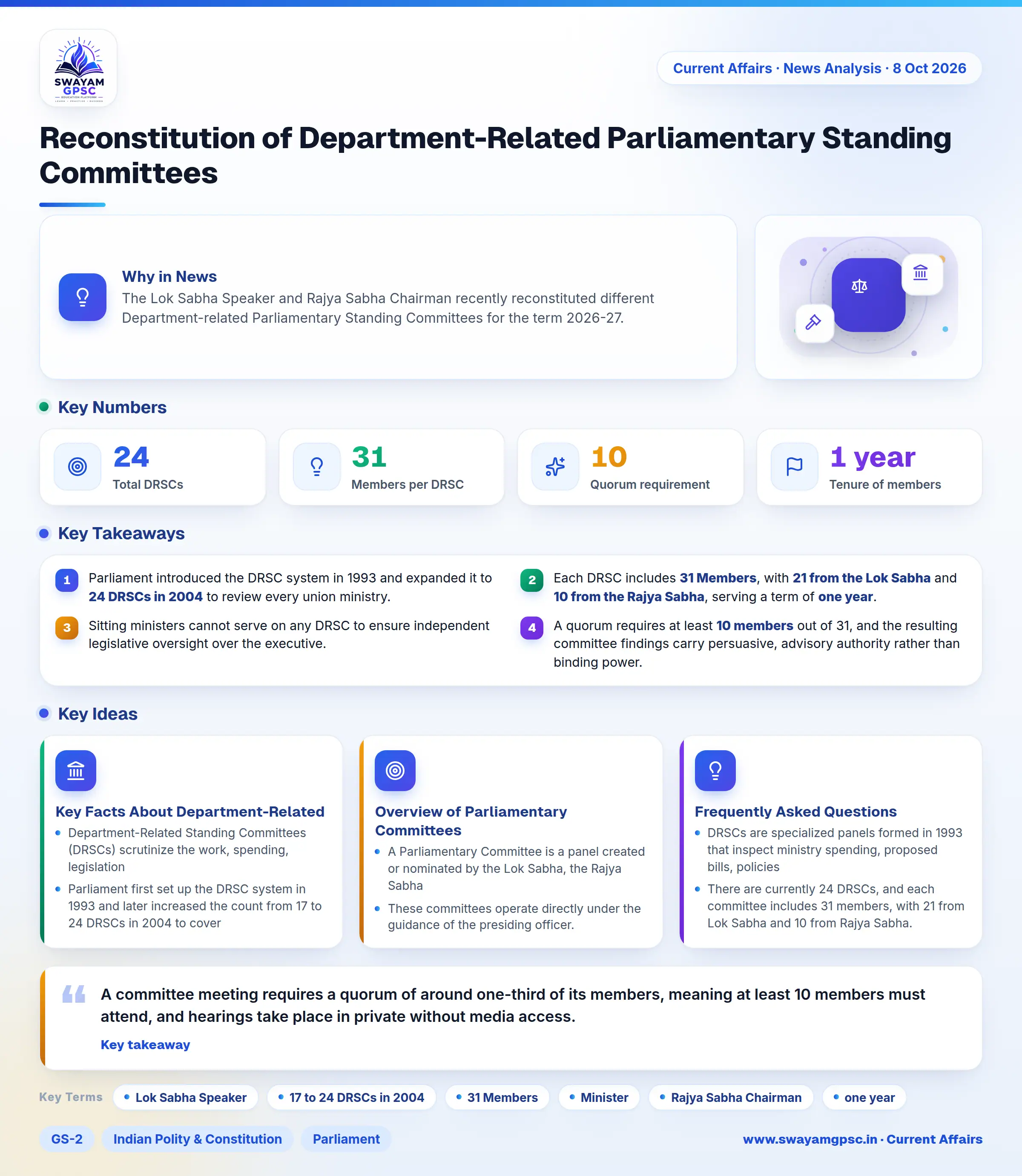
Reconstitution of Department-Related Parliamentary Standing Committees
#GS-2 #Indian Polity & Constitution #Parliament #Current Events #National #Quick Facts For Prelims
Key takeaways
- Parliament introduced the DRSC system in 1993 and expanded it to 24 DRSCs in 2004 to review every union ministry.
- Each DRSC includes 31 Members, with 21 from the Lok Sabha and 10 from the Rajya Sabha, serving a term of one year.
- Sitting ministers cannot serve on any DRSC to ensure independent legislative oversight over the executive.
- A quorum requires at least 10 members out of 31, and the resulting committee findings carry persuasive, advisory authority rather than binding power.
Why in News
- The Lok Sabha Speaker and Rajya Sabha Chairman recently reconstituted different Department-related Parliamentary Standing Committees for the term 2026-27.
Key Facts About Department-Related Parliamentary Standing Committees
- Department-Related Standing Committees (DRSCs) scrutinize the work, spending, legislation, and policies of central ministries, which helps keep the executive accountable to Parliament.
- Parliament first set up the DRSC system in 1993 and later increased the count from 17 to 24 DRSCs in 2004 to cover every central ministry.
- Every DRSC has 31 Members, including 21 from the Lok Sabha and 10 from the Rajya Sabha, based roughly on party strength in Parliament.
- A Minister cannot join a DRSC, and any sitting member who becomes a minister must step down immediately.
- The Rajya Sabha Chairman chooses chairpersons for committees under Part I of the Fifth Schedule, while the Lok Sabha Speaker selects chairpersons for Part II committees.
- Members serve on these committees for a period not exceeding one year, as Parliament reconstitutes them annually.
- Their main work involves reviewing Demands for Grants, bills, annual ministry reports, and long-term national policy papers.
- DRSCs do not manage regular daily ministry operations, and they avoid taking up issues that other parliamentary committees are already handling.
- The recommendations made by these committees are purely advisory, offering persuasive guidance rather than legally binding instructions.
- A committee meeting requires a quorum of around one-third of its members, meaning at least 10 members must attend, and hearings take place in private without media access.
- Members usually draft reports through broad agreement, but any member can formally attach a dissent note to present to Parliament.
- These panels can ask for government files, summon witnesses, and gather views from technical experts or the general public.
Overview of Parliamentary Committees
- A Parliamentary Committee is a panel created or nominated by the Lok Sabha, the Rajya Sabha, or the presiding officers to carry out specific legislative duties.
- These committees operate directly under the guidance of the presiding officer.
- They present their findings and finished reports directly to the House or the Speaker/Chairman.
- Staff from the Lok Sabha Secretariat or the Rajya Sabha Secretariat handle their administrative needs.
- The system draws inspiration from the British Parliament and gets its legal foundation from Article 105 and Article 118 of the Constitution.
Frequently Asked Questions
- DRSCs are specialized panels formed in 1993 that inspect ministry spending, proposed bills, policies, and program implementation.
- There are currently 24 DRSCs, and each committee includes 31 members, with 21 from Lok Sabha and 10 from Rajya Sabha.
- Members hold their posts for a term of one year, after which Parliament reconstitutes each panel.
- The presiding officers, namely the Lok Sabha Speaker and Rajya Sabha Chairman, reconstitute these committees under their respective authorities.
- The committees examine budget allocations, assess referred legislation, evaluate government policies, and submit reports to the legislature.