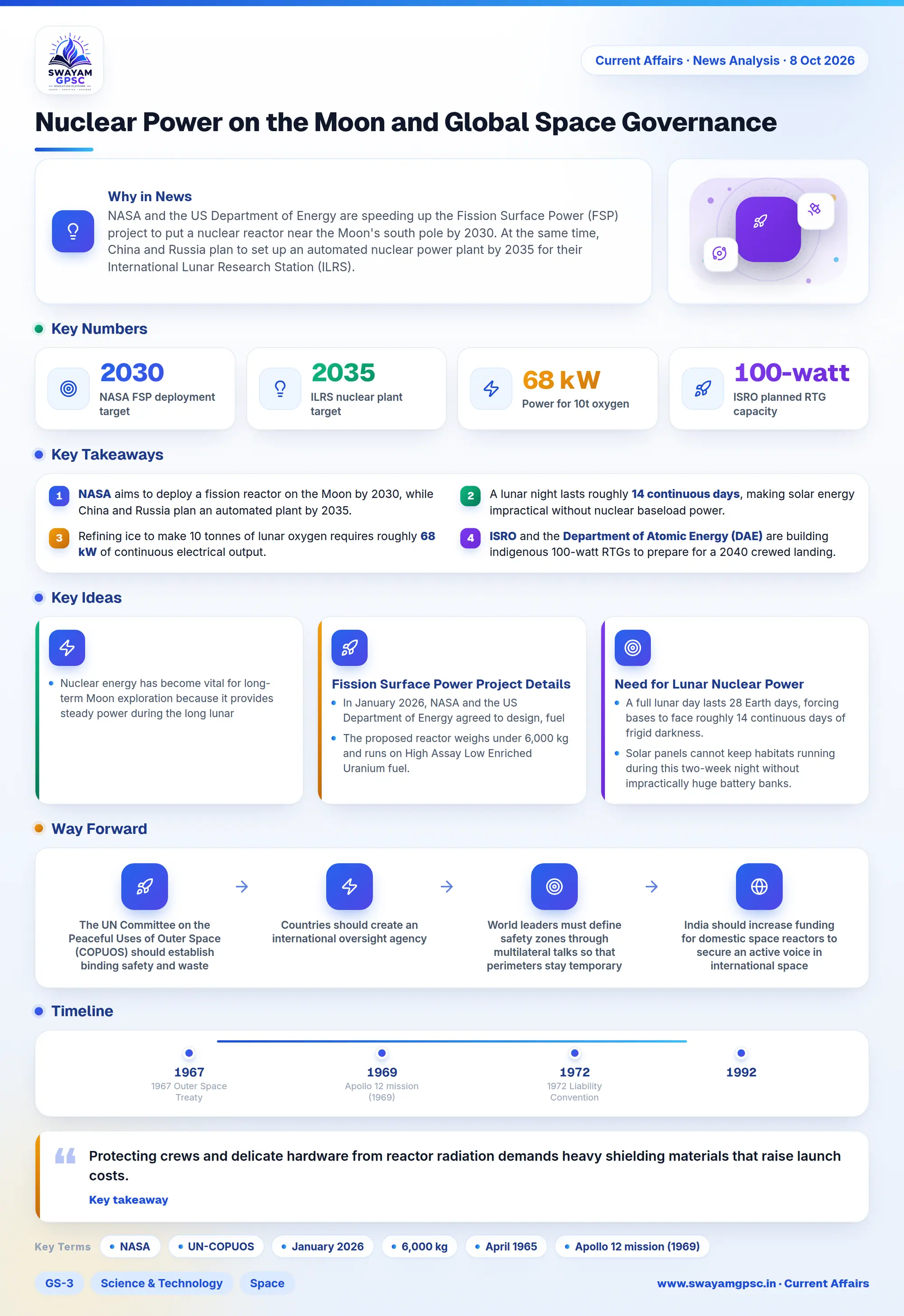
Nuclear Power on the Moon and Global Space Governance
#GS-3 #Science & Technology #Space #Energy #Current Events #International #NASA #Outer Space Treaty #Nuclear Power on the Moon
Key takeaways
- NASA aims to deploy a fission reactor on the Moon by 2030, while China and Russia plan an automated plant by 2035.
- A lunar night lasts roughly 14 continuous days, making solar energy impractical without nuclear baseload power.
- Refining ice to make 10 tonnes of lunar oxygen requires roughly 68 kW of continuous electrical output.
- ISRO and the Department of Atomic Energy (DAE) are building indigenous 100-watt RTGs to prepare for a 2040 crewed landing.
Why in News
- NASA and the US Department of Energy are speeding up the Fission Surface Power (FSP) project to put a nuclear reactor near the Moon's south pole by 2030.
- At the same time, China and Russia plan to set up an automated nuclear power plant by 2035 for their International Lunar Research Station (ILRS).
- This push toward industrial space projects creates new legal, environmental, and geopolitical questions about Moon territory and resource control.
Summary
- Nuclear energy has become vital for long-term Moon exploration because it provides steady power during the long lunar night.
- Deploying space reactors raises security and environmental concerns, which means countries need stronger safety rules through groups like UN-COPUOS.
Fission Surface Power Project Details
- In January 2026, NASA and the US Department of Energy agreed to design, fuel, and launch a lunar surface reactor by 2030 under the Artemis programme.
- The proposed reactor weighs under 6,000 kg and runs on High Assay Low Enriched Uranium fuel.
- It will supply baseload power for Moon bases, life support, rovers, and resource mining, while aiding future crewed trips to Mars.
- The United States launched its first space fission reactor, SNAP-10A, in April 1965, which generated about 500-600 watts for 43 days in orbit.
- During the Apollo 12 mission (1969), NASA used the SNAP-27 Radioisotope Thermoelectric Generator (RTG) to create at least 63 watts of power on the Moon.
- Unlike fission reactors, the SNAP-27 unit produced electricity directly from the decay heat of plutonium-238 without a chain reaction.
Need for Lunar Nuclear Power
- A full lunar day lasts 28 Earth days, forcing bases to face roughly 14 continuous days of frigid darkness.
- Solar panels cannot keep habitats running during this two-week night without impractically huge battery banks.
- Exploration teams focus on the lunar south pole, where deep craters sit in perpetual darkness.
- These dark craters hold water ice needed for drinking and rocket fuel, but zero sunlight reaches them.
- Traditional deep-space probes rely on Radioisotope Thermoelectric Generators (RTGs) that produce only a few hundred watts.
- Human bases need tens to hundreds of kilowatts of electricity, which only small fission reactors can deliver.
- Refining lunar ice into breathable oxygen and rocket propellant demands massive industrial energy.
- Extracting ice to create 10 tonnes of oxygen takes about 68 kW of nonstop electricity, making fission systems vital.
Geopolitics of Lunar Nuclear Deployment
- Prime spots near the lunar south pole with water ice, smooth terrain, and direct Earth communications remain extremely rare.
- The 1967 Outer Space Treaty (OST) bans countries from claiming sovereignty over celestial bodies.
- Even without formal claims, placing a reactor on prime ground gives a country practical control over that site.
- The US-led Artemis Accords permit safety zones around lunar hardware to stop harmful interference from other missions.
- Building reactors, power lines, and extraction gear near key resources gives early-arriving nations unfair strategic control.
- While Article IX of the Outer Space Treaty calls for mutual regard and talks, it does not grant operators exclusive territorial rights.
India's Nuclear Space Initiatives
- ISRO and the Department of Atomic Energy (DAE) are working together to build homegrown nuclear power systems for deep space.
- To back long missions like the Bharatiya Antariksh Station and the 2040 crewed lunar landing, ISRO is designing 100-watt RTGs.
- This project expands on Chandrayaan-3, which carried two 1-watt Radioisotope Heater Units on its propulsion module.
- The heating units on Chandrayaan-3 only kept systems warm, whereas the new RTGs will generate usable electricity.
Technical and Environmental Challenges
- Protecting crews and delicate hardware from reactor radiation demands heavy shielding materials that raise launch costs.
- Moving reactors away from living quarters requires robotic setup, long power cables, and sturdy transmission grids across rough soil.
- Because the Moon has no air for cooling, reactors must shed surplus heat using giant radiator panels.
- Lunar power plants must run on their own for years without repairs, coping with sharp temperature swings and launch stress.
- Rockets must launch reactors with unactivated fuel cores so an accidental launch explosion will not spread radiation on Earth.
- A reactor leak or cooling failure could permanently contaminate rare crater sites that hold clean water ice.
Governance and Regulatory Gaps
- The 1992 UN Principles Relevant to the Use of Nuclear Power Sources in Outer Space give safety advice but lack legal enforcement powers.
- These 1992 rules apply only to basic electric systems, completely omitting nuclear propulsion technologies.
- Current international treaties have no clear rules for decommissioning dead lunar reactors or managing nuclear waste.
- The 1972 Liability Convention covers space damage on Earth, but its rules remain unclear for accidents on the lunar surface.
- Broad safety perimeters around reactors clash with international laws that protect every country's right to explore space freely.
Way Forward
- The UN Committee on the Peaceful Uses of Outer Space (COPUOS) should establish binding safety and waste disposal standards.
- Countries should create an international oversight agency, similar to the International Atomic Energy Agency (IAEA), to monitor space reactors.
- World leaders must define safety zones through multilateral talks so that perimeters stay temporary and non-exclusive.
- India should increase funding for domestic space reactors to secure an active voice in international space rule-making.
Conclusion
- Nuclear energy will serve as a vital power source as humans build long-term bases on the Moon.
- However, countries must create strong global safety rules through UN-COPUOS to protect both Earth and the lunar environment.