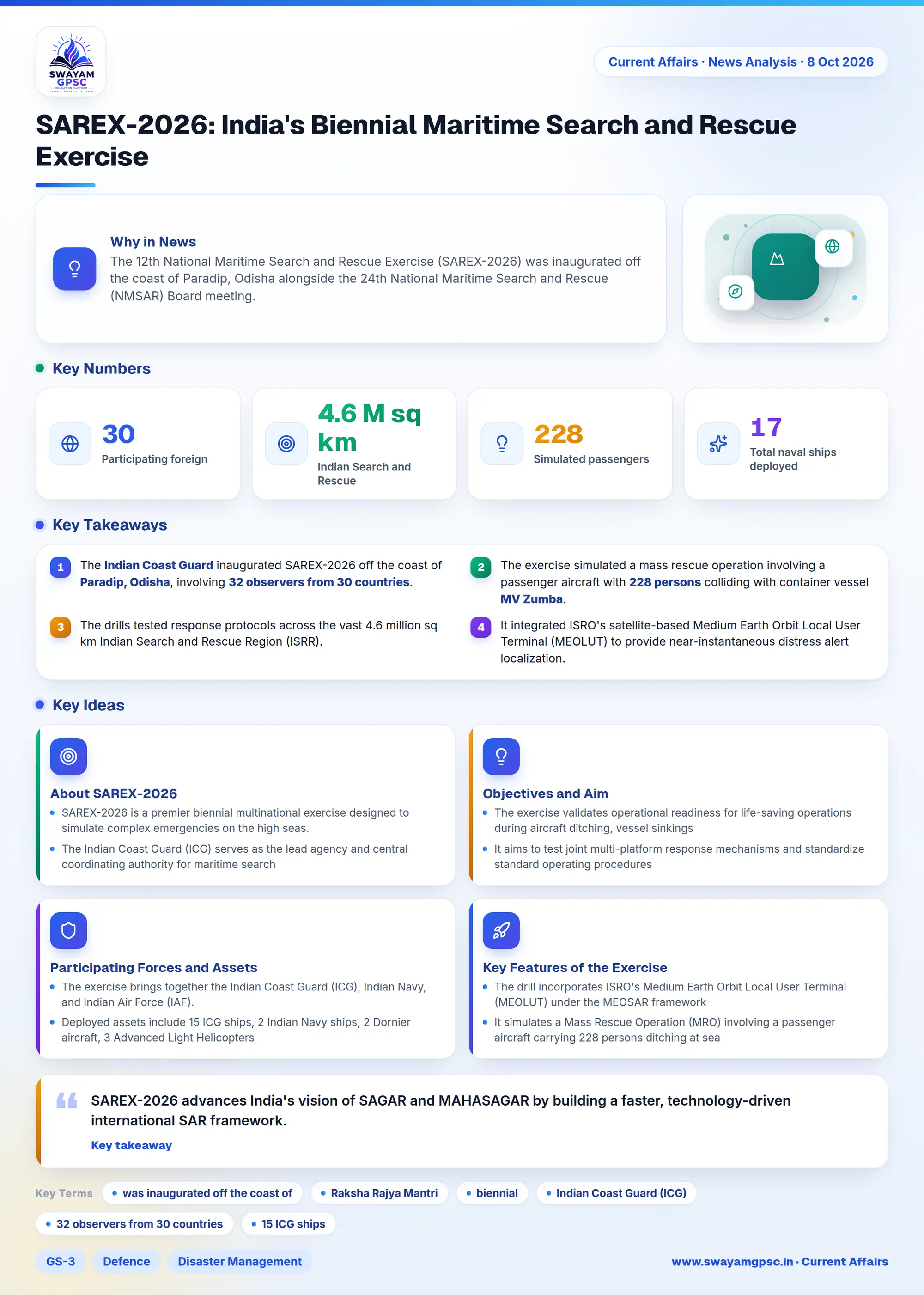
SAREX-2026: India's Biennial Maritime Search and Rescue Exercise
#GS-3 #Defence #Disaster Management #Current Events #National #Indian Coast Guard #SAREX-2026 #Maritime Security
Key takeaways
- The Indian Coast Guard inaugurated SAREX-2026 off the coast of Paradip, Odisha, involving 32 observers from 30 countries.
- The exercise simulated a mass rescue operation involving a passenger aircraft with 228 persons colliding with container vessel MV Zumba.
- The drills tested response protocols across the vast 4.6 million sq km Indian Search and Rescue Region (ISRR).
- It integrated ISRO's satellite-based Medium Earth Orbit Local User Terminal (MEOLUT) to provide near-instantaneous distress alert localization.
- Multiple defence arms deployed key assets including 15 ICG ships, 2 Indian Navy ships, Dornier aircraft, and C-130J aircraft.
Why in News
- The 12th National Maritime Search and Rescue Exercise (SAREX-2026) was inaugurated off the coast of Paradip, Odisha alongside the 24th National Maritime Search and Rescue (NMSAR) Board meeting.
- The exercise was inaugurated by the Raksha Rajya Mantri and features a live search and rescue demonstration at sea.
About SAREX-2026
- SAREX-2026 is a premier biennial multinational exercise designed to simulate complex emergencies on the high seas.
- The Indian Coast Guard (ICG) serves as the lead agency and central coordinating authority for maritime search and rescue in India.
- The exercise involves 32 observers from 30 countries, strengthening international cooperation and interoperability.
Objectives and Aim
- The exercise validates operational readiness for life-saving operations during aircraft ditching, vessel sinkings, and mass casualty situations.
- It aims to test joint multi-platform response mechanisms and standardize standard operating procedures among participating agencies.
- It fosters a Whole-of-Government and Whole-of-Nation approach to handle large-scale maritime disasters.
Participating Forces and Assets
- The exercise brings together the Indian Coast Guard (ICG), Indian Navy, and Indian Air Force (IAF).
- Deployed assets include 15 ICG ships, 2 Indian Navy ships, 2 Dornier aircraft, 3 Advanced Light Helicopters, 1 Chetak helicopter, 1 C-130J aircraft, and Mi-17 helicopters.
Key Features of the Exercise
- The drill incorporates ISRO's Medium Earth Orbit Local User Terminal (MEOLUT) under the MEOSAR framework, replacing older LEOSAR and GEOSAR systems for near-instant distress beacon localization.
- It simulates a Mass Rescue Operation (MRO) involving a passenger aircraft carrying 228 persons ditching at sea and colliding with the container vessel MV Zumba.
- Practical drills feature aircraft passenger evacuation, shipboard firefighting, liferaft air-drops from fixed-wing aircraft, and helicopter winching.
- Operations test command and distress data relay across the 4.6 million sq km Indian Search and Rescue Region (ISRR).
- Policy oversight is aligned with the 24th NMSAR Board meeting, chaired by the Director General of the Indian Coast Guard.
- The event includes tactical debriefs and tabletop simulations for foreign observers along critical Sea Lines of Communication (SLOCs).
Significance
- SAREX-2026 advances India's vision of SAGAR and MAHASAGAR by building a faster, technology-driven international SAR framework.
- It reinforces India's role as a primary security provider and net safety responder across the Indian Ocean Region.
- The exercise strengthens inter-agency coordination between defence forces, shipping authorities, coastal administrations, and aviation agencies for disaster management.
Prelims in Focus: Indian Coast Guard
- The Indian Coast Guard (ICG) is an Armed Force of the Union established under the Coast Guard Act, 1978 to safeguard India's maritime interests.
- The ICG serves as the central coordinating authority for oil-spill response in India's maritime zones.