Supreme Court Directs States to Declare Cancer as a Notifiable Disease
#GS-2 #Governance & Social Justice #Health #Current Events #National #Supreme Court #Notifiable Diseases
Key takeaways
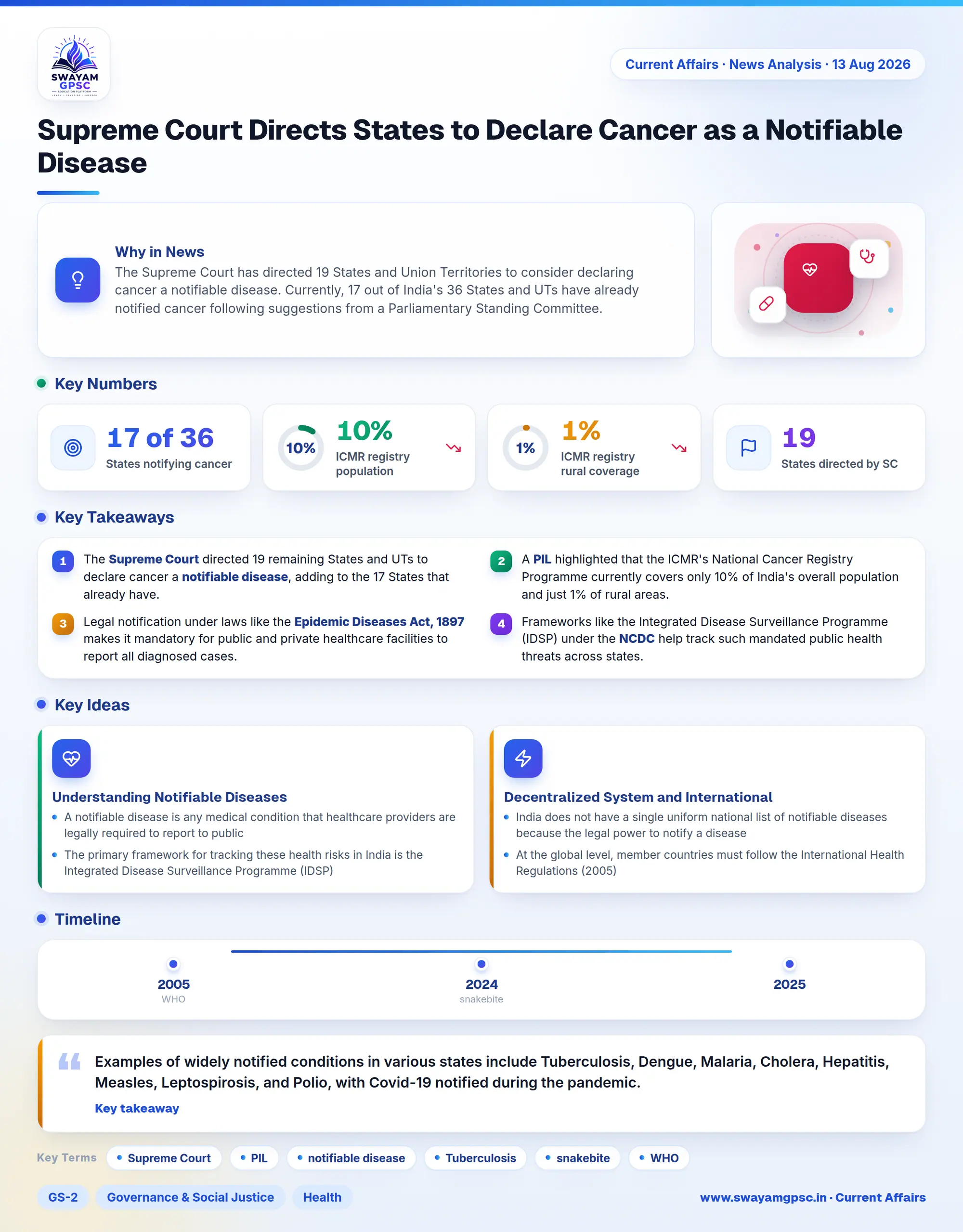
- The Supreme Court directed 19 remaining States and UTs to declare cancer a notifiable disease, adding to the 17 States that already have.
- A PIL highlighted that the ICMR's National Cancer Registry Programme currently covers only 10% of India's overall population and just 1% of rural areas.
- Legal notification under laws like the Epidemic Diseases Act, 1897 makes it mandatory for public and private healthcare facilities to report all diagnosed cases.
- Frameworks like the Integrated Disease Surveillance Programme (IDSP) under the NCDC help track such mandated public health threats across states.
Why in News
- The Supreme Court has directed 19 States and Union Territories to consider declaring cancer a notifiable disease.
- Currently, 17 out of India's 36 States and UTs have already notified cancer following suggestions from a Parliamentary Standing Committee.
- This direction came after a PIL revealed that the ICMR's National Cancer Registry Programme covers only about 10% of India's population, with rural coverage as low as 1%.
- Making cancer a notifiable disease mandates reporting of all diagnosed cases, which helps governments maintain systematic records, improve surveillance, and plan effective treatments early.
Understanding Notifiable Diseases
- A notifiable disease is any medical condition that healthcare providers are legally required to report to public health authorities under laws such as the Epidemic Diseases Act, 1897.
- The primary framework for tracking these health risks in India is the Integrated Disease Surveillance Programme (IDSP), which is managed by the National Centre for Disease Control (NCDC).
- Once authorities notify a disease, every public and private doctor, hospital, and clinic must report suspected, probable, and confirmed cases to official channels.
- Examples of widely notified conditions in various states include Tuberculosis, Dengue, Malaria, Cholera, Hepatitis, Measles, Leptospirosis, and Polio, with Covid-19 notified during the pandemic.
- Recent additions to this framework include snakebite in 2024 and human rabies in 2025.
Decentralized System and International Obligations
- India does not have a single uniform national list of notifiable diseases because the legal power to notify a disease sits primarily with state and UT governments.
- At the global level, member countries must follow the International Health Regulations (2005) under the WHO, which legally require informing WHO about public health events that could have global consequences.