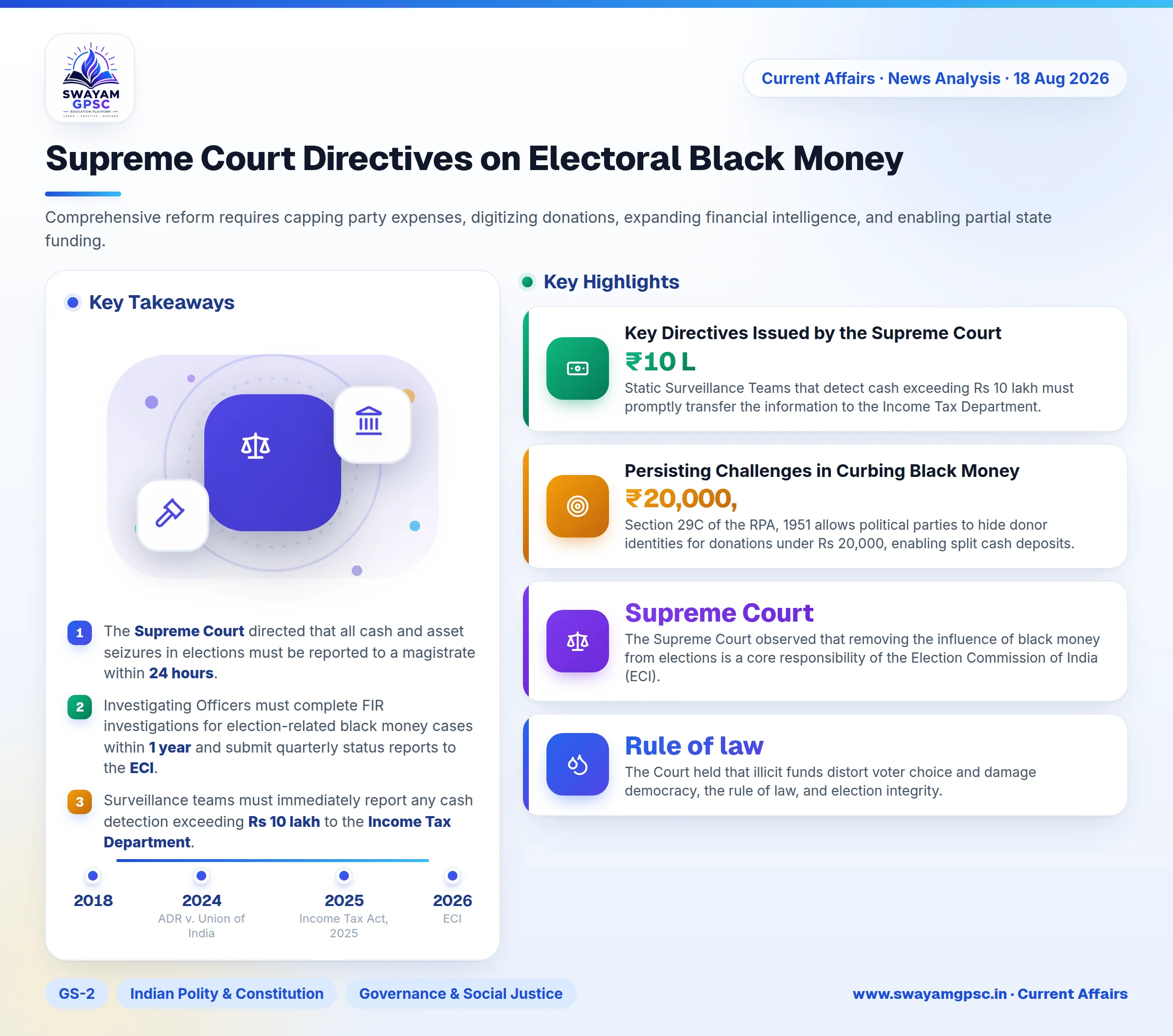
Supreme Court Directives on Electoral Black Money
#GS-2 #Indian Polity & Constitution #Governance & Social Justice #National #Representation of People's Act #Transparency & Accountability #GS-3 #Money Laundering
Key takeaways
- The Supreme Court directed that all cash and asset seizures in elections must be reported to a magistrate within 24 hours.
- Investigating Officers must complete FIR investigations for election-related black money cases within 1 year and submit quarterly status reports to the ECI.
- Surveillance teams must immediately report any cash detection exceeding Rs 10 lakh to the Income Tax Department.
- Section 29C of the Representation of the People Act, 1951 exempts donations under Rs 20,000 from donor disclosure, creating a major transparency loophole.
- Reforms proposed include capping political party expenses and implementing the Indrajit Gupta Committee (1998) recommendations for partial state funding in kind.
Why in News
- The Supreme Court observed that removing the influence of black money from elections is a core responsibility of the Election Commission of India (ECI).
- The Court held that illicit funds distort voter choice and damage democracy, the rule of law, and election integrity.
- The Supreme Court issued specific directions for time-bound investigations, seizure reporting, and fast-track trials in election-related black money cases.
Summary
- The Supreme Court directed the ECI to monitor black money in elections through mandatory seizure reports, strict investigation timelines, and fast-track trials.
- Electoral black money undermines voter autonomy, fair competition, transparency, and democratic accountability across the country.
- Comprehensive reform requires capping party expenses, digitizing donations, expanding financial intelligence, and enabling partial state funding.
Key Directives Issued by the Supreme Court
- Officers must report seized cash or assets within 24 hours to the District Magistrate or competent court with evidence showing a link to an election offence.
- Investigating Officers must complete election-related FIR investigations within 1 year and justify any delays directly to the ECI.
- Investigating Officers must submit quarterly status updates on election black money cases to the ECI.
- Static Surveillance Teams that detect cash exceeding Rs 10 lakh must promptly transfer the information to the Income Tax Department.
- High Courts must ensure the expeditious disposal of election-related financial crime cases through designated courts.
- State governments cannot withdraw criminal cases against election candidates without prior approval from the concerned High Court.
- The ECI and State Governments must submit full compliance reports to the Supreme Court by 18th November 2026.
Why Black Money Threatens Electoral Democracy
- Illicit money influences voter choices through cash inducements, violating Article 326 which guarantees Universal Adult Suffrage.
- In the PUCL v. Union of India (2013) NOTA judgment, the Court held that uncoerced choice is essential for genuine democratic elections.
- Unaccounted wealth creates an unequal playing field under Article 14, preventing resource-poor candidates from competing fairly.
- In Kanwar Lal Gupta v. Amar Nath Chawla (1974), the Court noted that financial disparities between candidates distort fair competition.
- In Indira Nehru Gandhi v. Raj Narain (1975), the Supreme Court ruled that free and fair elections form part of the Basic Structure of the Constitution.
- Black money creates crony capitalism, forcing elected candidates to return favors to donors through biased policies and public contracts.
- In the Electoral Bonds case (ADR v. Union of India, 2024), the Court struck down anonymous funding under Article 19(1)(a) to prevent corrupt deals.
- The Vohra Committee (1993) noted that distributing secret campaign cash relies on criminal syndicates, deepening the criminal-political nexus.
- In Public Interest Foundation v. Union of India (2018), the Court emphasized the urgent need to decriminalize politics and improve transparency.
Black Money in the Electoral Context
- Electoral black money refers to unaccounted and untaxed funds used outside formal and auditable financial channels during elections.
- It includes cash-for-votes, illegal liquor, unreported candidate expenses, hawala transfers, and funding routed through shell political parties.
Legal and Institutional Framework
- Section 123(1) of the Representation of the People Act, 1951 classifies voter bribery as a corrupt practice in elections.
- The Conduct of Election Rules, 1961 sets the statutory expenditure limits for individual candidates contesting elections.
- Following Common Cause v. Union of India (1996), political parties must submit detailed election financial statements.
- In Union of India v. ADR (2002), the Court affirmed the voter right to know a candidate criminal background, assets, and liabilities.
- The ECI deploys Expenditure Observers, Static Surveillance Teams, Flying Squads, and Video Surveillance Teams for field monitoring.
- Citizens can report real-time Model Code of Conduct violations and voter inducements using the ECI cVIGIL app.
- The Income Tax Act, 2025 and PMLA, 2002 provide statutory tools to track unaccounted wealth and crime proceeds.
Persisting Challenges in Curbing Black Money
- Section 77 of the Representation of the People Act, 1951 caps candidate spending but places no overall expenditure limit on political parties.
- Section 29C of the RPA, 1951 allows political parties to hide donor identities for donations under Rs 20,000, enabling split cash deposits.
- The ECI relies on state police and district officials under Article 324 because it lacks an independent financial-forensics wing.
- Tracking complex hawala channels and shell entities requires coordination among multiple agencies, creating delays in investigation.
- The Model Code of Conduct lacks statutory backing, which limits direct statutory penalties for financial violations.
- Widespread cash usage in informal rural markets makes it hard to link seized money to specific election offences.
- Distribution of cash, liquor, and gifts peaks during the final 24 to 48 hours before polling, making detection difficult.
- Low conviction rates for electoral financial offences reduce the deterrent effect of existing election laws.
Way Forward
- Parliament should pass legislation to set a strict spending cap on political parties based on the number of seats contested.
- The ECI should receive statutory power to deregister inactive or shell political parties used for money laundering.
- Cash donations to political parties must be eliminated in favor of traceable digital payments audited by the CAG.
- The ECI requires an autonomous financial intelligence unit integrated with data from FIU-IND and CBDT.
- India should implement the Indrajit Gupta Committee (1998) proposal for state funding of elections in kind.
- The judiciary should set up special fast-track courts to resolve electoral financial crime cases within the mandated 1 year deadline.
Committees and Commissions on Electoral Reform
- The Dinesh Goswami Committee (1990) recommended state support in kind to reduce candidate reliance on private cash.
- The Vohra Committee (1993) documented the entrenched network between politicians, criminal syndicates, and bureaucrats.
- The Law Commission 170th Report (1999) advocated internal democracy and complete financial transparency for political parties.
- The Law Commission 255th Report (2015) proposed strict financial audits for parties and detailed countermeasures against election cash laundering.
Conclusion
- The Supreme Court judgment strengthens institutional enforcement by making the ECI directly responsible for curbing electoral black money.
- Setting strict investigation timelines and requiring judicial approval for case withdrawals reinforces election transparency under the Representation of the People Act, 1951.
Frequently Asked Questions
- Article 324 gives the ECI constitutional authority to superintend and control elections, forming the basis for monitoring illegal expenditure.
- Section 123(1) of the Representation of the People Act, 1951 explicitly defines voter bribery as a corrupt practice.
- The cVIGIL app allows citizens to upload real-time photos and videos of illegal inducements directly to election authorities.
- In ADR v. Union of India (2024), the Court struck down electoral bonds, linking financial transparency to the voter Right to Information.
- Key remedies include capping party expenditure, digitizing donations, introducing partial state funding, and enforcing fast-track trials.