Supreme Court Directives on Early Release Policy for Elderly and Terminally Ill Prisoners
#GS-2 #Indian Polity & Constitution #Judiciary #Governance & Social Justice #Vulnerable Sections
Why in News
- The Supreme Court has ordered all States and Union Territories to create and notify a uniform policy within three months for the early release of elderly and terminally ill prisoners on humanitarian grounds.
- The apex court gave this directive while hearing a petition filed by the National Legal Services Authority (NALSA), which pointed out that India lacks a common national rule for such inmates.
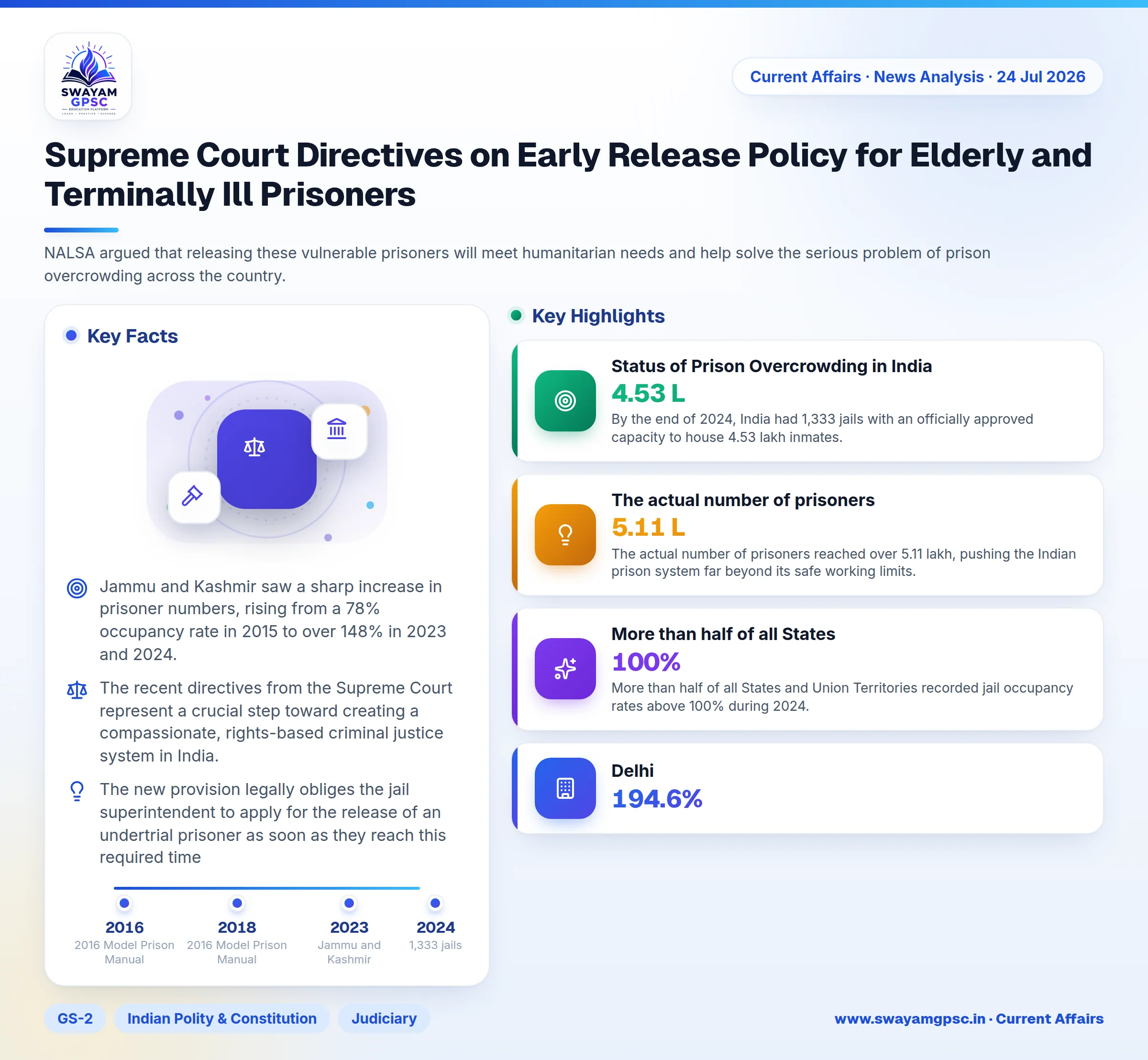
- NALSA argued that releasing these vulnerable prisoners will meet humanitarian needs and help solve the serious problem of prison overcrowding across the country.
Supreme Court Directives for Premature Release
- The main objective of these directions is to guarantee humane treatment for vulnerable prisoners, cut down prison overcrowding, enhance access to justice, and create a single national mechanism.
- Every State policy must clearly specify eligibility rules, application steps, and fixed time limits for processing requests for early release or sentence reduction.
- States must prepare these policies in consultation with their respective State Legal Services Authorities (SLSAs) to build better coordination and identify eligible inmates accurately.
- States and Union Territories must establish independent medical boards to evaluate and certify cases involving terminal illness, old age, and severe medical weakness.
- Policies must adopt a standard definition of terminal illness, and authorities can use the definition from the UN Office on Drugs and Crime (UNODC) Handbook on Prisoners with Special Needs.
- Under Trial Review Committees (UTRCs) must regularly examine the cases of terminally ill, elderly, or physically disabled prisoners and recommend legal remedies like bail, parole, remission, or release.
- Government authorities must eliminate procedural delays that force dying inmates to spend their final days behind bars, while making sure all rejection orders contain proper legal reasons subject to judicial review.
- The Central Government, together with the National Informatics Centre (NIC), will build an e-portal and provide digital tools and training to track all early release applications smoothly.
- The digital portal will send automated alerts, track deadlines, generate progress reports, and enable official supervision while protecting the privacy of the medical details of prisoners.
- The Centre, States, and Union Territories must submit compliance affidavits to the court within six months, providing full details about identified prisoners, released inmates, and pending applications.
Status of Prison Overcrowding in India
- By the end of 2024, India had 1,333 jails with an officially approved capacity to house 4.53 lakh inmates.
- The actual number of prisoners reached over 5.11 lakh, pushing the Indian prison system far beyond its safe working limits.
- More than half of all States and Union Territories recorded jail occupancy rates above 100% during 2024.
- Delhi reported the highest prison occupancy rate in the nation at 194.6% in 2024, followed by Meghalaya at 163.5%, Jammu and Kashmir at 148.3%, and Madhya Pradesh at 147.1%.
- Jammu and Kashmir saw a sharp increase in prisoner numbers, rising from a 78% occupancy rate in 2015 to over 148% in 2023 and 2024.
- On the other hand, Chhattisgarh successfully reduced overcrowding from a staggering 234% in 2015 down to 127.6% in 2024, with Uttar Pradesh showing similar progress.
Government Initiatives to Address Prison Overcrowding
- Under Section 479(1) of the Bharatiya Nagarik Suraksha Sanhita (BNSS), 2023, first-time offenders who complete one-third of their maximum possible sentence get released on bond, replacing the older CrPC Section 436A.
- The new provision legally obliges the jail superintendent to apply for the release of an undertrial prisoner as soon as they reach this required time limit.
- The Model Prisons and Correctional Services Act, 2023 replaced the Prisons Act of 1894, shifting the official focus from punishment toward prisoner reformation, rehabilitation, and electronic tracking during parole.
- The government introduced the 2016 Model Prison Manual to standardize jail administration and created the Prisons Development Fund in 2018 to upgrade physical infrastructure.
- The E-Prisons Project connects digital jail records with the Inter-operable Criminal Justice System (ICJS), sending automated notifications when an inmate becomes eligible for bail.
- The Ministry of Home Affairs launched the Support to Poor Prisoners Scheme to provide financial help to poor undertrials who cannot afford bail bonds or surety amounts.
National Legal Services Authority (NALSA)
- NALSA is a statutory organization formed in 1995 under the Legal Services Authorities Act, 1987, with the Chief Justice of India (CJI) serving as its Patron-in-Chief.
- The organization fulfills the constitutional directive of Article 39A, which requires the State to offer free legal aid, while also protecting individual rights under Article 14 and Article 22(1).
- The core functions of NALSA include setting national policies for legal aid, monitoring legal assistance programs, and releasing government funds to SLSAs and non-profit groups.
- NALSA operates at the top of a nationwide legal assistance structure that includes State Legal Services Authorities (SLSAs), District Legal Services Authorities (DLSAs), and Taluk Legal Services Committees.
- Free legal services provided by this framework are available to women, children, Scheduled Castes (SC), Scheduled Tribes (ST), Economically Weaker Sections (EWS), industrial workers, and disabled individuals.
Way Forward and Conclusion
- The recent directives from the Supreme Court represent a crucial step toward creating a compassionate, rights-based criminal justice system in India.
- Establishing clear state policies, independent medical boards, coordinated legal aid, and automated digital tracking will bring accountability and dignity to elderly and terminally ill inmates.
- Timely and strict implementation by all States and Union Territories will remain essential to convert these legal directions into real relief on the ground.