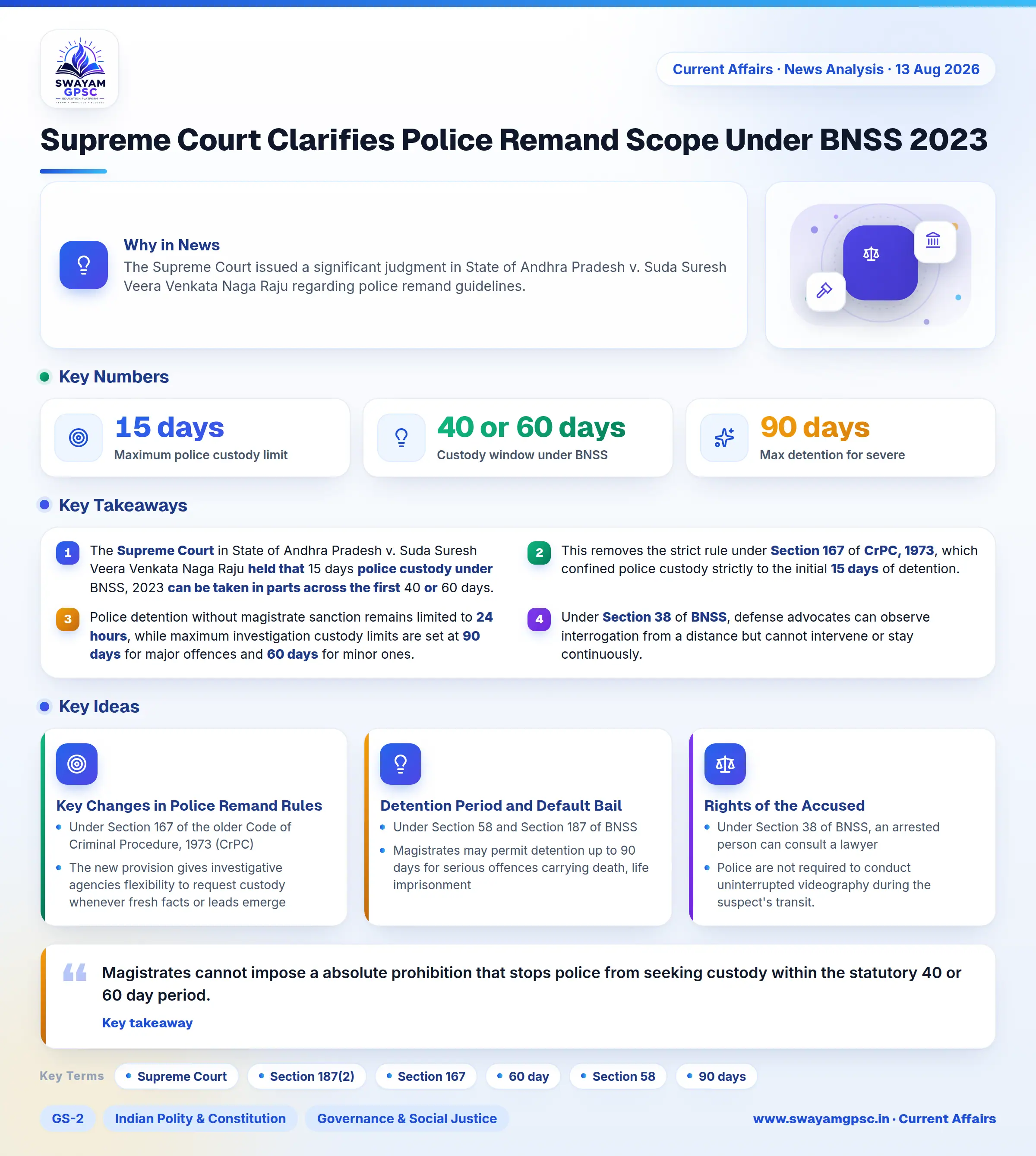
Supreme Court Clarifies Police Remand Scope Under BNSS 2023
#GS-2 #Indian Polity & Constitution #Governance & Social Justice #Current Events #BNSS #Supreme Court #Criminal Justice Reform
Key takeaways
- The Supreme Court in State of Andhra Pradesh v. Suda Suresh Veera Venkata Naga Raju held that 15 days police custody under BNSS, 2023 can be taken in parts across the first 40 or 60 days.
- This removes the strict rule under Section 167 of CrPC, 1973, which confined police custody strictly to the initial 15 days of detention.
- Police detention without magistrate sanction remains limited to 24 hours, while maximum investigation custody limits are set at 90 days for major offences and 60 days for minor ones.
- Under Section 38 of BNSS, defense advocates can observe interrogation from a distance but cannot intervene or stay continuously.
Why in News
- The Supreme Court issued a significant judgment in State of Andhra Pradesh v. Suda Suresh Veera Venkata Naga Raju regarding police remand guidelines.
- The Court clarified that Section 187(2) of the Bharatiya Nagarik Suraksha Sanhita, 2023 (BNSS) allows police custody in staggered parts up to 15 days during the initial 40 or 60 days window.
Key Changes in Police Remand Rules
- Under Section 167 of the older Code of Criminal Procedure, 1973 (CrPC), police custody was strictly restricted to the first 15 days of arrest.
- The new provision gives investigative agencies flexibility to request custody whenever fresh facts or leads emerge later during investigation.
- Magistrates cannot impose a absolute prohibition that stops police from seeking custody within the statutory 40 or 60 day period.
Detention Period and Default Bail
- Under Section 58 and Section 187 of BNSS, police cannot keep an arrested suspect in custody beyond 24 hours without magistrate approval.
- Magistrates may permit detention up to 90 days for serious offences carrying death, life imprisonment, or prison sentences of 10 years or more.
- For all other lesser offences, the maximum permitted statutory detention period is set at 60 days.
- If police fail to complete investigation within these timeframes, the accused earns a statutory right to default bail.
Rights of the Accused and Interrogation Rules
- Under Section 38 of BNSS, an arrested person can consult a lawyer, but the advocate cannot remain continuously present throughout interrogation or interfere in proceedings.
- Police are not required to conduct uninterrupted videography during the suspect's transit.
- Audio-visual recording is compulsory only during actual interrogation sessions and physical recovery of evidence.