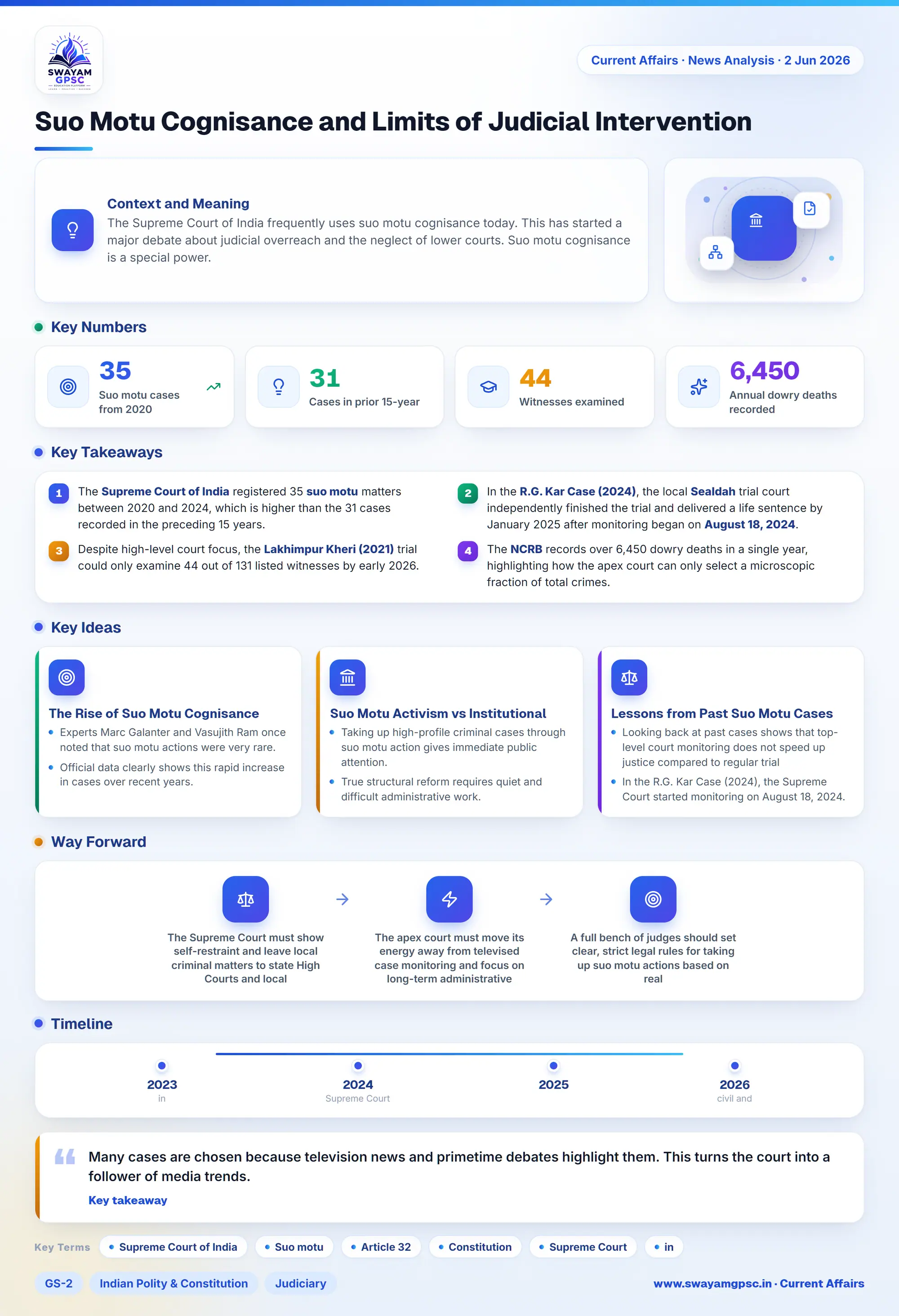
Suo Motu Cognisance and Limits of Judicial Intervention
#GS-2 #Indian Polity & Constitution #Judiciary #Governance & Social Justice #Good Governance #Current Events #National
Key takeaways
- The Supreme Court of India registered 35 suo motu matters between 2020 and 2024, which is higher than the 31 cases recorded in the preceding 15 years.
- In the R.G. Kar Case (2024), the local Sealdah trial court independently finished the trial and delivered a life sentence by January 2025 after monitoring began on August 18, 2024.
- Despite high-level court focus, the Lakhimpur Kheri (2021) trial could only examine 44 out of 131 listed witnesses by early 2026.
- The NCRB records over 6,450 dowry deaths in a single year, highlighting how the apex court can only select a microscopic fraction of total crimes.
Context and Meaning
- The Supreme Court of India frequently uses suo motu cognisance today. This has started a major debate about judicial overreach and the neglect of lower courts.
- Suo motu cognisance is a special power. It lets the Supreme Court and High Courts start legal cases on their own without any formal petition from a victim.
- This power comes from Public Interest Litigation and is supported by Article 32 and Article 142 of the Constitution. It acts as a safety valve to protect basic human rights.
- However, this power must follow the rule of separation of powers and respect the structure of the judicial system.
- The Constitution intended for these powers to solve big system-level problems. They should not be used to manage normal criminal cases running in local trial courts.
The Rise of Suo Motu Cognisance
- Experts Marc Galanter and Vasujith Ram once noted that suo motu actions were very rare. Now, they have become very common.
- Official data clearly shows this rapid increase in cases over recent years. Between 2020 and 2024, the Supreme Court started 35 suo motu matters.
- This number is higher than the 31 total cases registered in the entire 15-year period before that.
- Yearly numbers show steady growth. The court took up 10 cases in 2020, 8 in 2021, 1 in 2022, 4 in 2023, and 12 in 2024.
- This trend continued into 2025 with 10 civil and 3 criminal writs.
- By late May 2026, the apex court has already registered 4 civil and 4 criminal suo motu matters.
Suo Motu Activism vs Institutional Reform
- Taking up high-profile criminal cases through suo motu action gives immediate public attention. However, it only acts as a temporary bandage on deeper problems.
- True structural reform requires quiet and difficult administrative work. This includes working with High Courts under Article 235 to supervise lower courts.
- It also means helping state governments fix broken trial court buildings, filling empty judge seats, and modernizing training at the National Judicial Academy.
- Bypassing local legal systems sends a negative message. It wrongly suggests that lower courts cannot handle complex matters on their own.
Lessons from Past Suo Motu Cases
- Looking back at past cases shows that top-level court monitoring does not speed up justice compared to regular trial courts.
- In the R.G. Kar Case (2024), the Supreme Court started monitoring on August 18, 2024. Yet, the local Sealdah trial court finished the trial and gave a life sentence by January 2025.
- In the Lakhimpur Kheri (2021) case, despite heavy focus from the top court, trial delays remained. By early 2026, the court had only checked 44 out of 131 witnesses.
- The Manipur (2023) violence video case saw major court attention from July 2023, but it has not reached a final conviction yet.
- In the Hathras case from October 2020, the Supreme Court wisely sent the case back to the Allahabad High Court, respecting local judicial boundaries.
Challenges Associated with Suo Motu Cognisance
- Many cases are chosen because television news and primetime debates highlight them. This turns the court into a follower of media trends.
- Using strong presumptive titles before any formal trial hurts the neutral image of the court.
- The court has limited time and staff. Over 6,450 dowry deaths are recorded by the NCRB in a single year, but the court can only pick a tiny few to watch.
- Constant interference from the top court hurts the morale and authority of local magistrates and High Courts who are already doing their jobs.
Way Forward
- The Supreme Court must show self-restraint and leave local criminal matters to state High Courts and local magistrates unless the system completely breaks down.
- The apex court must move its energy away from televised case monitoring and focus on long-term administrative improvements.
- A full bench of judges should set clear, strict legal rules for taking up suo motu actions based on real systemic gravity rather than media pressure.
Conclusion
- Suo motu powers are important to fix system-wide failures. However, using them too much turns the top court into a media-driven office.
- Real justice comes from steady institutional reform, not from a few televised interventions that ignore lower courts.