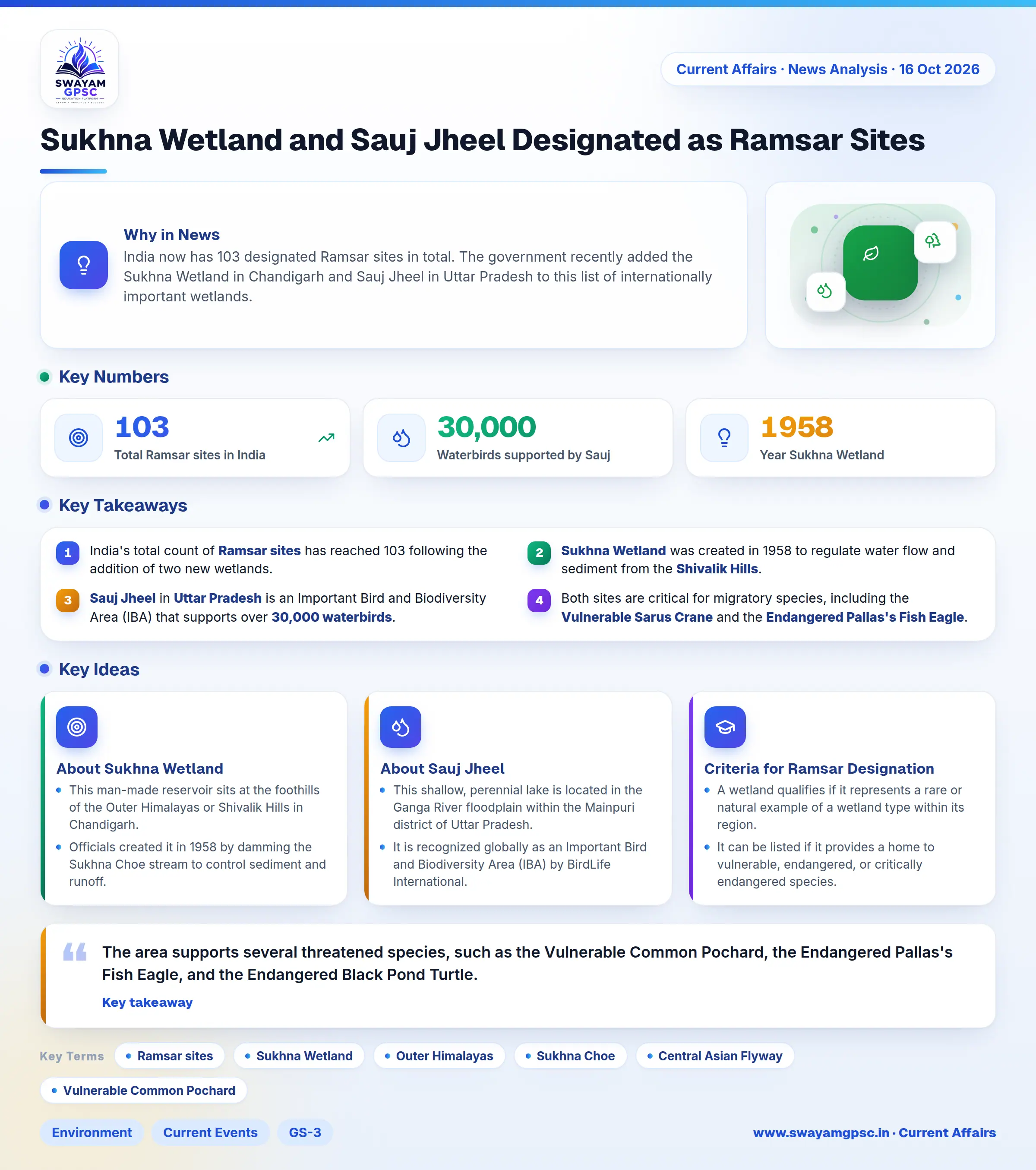
Sukhna Wetland and Sauj Jheel Designated as Ramsar Sites
#Environment #Current Events #GS-3 #Conservation #Biodiversity
Key takeaways
- India's total count of Ramsar sites has reached 103 following the addition of two new wetlands.
- Sukhna Wetland was created in 1958 to regulate water flow and sediment from the Shivalik Hills.
- Sauj Jheel in Uttar Pradesh is an Important Bird and Biodiversity Area (IBA) that supports over 30,000 waterbirds.
- Both sites are critical for migratory species, including the Vulnerable Sarus Crane and the Endangered Pallas's Fish Eagle.
Why in News
- India now has 103 designated Ramsar sites in total.
- The government recently added the Sukhna Wetland in Chandigarh and Sauj Jheel in Uttar Pradesh to this list of internationally important wetlands.
About Sukhna Wetland
- This man-made reservoir sits at the foothills of the Outer Himalayas or Shivalik Hills in Chandigarh.
- Officials created it in 1958 by damming the Sukhna Choe stream to control sediment and runoff.
- It acts as a crucial stopover for migratory birds using the Central Asian Flyway during winter.
- The area supports several threatened species, such as the Vulnerable Common Pochard, the Endangered Pallas's Fish Eagle, and the Endangered Black Pond Turtle.
- Conservation efforts here focus on managing soil erosion, reducing silt inflow from the catchment, and removing invasive aquatic plants.
About Sauj Jheel
- This shallow, perennial lake is located in the Ganga River floodplain within the Mainpuri district of Uttar Pradesh.
- It is recognized globally as an Important Bird and Biodiversity Area (IBA) by BirdLife International.
- The lake regularly hosts over 30,000 waterbirds, providing them with essential space for feeding and breeding.
- It serves as a habitat for vulnerable species like the Sarus Crane and the Greater Spotted Eagle.
- The site features rich vegetation including the Sacred Lotus and Wild Sugarcane.
- Management plans include banning fishing during breeding seasons, stopping the use of fine-mesh nets, and controlling cattle grazing near the water.
Criteria for Ramsar Designation
- A wetland qualifies if it represents a rare or natural example of a wetland type within its region.
- It can be listed if it provides a home to vulnerable, endangered, or critically endangered species.
- Designation is granted if a site supports significant biological diversity important for its biogeographic region.
- Sites that provide essential habitats for species during critical life cycles, such as breeding or migration, are eligible.
- A wetland qualifies if it consistently supports at least 20,000 waterbirds.
- It also qualifies if it hosts at least 1% of the population of a specific waterbird species.
- Wetlands supporting indigenous fish diversity or providing important spawning and migration habitats meet the criteria.
- Other sites are recognized for supporting large populations of various wetland-dependent animal species.