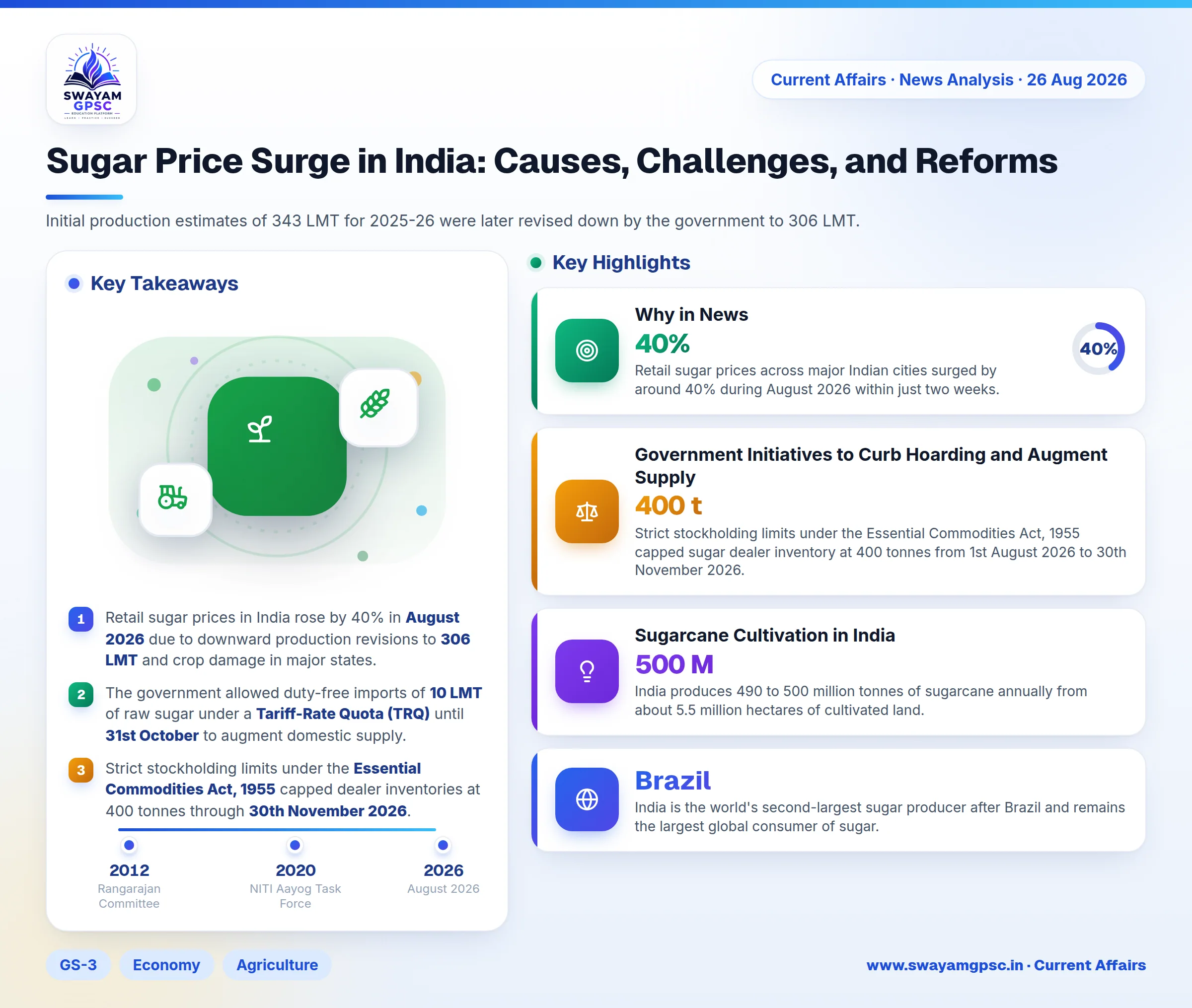
Sugar Price Surge in India: Causes, Challenges, and Reforms
#GS-3 #Economy #Agriculture #Food Security #Inflation #GS-2 #Current Events #National #Agricultural Pricing #Buffer Stocks & Food Security
Key takeaways
- Retail sugar prices in India rose by 40% in August 2026 due to downward production revisions to 306 LMT and crop damage in major states.
- The government allowed duty-free imports of 10 LMT of raw sugar under a Tariff-Rate Quota (TRQ) until 31st October to augment domestic supply.
- Strict stockholding limits under the Essential Commodities Act, 1955 capped dealer inventories at 400 tonnes through 30th November 2026.
- Global sugar supply deficit is projected at 33 LMT for 2026-27, pushing international prices up to USD 552 per tonne in August 2026.
- Structural reforms recommended by the Rangarajan Committee and NITI Aayog Task Force emphasize revenue sharing, micro-irrigation, and multi-feedstock bio-refineries.
Why in News
- Retail sugar prices across major Indian cities surged by around 40% during August 2026 within just two weeks.
- This price surge was unexpected because India entered the 2025-26 sugar season expecting a comfortable surplus and had permitted initial exports.
- Successive reductions in production estimates, crop damage, festive demand, and market tightness rapidly changed the domestic supply outlook.
Status of Sugar Production in India
- India is the world's second-largest sugar producer after Brazil and remains the largest global consumer of sugar.
- India normally produces 320 to 340 LMT of sugar annually against a domestic consumption requirement of 280 to 290 LMT.
- Initial production estimates of 343 LMT for 2025-26 were later revised down by the government to 306 LMT.
- The government maintains that adequate stocks remain available to fulfill domestic demand until the new crushing season begins in October.
- The All India Sugar Trade Association (AISTA) lowered its net production estimate to around 28.3 MT.
- The initial expectation of a comfortable surplus has gradually shifted toward a tighter domestic supply situation.
Factors Leading to Sugar Price Surge
- Excessive rainfall in Maharashtra, along with Red Rot and Top Borer diseases, damaged sugarcane crops and reduced sugar recovery.
- Festive demand increased significantly ahead of Onam and Raksha Bandhan, driving up sugar consumption for sweets and confectionery.
- Lower carry-over stocks and previous exports of 8 LMT tightened domestic availability ahead of the October crushing period.
- Hoarding and speculative buying by mills, traders, and bulk buyers restricted immediate market availability and pushed prices higher.
- Global sugar supplies tightened with a projected 33 LMT deficit for 2026-27, raising international prices from USD 474 per tonne in June to USD 552 per tonne in August 2026.
- Sugarcane diversion for ethanol was 3 MT in 2025-26, which was lower than expected, showing that ethanol was not the main cause of the surge.
Government Initiatives to Curb Hoarding and Augment Supply
- The government allowed duty-free import of up to 10 LMT of raw sugar under a Tariff-Rate Quota (TRQ) until 31st October.
- Strict stockholding limits under the Essential Commodities Act, 1955 capped sugar dealer inventory at 400 tonnes from 1st August 2026 to 30th November 2026.
- Bulk consumers are prohibited from holding sugar stocks exceeding 15 days of their consumption starting from 1st September 2026.
- State governments and mill associations were urged to start early crushing operations to replenish retail channels before Diwali.
- Joint central and state government teams conducted physical verifications of sugar stocks at mills to check artificial scarcity.
Structural Issues in India's Sugar Sector
- Disparity between the central Fair and Remunerative Price (FRP) and state State Advised Prices (SAP) increases mill costs and causes cane payment arrears.
- Cultivation in semi-arid states like Maharashtra and Karnataka relies heavily on irrigation, leading to severe groundwater depletion.
- Continuous monoculture of sugarcane degrades soil fertility, increases salinisation, and raises overall cultivation costs for farmers.
- Small mill sizes and outdated machinery cause processing inefficiencies, lower recovery rates, and reduced global competitiveness.
- Export support measures have faced scrutiny under WTO rules, exposing India to international trade disputes.
- Diverting sugarcane for the Ethanol Blended Petrol (EBP) Programme supports mill revenues but can reduce sugar availability during low-production years.
Sugarcane Cultivation in India
- India produces 490 to 500 million tonnes of sugarcane annually from about 5.5 million hectares of cultivated land.
- Sugarcane requires temperatures between 20 and 30 degrees Celsius, 75 to 150 cm of rainfall, and a cool ripening period.
- Northern India follows Autumn planting in October and November and Spring planting in February and March.
- Southern India follows Adsali planting in July and August lasting 15 to 18 months, and Eksali planting in January and February.
- Cultivation involves practices like deep ploughing, disease-free setts, tissue culture, trench methods, drip irrigation, and harvesting after 10 to 18 months.
- Uttar Pradesh is the top producer, followed by Maharashtra, Karnataka, Tamil Nadu, and Gujarat.
Way Forward
- Implement the Rangarajan Committee (2012) recommendations to link sugarcane prices with sugar market realisations and ease distance rules.
- Adopt the NITI Aayog Task Force (2020) recommendations to promote crop diversification and transform sugar mills into integrated bio-refineries.
- Promote drip and subsurface micro-irrigation in water-stressed regions to improve water use efficiency.
- Encourage sugarcane farming in agro-climatically suitable and water-abundant regions while shifting water-intensive farming away from stressed areas.
- Develop multi-feedstock bio-refineries capable of using molasses, surplus maize, and agricultural waste.
- Establish a predictable, formula-based trade mechanism to replace sudden export bans and duty adjustments.
- Promote drought-resistant crop varieties, soil health management, and crop rotation to lower the ecological footprint.
- Maintain policy stability regarding sugar pricing, ethanol diversion, exports, and stock limits to ensure certainty for all stakeholders.
Conclusion
- India's sugar sector must transition from short-term price intervention measures to comprehensive long-term structural reforms.
- Balancing farmer incomes, consumer affordability, food security, and biofuel goals through predictable policies will create a resilient sugar economy.