Subsea Cable Infrastructure and India's Emerging Digital Gateways
#GS-3 #Science & Technology #ICT #Infrastructure #Subsea Cables #Visakhapatnam
Key takeaways
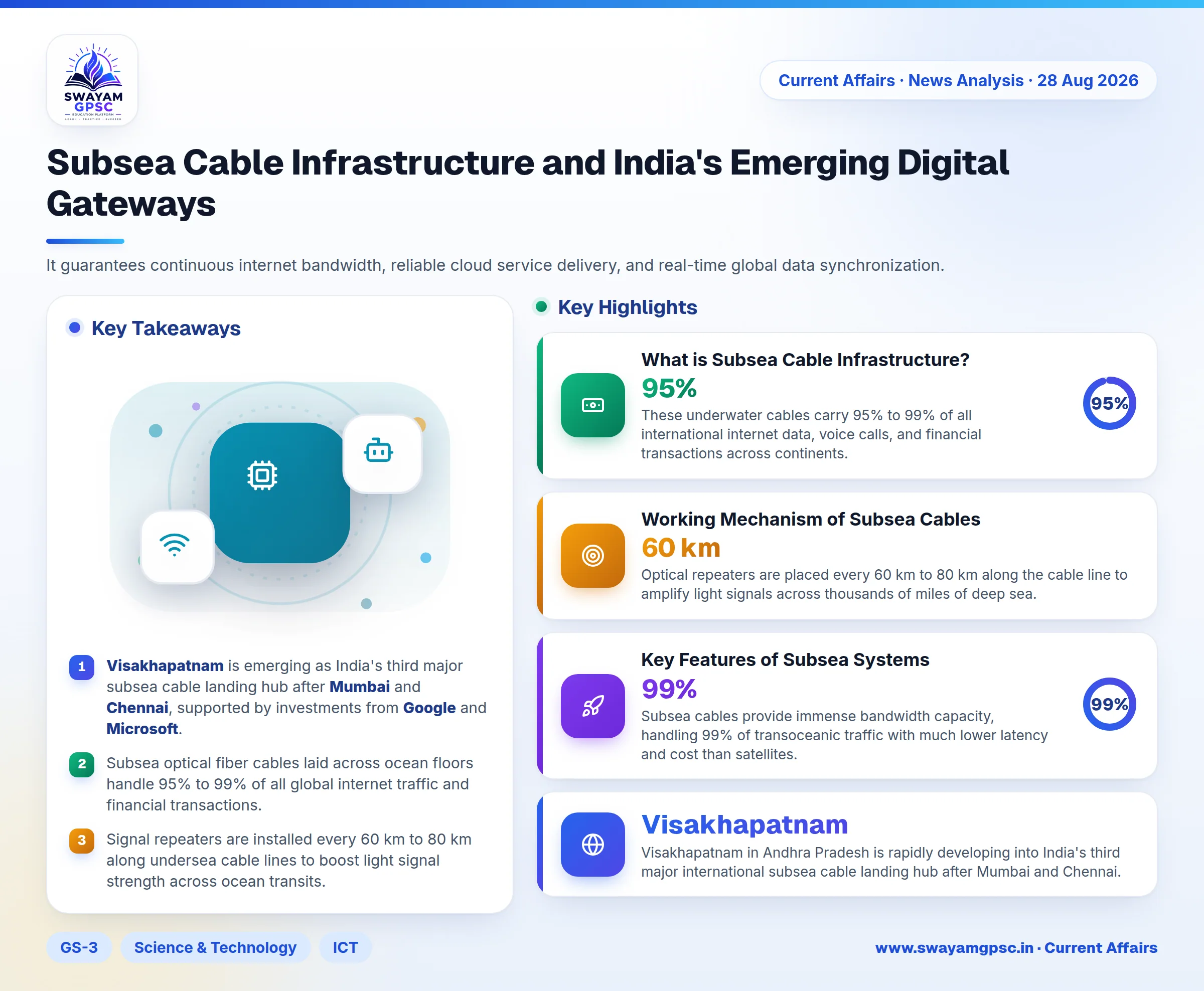
- Visakhapatnam is emerging as India's third major subsea cable landing hub after Mumbai and Chennai, supported by investments from Google and Microsoft.
- Subsea optical fiber cables laid across ocean floors handle 95% to 99% of all global internet traffic and financial transactions.
- Signal repeaters are installed every 60 km to 80 km along undersea cable lines to boost light signal strength across ocean transits.
- Subsea cable networks carry 99% of transoceanic traffic with much lower latency and cheaper costs compared to satellite communications.
Why in News
- Visakhapatnam in Andhra Pradesh is rapidly developing into India's third major international subsea cable landing hub after Mumbai and Chennai.
- This growth is mainly driven by massive investments in artificial intelligence data centers by tech companies like Google and Microsoft.
What is Subsea Cable Infrastructure?
- Subsea cable infrastructure consists of massive networks of fiber-optic cables laid along ocean floors and coastal seabeds.
- These underwater cables carry 95% to 99% of all international internet data, voice calls, and financial transactions across continents.
Primary Objectives
- The main objective is to provide high-capacity, low-latency, and cost-effective digital connectivity across international boundaries.
- It guarantees continuous internet bandwidth, reliable cloud service delivery, and real-time global data synchronization.
Major Indian Subsea Landing Hubs
- Mumbai in Maharashtra operates as the primary western gateway connecting India to the Middle East, Europe, and Africa.
- Chennai in Tamil Nadu serves as the main eastern gateway linking India to Southeast Asia and East Asia.
- Visakhapatnam in Andhra Pradesh is emerging as the third gateway, directly linking India's east coast to Southeast Asia, Australia, the US, and domestic industrial hubs.
Working Mechanism of Subsea Cables
- Land terminal stations use lasers to turn digital binary data into high-frequency light pulses, sending them through hair-thin glass optical fibers using total internal reflection.
- Optical repeaters are placed every 60 km to 80 km along the cable line to amplify light signals across thousands of miles of deep sea.
- When cables reach land, they enter a specialized facility called a Cable Landing Station (CLS).
- The CLS decodes and amplifies the optical signals, then routes them directly into national fiber networks, cloud regions, and data center clusters.
Key Features of Subsea Systems
- Subsea cables provide immense bandwidth capacity, handling 99% of transoceanic traffic with much lower latency and cost than satellites.
- Cables near shore receive heavy armoring made of steel wire, tarred nylon, aluminum barriers, and polyethylene sheaths to prevent physical damage.
- Big cloud and AI technology companies are now directly funding and owning these cables instead of relying only on traditional telecom groups.
- Network resilience is maintained by spreading data traffic across multiple physical routes so internet service remains active if a cable breaks.
Key Applications
- These cables form the core physical structure for public websites, video streaming, inter-datacenter backups, and global cloud computing.
- They facilitate real-time cross-border data transfer required for high-performance AI processing and regional enterprise tasks.
- They support high-frequency financial trading by offering ultra-low latency for foreign exchange trades and global stock market transactions.
- They offer secure channels for encrypted government communications, diplomatic messages, and international defense intelligence.