Strengthening India's Manufacturing Ecosystem: Key Sectoral Reforms and Growth Drivers
#GS-2 #GS-3 #Economy #Growth #Infrastructure #Employment #Government Policies & Interventions #Current Events #National
Key takeaways
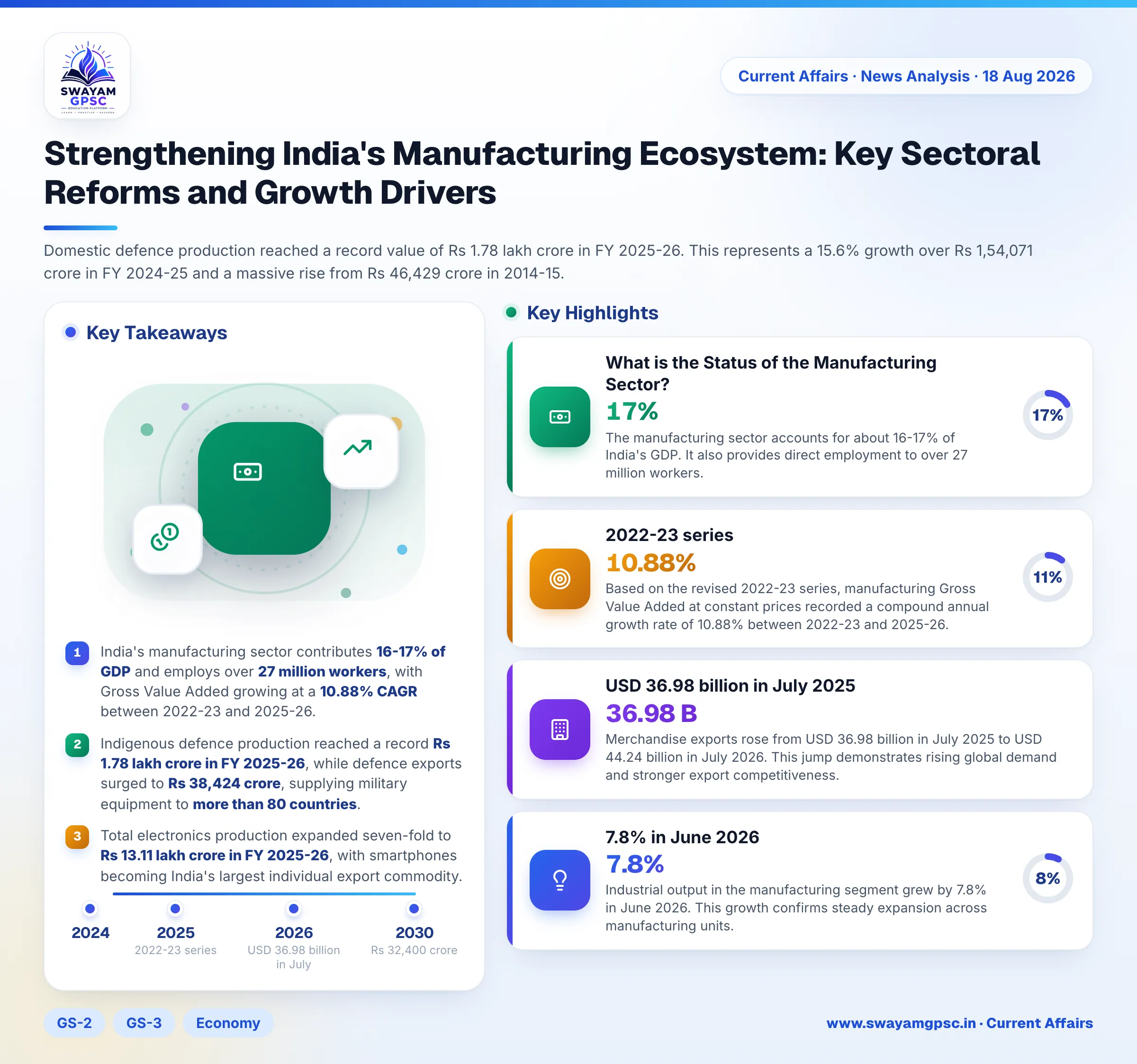
- India's manufacturing sector contributes 16-17% of GDP and employs over 27 million workers, with Gross Value Added growing at a 10.88% CAGR between 2022-23 and 2025-26.
- Indigenous defence production reached a record Rs 1.78 lakh crore in FY 2025-26, while defence exports surged to Rs 38,424 crore, supplying military equipment to more than 80 countries.
- Total electronics production expanded seven-fold to Rs 13.11 lakh crore in FY 2025-26, with smartphones becoming India's largest individual export commodity.
- Under the semiconductor initiative, 12 manufacturing units involving investments over Rs 1.64 lakh crore have been approved, supported by the Rs 1.275 lakh crore Semicon 2.0 programme.
- In the maritime and clean energy sectors, a Rs 69,725 crore package targets 4.5 million GT shipbuilding capacity, while solar module manufacturing capacity reached 172 GW by March 2026.
Why in News
- As India marks its 80th Independence Day, the government showcased major progress in the domestic manufacturing sector. This progress plays a vital role in building a self-reliant, globally competitive, and future-ready economy.
What is the Status of the Manufacturing Sector?
- Over the past 12 years, policy reforms under the Make in India initiative have built a strong domestic manufacturing base. This ongoing transformation has gradually turned India into an emerging global production hub.
- The country now produces defence equipment, textiles, pharmaceuticals, medical devices, and heavy machinery. These goods meet international quality standards for both domestic consumption and export markets.
- The manufacturing sector accounts for about 16-17% of India's GDP. It also provides direct employment to over 27 million workers.
- Based on the revised 2022-23 series, manufacturing Gross Value Added at constant prices recorded a compound annual growth rate of 10.88% between 2022-23 and 2025-26.
- Merchandise exports rose from USD 36.98 billion in July 2025 to USD 44.24 billion in July 2026. This jump demonstrates rising global demand and stronger export competitiveness.
- Industrial output in the manufacturing segment grew by 7.8% in June 2026. This growth confirms steady expansion across manufacturing units.
- Key government schemes support this growth, including the Production Linked Incentive Scheme, PM GatiShakti, National Logistics Policy, BHAVYA, and dedicated programs for electronics and MSMEs.
India's Defence Transformation
- Domestic defence production reached a record value of Rs 1.78 lakh crore in FY 2025-26. This represents a 15.6% growth over Rs 1,54,071 crore in FY 2024-25 and a massive rise from Rs 46,429 crore in 2014-15.
- Annual defence exports grew from Rs 686 crore in 2013-14 to Rs 38,424 crore in 2025-26. This growth reflects India's expanding role in global defence supply chains.
- Indian defence items reach more than 80 countries. Total defence exports have surged by over 5,500% during the past 12 years.
- Public sector undertakings generated 76% of total defence production in FY 2025-26. Meanwhile, private sector participation increased to 24%.
- By May 2026, the government released 10 Positive Indigenisation Lists covering 5,521 items. These lists prohibit imports of specific military items to boost local production.
- The government created the Srijan Defence Equipment Empowerment Platform (DEEP) to list local military sourcing options. By May 2026, the digital portal cataloged over 41,000 vendors and 2.7 lakh products.
India's Electronics Manufacturing Boost
- Total electronics output expanded from Rs 1.9 lakh crore in 2014-15 to Rs 13.11 lakh crore in 2025-26. This represents a seven-fold growth, rising 15.8% from Rs 11.32 lakh crore in FY 2024-25.
- Overseas shipments of electronic goods increased from Rs 38,000 crore in 2014-15 to Rs 4.24 lakh crore in 2025-26. This performance represents an 11-fold increase.
- Targeted policies like the National Policy on Electronics, SPECS, EMC 2.0, PLI Scheme, and Electronics Components Manufacturing Scheme (ECMS) have improved national industry competitiveness.
- Mobile handset production expanded from Rs 18,000 crore in 2014-15 to Rs 6.27 lakh crore in 2025-26.
- Export sales of mobile phones surged from Rs 1,500 crore to Rs 2.59 lakh crore over the same timeframe.
Semicon Manufacturing
- The government launched the Semicon India Programme 1.0 in December 2021 with a budget of Rs 76,000 crore to develop chip manufacturing.
- Ministers approved Semicon 2.0 in July 2026 with an outlay of Rs 1.275 lakh crore to expand the domestic semiconductor ecosystem.
- By July 2026, authorities approved 12 semiconductor manufacturing units involving a total investment of Rs 1.64 lakh crore.
- Companies like Micron, Kaynes, and CG Semi have already started commercial production, while another factory expects to begin operations within 2026.
- The approved facilities include one silicon fab, one silicon-carbide fab, one Gallium Nitride Micro-LED display fab, and nine packaging units.
Mobile Phone Manufacturing
- Domestically manufactured handsets now make up 99.2% of all mobile phones used in India. This change drastically lowers import reliance.
- India has become the world's second-largest mobile phone manufacturer by volume.
- The nation transformed from a net importer into a net exporter of mobile phones after 2014.
- The PLI Scheme for Large Scale Electronics Manufacturing (LSEM) attracted Rs 96,000 crore in total investments across the supply chain.
- Local value addition in mobile production reached 23% in FY 2023-24 alongside rapid production growth.
- Smartphones emerged as India's largest individual export commodity in FY 2025-26, surpassing petroleum products and gems and jewellery.
- On 15th July 2026, the government approved the Mobile Phone Manufacturing Scheme, 2026 with an outlay of Rs 62,500 crore.
- Operating from FY 2026-27 to FY 2030-31, the scheme offers incentives ranging between 2.25% and 5%. It provides extra support for local sourcing, Indian brands, product design, and R&D.
India's Pharma Manufacturing Edge
- India ranks 3rd globally by volume and 11th by value in pharmaceutical output. It supplies 20% of all global generic medicines and a large share of vaccines.
- Total revenue for the pharmaceutical sector reached Rs 4.72 lakh crore in 2024-25.
- Three PLI schemes in pharmaceuticals and medical devices carry a combined outlay of Rs 25,360 crore and have attracted over Rs 51,997 crore in investments.
- These PLI schemes produced cumulative sales of Rs 3.88 lakh crore, including export sales worth Rs 2.43 lakh crore.
- Factories can now produce 218 Active Pharmaceutical Ingredients (APIs), Key Starting Materials, and drug intermediates locally.
- Domestic manufacturing capacity exists for 57 medical devices, including CT scanners, MRI machines, ultrasound units, and critical implants.
- Medical device exports increased from Rs 26,915 crore in 2019-20 to Rs 42,360 crore in 2024-25.
- Domestic production of medical devices expanded from Rs 28,000 crore in 2019-20 to Rs 41,500 crore in 2024-25.
- Approved in 2020, the Scheme for Promotion of Bulk Drug Parks builds common infrastructure. Three parks were approved in Andhra Pradesh, Gujarat, and Himachal Pradesh during FY 2022-23.
- The Union Budget 2026-27 launched Biopharma SHAKTI with a Rs 10,000 crore outlay over five years to advance biopharmaceutical research and production.
Textiles and Apparel on the Rise
- The textile and apparel sector acts as the 2nd-largest employer after agriculture, offering work to over 45 million people.
- India possesses strong structural advantages, including an abundant raw material supply and complete manufacturing integration across the value chain.
- The nation ranks among the largest cotton producers and stands as the largest exporter of cotton yarn worldwide.
- Textiles contribute 2% to national GDP, 11% to manufacturing GVA, and 9% of total merchandise exports.
- In FY 2024-25, India exported textile goods valued at USD 37.7 billion.
- India holds 4.1% of global textile exports, making it the sixth-largest exporter worldwide.
- The PLI Scheme for Textiles encourages investments and manufacturing in high-value textile segments.
- The PM MITRA Parks project builds integrated textile parks with modern infrastructure.
- The National Technical Textiles Mission funds research and development in technical fabrics.
- Programs like the Textiles Export Promotion Mission, National Fibre Mission, and Mission for Cotton Productivity enhance raw material supply and export capacity.
India's Maritime Manufacturing Push
- In September 2025, the government announced a Rs 69,725 crore package to upgrade shipbuilding, financing, and maritime skills.
- The Shipbuilding Development Scheme (SbDS) carries an outlay of Rs 19,989 crore to expand annual capacity to 4.5 million Gross Tonnage (GT).
- Greenfield shipbuilding clusters receive 100% capital support for common infrastructure through a 50:50 Centre-State Special Purpose Vehicle.
- Existing shipyards receive 25% capital assistance to modernize dry docks, ship lifts, and automated production machinery.
- Authorities selected Andhra Pradesh, Gujarat, and Tamil Nadu for greenfield clusters while giving in-principle approval to three expansion projects.
- A Rs 25,000 crore Maritime Development Fund offers long-term financing for maritime projects.
- This includes a Rs 20,000 crore Maritime Investment Fund where the government holds 49% equity.
- A separate Rs 5,000 crore Interest Incentivisation Fund helps lower interest rates on shipyard loans.
- The Shipbuilding Financial Assistance Scheme received Rs 24,736 crore to address cost disadvantages, with updated guidelines released on 26th December 2025.
- Announced in the Union Budget 2026-27, the Container Manufacturing Assistance Scheme (CMAS) allocates Rs 10,000 crore over five years for container production.
- CMAS targets an annual container output of 7.5 lakh TEUs, which is 10 times current capacity.
- In July 2026, India built its first domestic EXIM shipping container for A.P. Moller-Maersk at the Dadri Inland Container Depot in Uttar Pradesh.
Automobiles: Manufacturing Strength
- India represents the world's largest market for two-wheelers and three-wheelers and ranks third globally for passenger and commercial vehicles.
- The automotive sector provides direct and indirect jobs to over 30 million people across the country.
- Vehicle production grew from 22.65 million units in FY 2020-21 to 31.03 million units in FY 2024-25, rising 33% between FY 2014-15 and FY 2024-25.
- Approved in September 2021 with a Rs 25,938 crore outlay, the PLI Scheme for Automobile and Auto Components encourages advanced vehicle technology.
- By March 2026, this automotive PLI scheme secured Rs 44,326 crore in investments and generated 67,820 jobs.
- Launched in September 2024 with an outlay of Rs 10,900 crore, the PM E-DRIVE Scheme accelerates electric vehicle adoption across two-wheelers, three-wheelers, trucks, buses, and ambulances.
- The scheme provides incentive support for about 28.30 lakh electric vehicles.
- Out of Rs 4,391 crore set aside for 14,028 electric buses, authorities have already deployed nearly 14,000 e-buses.
- The scheme allocated Rs 2,000 crore to build public charging stations across India.
India's Solar PV Manufacturing
- India's domestic solar photovoltaic market holds a value of Rs 32,400 crore and anticipates rapid expansion through 2030.
- Industry estimates project the solar PV market to grow at a compound annual rate of 17-20% between FY 2022-23 and FY 2029-30.
- Approved solar module capacity under the ALMM list reached 100 GW in August 2025, up from 2.3 GW in 2014, and hit 172 GW by 31st March 2026.
- Domestic solar cell manufacturing capacity expanded from under 1.2 GW in 2014 to 25 GW by March 2025.
- The PLI Scheme for High-Efficiency Solar PV Modules features a total outlay of Rs 24,000 crore across two tranches and awarded 48 GW of manufacturing capacity.
- Overseas sales of solar PV equipment in FY 2024-25 were 8 times higher than levels recorded in FY 2017-18.
Conclusion
- Strong output growth in defence, electronics, chips, medicine, textiles, shipping, automobiles, and solar energy shows that Make in India is delivering concrete industrial results.
- Continued policy reforms, private investment, logistics integration, and skill development will position manufacturing as a central driver of Atmanirbhar Bharat and Viksit Bharat.