Strengthening India's Gig Economy and Protecting Worker Rights
#GS-3 #Economy #Employment #Infrastructure #GS-2 #Governance & Social Justice #Good Governance #Social Justice #Current Events #National
Key takeaways
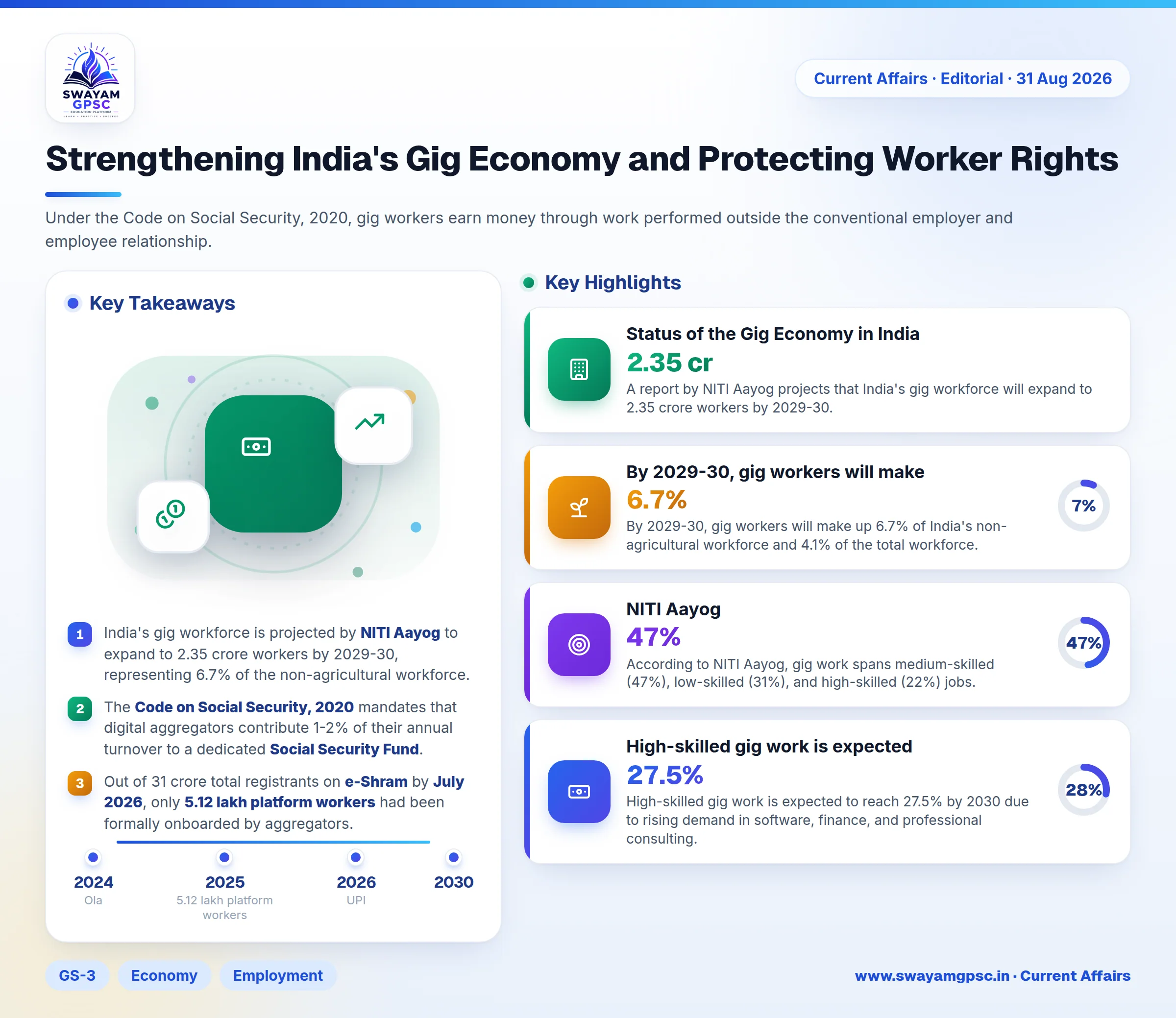
- India's gig workforce is projected by NITI Aayog to expand to 2.35 crore workers by 2029-30, representing 6.7% of the non-agricultural workforce.
- The Code on Social Security, 2020 mandates that digital aggregators contribute 1-2% of their annual turnover to a dedicated Social Security Fund.
- Out of 31 crore total registrants on e-Shram by July 2026, only 5.12 lakh platform workers had been formally onboarded by aggregators.
- The International Labour Organization adopted the Decent Work in the Platform Economy Convention, 2026 (No. 193) to regulate algorithmic control and safeguard worker rights globally.
- Key policy recommendations include establishing a net earnings floor, creating a portable Social Security Wallet, and launching a Gig Worker Passport.
Why in News
- Millions of app-based gig workers in India face severe job insecurity, opaque algorithmic control, and arbitrary account suspensions.
- The Code on Social Security, 2020 offers a foundational framework, but urgent legal reforms are needed to ensure fair pay and worker safety.
What is the Gig Economy?
- The gig economy is a flexible labour market where individuals perform short-term, task-based work instead of holding permanent traditional jobs.
- Under the Code on Social Security, 2020, gig workers earn money through work performed outside the conventional employer and employee relationship.
- Gig work is a broad term covering independent contractors such as freelance writers, tutors, and technicians.
- Platform workers represent a specific subcategory of gig workers who get work through digital applications like Uber, Ola, Swiggy, and Zomato.
- All platform workers fall under the category of gig workers, but not all gig workers are platform workers.
Key Features of the Gig Economy
- Platforms pay workers for completing specific tasks, rides, or deliveries rather than providing a fixed monthly salary.
- Workers enjoy flexible working schedules, though platform algorithms and financial incentives heavily shape their daily choices.
- Individuals can work across multiple digital platforms simultaneously, such as taking rides on both Ola and Uber.
- Digital platforms use mobile applications to connect customers with service providers, fix prices, assign tasks, and handle payments.
- Automated algorithms manage workers through ratings, incentives, performance penalties, and automated account deactivations.
- Workers provide their own vehicles, mobile phones, fuel, and maintenance, which transfers major operating costs from companies to workers.
Status of the Gig Economy in India
- A report by NITI Aayog projects that India's gig workforce will expand to 2.35 crore workers by 2029-30.
- By 2029-30, gig workers will make up 6.7% of India's non-agricultural workforce and 4.1% of the total workforce.
- According to NITI Aayog, gig work spans medium-skilled (47%), low-skilled (31%), and high-skilled (22%) jobs.
- High-skilled gig work is expected to reach 27.5% by 2030 due to rising demand in software, finance, and professional consulting.
- Gig work has expanded rapidly into e-commerce logistics, home services, ed-tech, and online healthcare.
- The Code on Social Security, 2020 formally recognised gig workers, requiring aggregators to contribute 1-2% of annual turnover to a Social Security Fund.
- By December 2025, aggregators had onboarded about 5.12 lakh platform workers onto the e-Shram portal across 12 major platforms.
- States like Rajasthan enacted the Rajasthan Platform-Based Gig Workers Act, 2023, while Bihar (2025 Act) and Karnataka created dedicated welfare boards.
Significance of the Gig Economy for India
- Gig work creates vital employment opportunities, helping meet the Economic Survey target of generating 78.5 lakh non-farm jobs annually until 2030.
- Flexible working hours encourage female economic participation, with women accounting for 28% of the gig workforce in digital sectors.
- The sector accelerates digital economy growth by using digital payments like UPI, which processed 23 billion transactions worth ₹30 lakh crore in July 2026.
- Delivery partners support e-commerce firms like Amazon and Blinkit by enabling fast last-mile logistics across urban centers.
- Small businesses benefit from affordable freelance services and logistics networks like ONDC, which operates across 700 districts.
- Platform models encourage entrepreneurship by enabling vehicle owners and skilled professionals to generate direct income.
- The gig economy has driven India to build portable social security frameworks using Universal Account Numbers and e-Shram registration.
Challenges Associated with the Gig Economy
- Fluctuating task-based pay and high platform commissions leave workers without guaranteed living wages, as shown by zero scores for Ola and Uber in Fairwork India Ratings 2024.
- Workers spend significant unpaid time waiting for tasks, averaging 9 hours per week according to European Commission data, while bearing all operational expenses.
- Social security coverage remains narrow, with only 5.12 lakh platform workers registered on e-Shram out of 31 crore total registrants by July 2026.
- Opaque automated algorithms lock or suspend worker accounts without clear explanations or accessible human grievance redressal.
- Heavy workload and incentive pressure create health risks, with NITI Aayog data showing 27% of gig workers suffer workplace accidents without paid sick leave.
- Female gig workers face digital access gaps, physical safety concerns, and unpaid domestic duties, concentrating them in lower-paying tasks.
- Platforms classify workers as independent contractors to avoid legal obligations regarding minimum wages, working hour limits, and health benefits.
International Best Practices
- The EU Platform Work Directive mandates human supervision over algorithmic management decisions to prevent arbitrary automated treatment.
- In the landmark Uber BV v. Aslam (2021) ruling, the UK Supreme Court classified drivers as workers entitled to minimum wage and paid annual leave.
- Spain introduced the Riders Law, which presumes delivery workers are regular employees when platforms exercise algorithmic management.
- Singapore passed the Platform Workers Act, 2024, establishing shared financial contributions between platforms and workers for injury protection and retirement funds.
ILO Convention No. 193
- The International Labour Conference adopted the Decent Work in the Platform Economy Convention, 2026 (No. 193) as the first international labor standard for platform work.
- The convention establishes binding rights regarding fair remuneration, reasonable working hours, occupational health, and collective bargaining.
- It treats algorithms as active tools of managerial authority over workers rather than neutral software technology.
Way Forward
- India should establish a net earnings floor for gig tasks that guarantees basic minimum pay after deducting operational expenses like fuel and maintenance.
- The government should create a digital Social Security Wallet linked to e-Shram, funded by automatic transaction micro-contributions across platforms.
- A dedicated Platform Work Regulatory Authority should conduct mandatory third-party audits of automated algorithms to prevent unfair task allocations.
- India should introduce a portable Gig Worker Passport that allows workers to transfer verified ratings and work history across different platforms.
- Platforms must implement an automatic Safe Mode during severe weather events to suspend rating penalties, provide hazard pay, and protect worker safety.
- State governments should promote worker-owned platform cooperatives like Kerala Savari to help drivers share platform profits.
- Platforms should place average weekly earnings in escrow before suspending any worker, compensating them if independent appeals find the suspension unjustified.
Conclusion
- India's gig economy provides vital employment flexibility but relies heavily on insecure, algorithmically controlled labour.
- Building a sustainable platform economy requires enforceable statutory rights, portable welfare safeguards, fair pay guarantees, and strict algorithmic transparency.