Geothermal Energy Development and Geological Mapping in India
#GS-3 #Science & Technology #Energy #Geography #Resources #Environment #Sustainable Development #Current Events #National #Geothermal Energy #Renewable Energy
Key takeaways
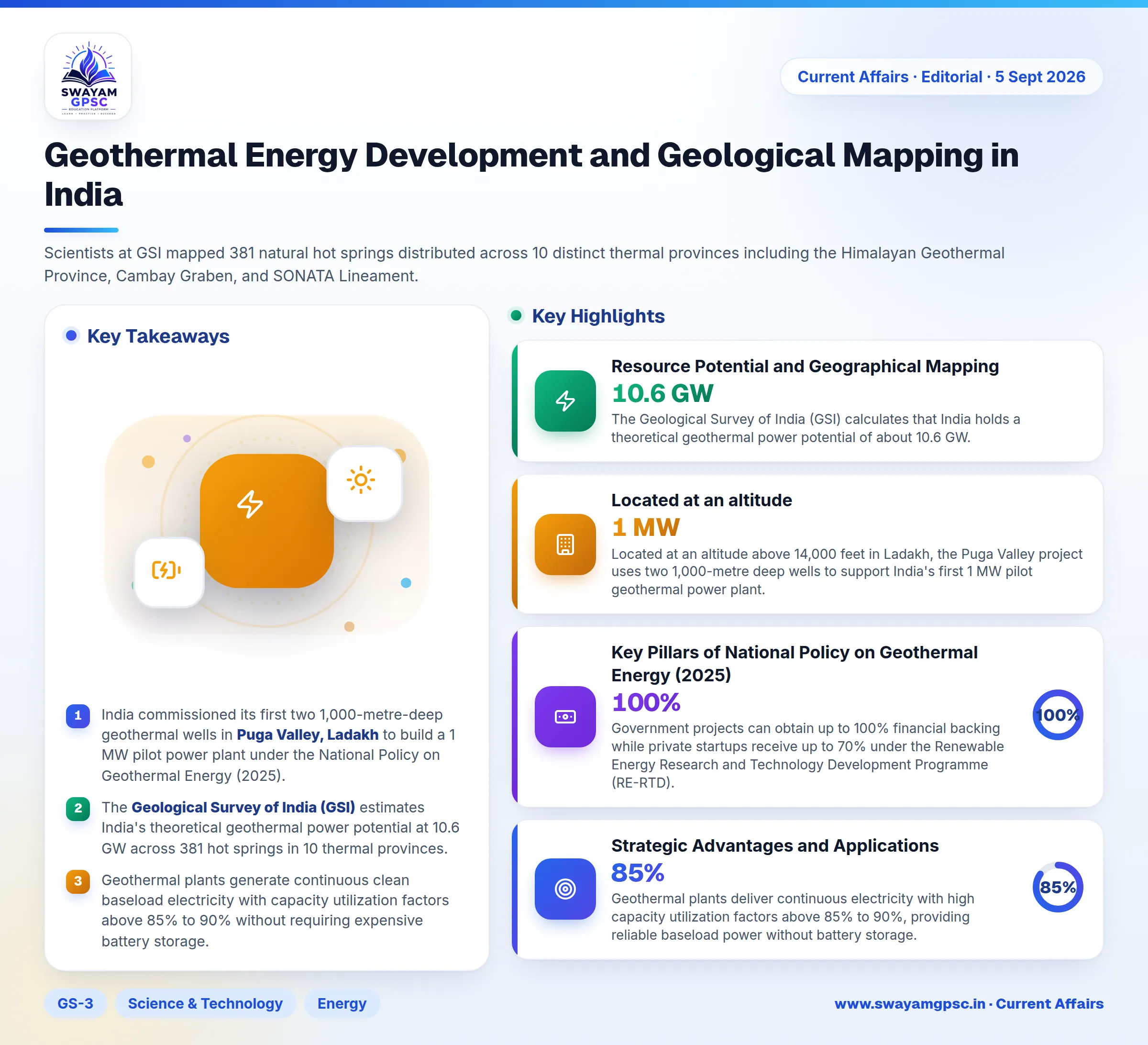
- India commissioned its first two 1,000-metre-deep geothermal wells in Puga Valley, Ladakh to build a 1 MW pilot power plant under the National Policy on Geothermal Energy (2025).
- The Geological Survey of India (GSI) estimates India's theoretical geothermal power potential at 10.6 GW across 381 hot springs in 10 thermal provinces.
- Geothermal plants generate continuous clean baseload electricity with capacity utilization factors above 85% to 90% without requiring expensive battery storage.
- The new policy offers up to 100% financial support for public research under the RE-RTD Scheme and allows exploration permits lasting 3 to 5 years.
Why in News
- India made major progress in renewable energy by commissioning its first two 1,000-metre-deep geothermal wells in Puga Valley, Ladakh under the National Policy on Geothermal Energy (2025).
Understanding Geothermal Energy and Its Origin
- Geothermal energy is a clean renewable heat source generated deep inside the Earth through the natural decay of radioactive isotopes like uranium, thorium, and potassium.
- In active geological areas like plate boundaries and crustal faults, subterranean fluids carry heat upward and trap high-temperature steam inside porous rock formations.
- Engineers drill into these reservoirs to bring steam to the surface, spin electricity turbines, and then pump cooled fluids back underground to preserve reservoir pressure.
Resource Potential and Geographical Mapping
- The Geological Survey of India (GSI) calculates that India holds a theoretical geothermal power potential of about 10.6 GW.
- Scientists at GSI mapped 381 natural hot springs distributed across 10 distinct thermal provinces including the Himalayan Geothermal Province, Cambay Graben, and SONATA Lineament.
- Located at an altitude above 14,000 feet in Ladakh, the Puga Valley project uses two 1,000-metre deep wells to support India's first 1 MW pilot geothermal power plant.
Status of Key Government Projects
- In Puga Valley, Ladakh, the ONGC Energy Centre and local administration commissioned production wells to construct a 1 MW pilot energy plant.
- In Ankleshwar, Gujarat, the Ministry of New and Renewable Energy (MNRE) leads a project to convert depleted oil and gas wells into geothermal heat sources.
- In Gandhinagar, Gujarat, an active solar-geothermal plant drilled three wells producing fluids at 70°C to 80°C to generate hybrid electricity.
- In Tawang, Arunachal Pradesh, field teams perform geochemical testing across 5 thermal spring sites to map high-altitude heat energy.
- In Hyderabad, Telangana, researchers are developing closed-loop cooling systems that use ground temperature to lower building air-conditioning electricity usage.
- Under the RE-RTD Scheme, national institutes build computer models for Borehole Heat Exchangers (BHE) to support ground-source heat pumps.
Key Pillars of National Policy on Geothermal Energy (2025)
- State and Union Territory governments can grant exploration permits for 3 to 5 years and long-term production leases up to 30 years.
- The policy sets clear standards to convert old, empty hydrocarbon wells into clean geothermal producers using existing drilling datasets from ONGC and OIL.
- Government projects can obtain up to 100% financial backing while private startups receive up to 70% under the Renewable Energy Research and Technology Development Programme (RE-RTD).
- The framework promotes advanced options like Enhanced Geothermal Systems (EGS), which fracture hot rocks underground to create artificial thermal fluid pathways.
- The government formed the National Geothermal Data Repository (NGDR) to combine heat maps and geological survey records from GSI, the Ministry of Mines, and the DGH.
Strategic Advantages and Applications
- Geothermal plants deliver continuous electricity with high capacity utilization factors above 85% to 90%, providing reliable baseload power without battery storage.
- Clean underground heat replaces polluting diesel generators in Himalayan border zones like Ladakh, Lahaul-Spiti, and Tawang.
- Thermal water between 30°C and 90°C provides direct heat for greenhouse farming, fruit drying, fish farming, building space heating, and eco-tourism.
- Geothermal water frequently carries dissolved critical minerals like lithium, cesium, rubidium, and boron that companies can extract under the Mines and Minerals (Development and Regulation) Act, 1957.
Challenges in Developing Geothermal Energy
- Deep exploratory drilling requires heavy upfront capital spending while carrying significant risk if workers fail to find active thermal reservoirs.
- High-altitude locations like Puga Valley sit above 14,000 feet, where freezing temperatures, thin air, and steep mountain passes hamper heavy machinery transport.
- Underground fluids carry dissolved silica, sulfur, and salts that cause rapid pipe corrosion and damage turbine components.
- Rock fracturing in Enhanced Geothermal Systems (EGS) carries small risks of triggering micro-earthquakes if operators manage subsurface pressure poorly.
- India lacks home-grown supply chains for specialized deep-well pumps and binary turbines, forcing developers to import key equipment.
Way Forward
- The government can lower private investment risk by offering Viability Gap Funding (VGF) grants and exploratory risk coverage modeled on success in Iceland.
- India should expand technical partnerships with advanced geothermal nations like Iceland, Australia, and Saudi Arabia to share deep drilling expertise.
- State regulators should mandate that state oil entities share existing underground temperature and seismic data publicly to prevent unnecessary survey costs.
- Cities should adapt local building codes to encourage ground-source heat pumps for centralized thermal management in commercial structures.
- Environmental agencies must enforce strict rules ensuring companies reinject all used fluids underground to safeguard local water tables and sustain reservoir pressure.
Conclusion
- Geothermal energy offers dependable continuous power to support India's target of 500 GW of non-fossil capacity and its Net Zero 2070 climate goal. Combining targeted subsidies, advanced directional drilling, and former oil well conversion will establish geothermal energy as a sturdy pillar of India's green grid.