26th SCO Summit 2026 Key Highlights and Strategic Significance for India
#GS-2 #Current Events #International #SCO #India and its Neighbourhood #Eurasia #CPEC #RATS #INSTC
Key takeaways
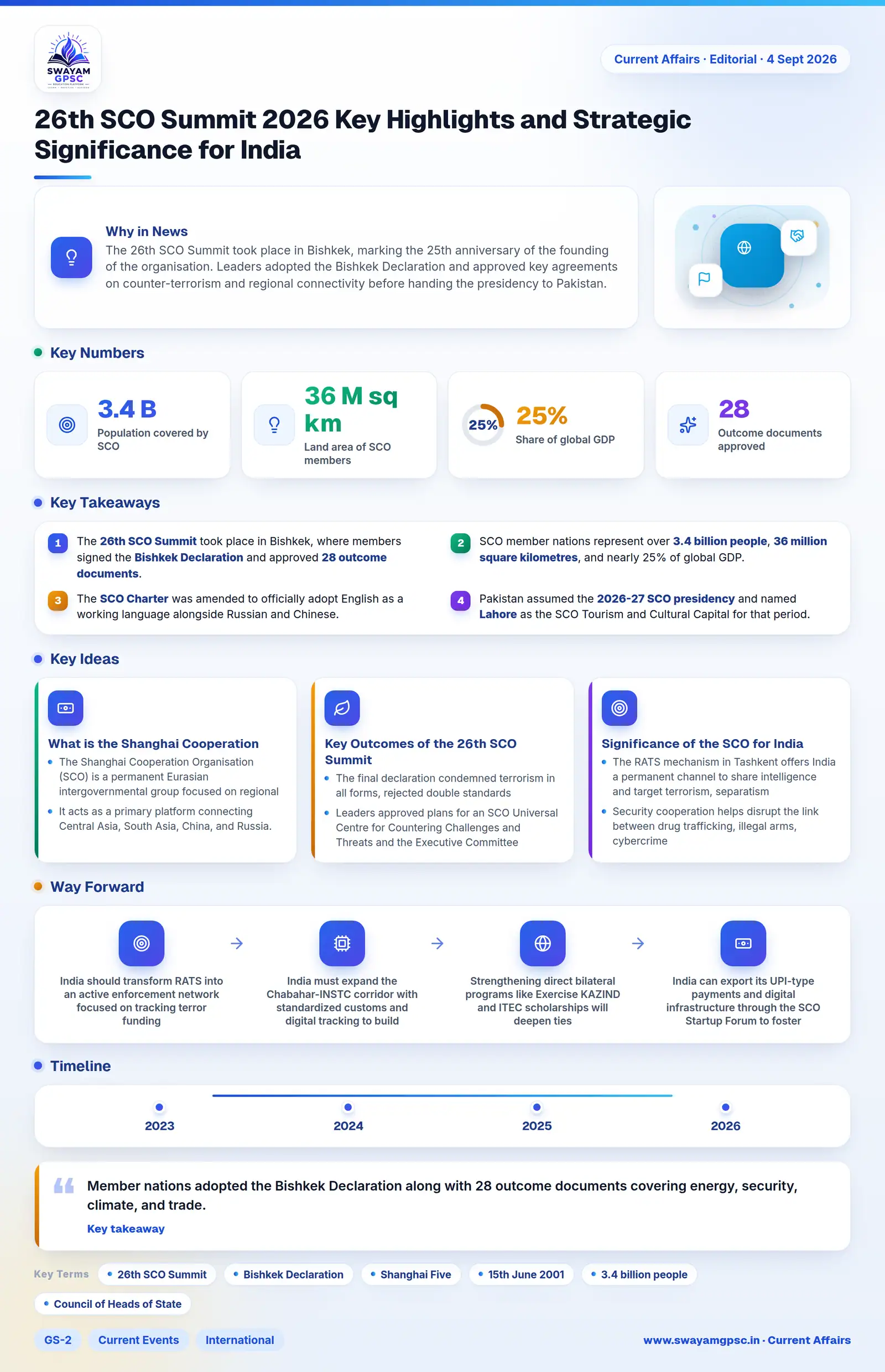
- The 26th SCO Summit took place in Bishkek, where members signed the Bishkek Declaration and approved 28 outcome documents.
- SCO member nations represent over 3.4 billion people, 36 million square kilometres, and nearly 25% of global GDP.
- The SCO Charter was amended to officially adopt English as a working language alongside Russian and Chinese.
- Pakistan assumed the 2026-27 SCO presidency and named Lahore as the SCO Tourism and Cultural Capital for that period.
- India continues to oppose the China-Pakistan Economic Corridor (CPEC) due to sovereignty violations, while expanding alternative routes like Chabahar Port.
Why in News
- The 26th SCO Summit took place in Bishkek, marking the 25th anniversary of the founding of the organisation.
- Leaders adopted the Bishkek Declaration and approved key agreements on counter-terrorism and regional connectivity before handing the presidency to Pakistan.
- For India, this platform presents both complex challenges and strategic opportunities while engaging with China, Russia, Pakistan, and Iran.
- The summit highlighted India's continuous effort to balance its Eurasian ties alongside strong partnerships with Western nations.
What is the Shanghai Cooperation Organisation?
- The Shanghai Cooperation Organisation (SCO) is a permanent Eurasian intergovernmental group focused on regional security, political stability, and trade.
- It acts as a primary platform connecting Central Asia, South Asia, China, and Russia.
- China, Russia, Kazakhstan, Kyrgyzstan, and Tajikistan originally created the Shanghai Five in 1996 to settle border disputes.
- The group officially became the SCO on 15th June 2001 after Uzbekistan joined, and the SCO Charter took effect in 2003.
- India and Pakistan obtained full membership in 2017, followed by Iran in 2023 and Belarus in 2024.
- Member countries represent over 3.4 billion people, cover 36 million square kilometres, and generate nearly 25% of global GDP.
- The Council of Heads of State serves as the top decision-making body, while the Council of Heads of Government manages economic affairs.
- The SCO Secretariat operates in Beijing, China, while the Regional Anti-Terrorist Structure (RATS) operates in Tashkent, Uzbekistan.
- India became an observer in 2005 and a full member in 2017, hosting the 2023 virtual summit where leaders signed the New Delhi Declaration.
Key Outcomes of the 26th SCO Summit 2026
- Member nations adopted the Bishkek Declaration along with 28 outcome documents covering energy, security, climate, and trade.
- The final declaration condemned terrorism in all forms, rejected double standards, and demanded an end to cross-border terror networks.
- Leaders approved plans for an SCO Universal Centre for Countering Challenges and Threats and the Executive Committee of the SCO Anti-Drug Centre.
- Members amended the SCO Charter to add English as an official working language alongside Russian and Chinese.
- The summit adopted a joint statement on emergency response to improve disaster relief for floods, earthquakes, and extreme weather.
- The SCO Secretariat signed a memorandum of understanding with the African Union Commission to expand global ties.
- Participating states supported youth initiatives, while India announced it will host the first SCO Civilisation Dialogue Forum in 2026.
- Connectivity plans stressed full respect for national sovereignty, supporting India's opposition to the China-Pakistan Economic Corridor (CPEC).
- Kyrgyzstan transferred the 2026-27 SCO presidency to Pakistan, which designated Lahore as the cultural capital for that term.
Significance of the SCO for India
- The RATS mechanism in Tashkent offers India a permanent channel to share intelligence and target terrorism, separatism, and extremism.
- Security cooperation helps disrupt the link between drug trafficking, illegal arms, cybercrime, and terror funding from the Afghanistan-Pakistan region.
- The SCO gives India institutional access to Central Asian nations, complementing its Connect Central Asia Policy 2012.
- Partnering with Russia and Iran for oil and gas and Kazakhstan for uranium strengthens India's long-term energy security.
- Membership allows India to practice multi-alignment, maintaining ties with Eurasia while deepening cooperation with the Quad.
- The forum offers a direct channel for diplomatic communication with China and Pakistan during moments of high bilateral tension.
- Developing multimodal routes like Chabahar Port and the International North-South Transport Corridor (INSTC) helps India bypass transit restrictions in Pakistan.
- India projects its cultural influence by promoting Yoga, Ayurveda, Buddhism, and its startup ecosystem across member states.
Challenges
- The strong strategic alliance between China and Pakistan often restricts the consensus-based group from taking firm action on terrorism and Kashmir.
- The lack of a unified definition of terrorism leads to double standards, forcing India to reject documents like the 2025 Qingdao Defence Ministers' communique.
- Pakistan blocks direct overland transit, leaving India logistically disconnected from Central Asia and reliant on sea routes.
- China dominates the group's economic direction through its Belt and Road Initiative (BRI), which India opposes due to CPEC passing through PoK.
- Balancing participation in non-Western groups like the SCO with Western alliances like the Quad creates strategic pressure.
- Slow progress on initiatives like the SCO Development Bank leaves a gap between official declarations and actual project delivery.
- Security instability in Afghanistan increases the risk of drug trafficking and extremism across the region.
- High-tech surveillance and data-sharing norms within the group raise concerns regarding privacy and digital sovereignty.
Way Forward
- India should transform RATS into an active enforcement network focused on tracking terror funding and blacklisting extremist groups.
- India must expand the Chabahar-INSTC corridor with standardized customs and digital tracking to build a reliable transit network.
- Strengthening direct bilateral programs like Exercise KAZIND and ITEC scholarships will deepen ties with Central Asian republics.
- India can export its UPI-type payments and digital infrastructure through the SCO Startup Forum to foster economic growth.
- Re-activating the SCO-Afghanistan Contact Group can help address humanitarian needs and security risks without recognizing the Taliban government.
- Institutionalising cultural programs like the SCO Civilisation Dialogue Forum will build long-term goodwill and soft power across Eurasia.
Conclusion
- The SCO remains a diverse regional forum rather than a unified anti-Western bloc.
- India must engage selectively to protect its security interests, maintain strategic autonomy, and expand access to Central Asia.