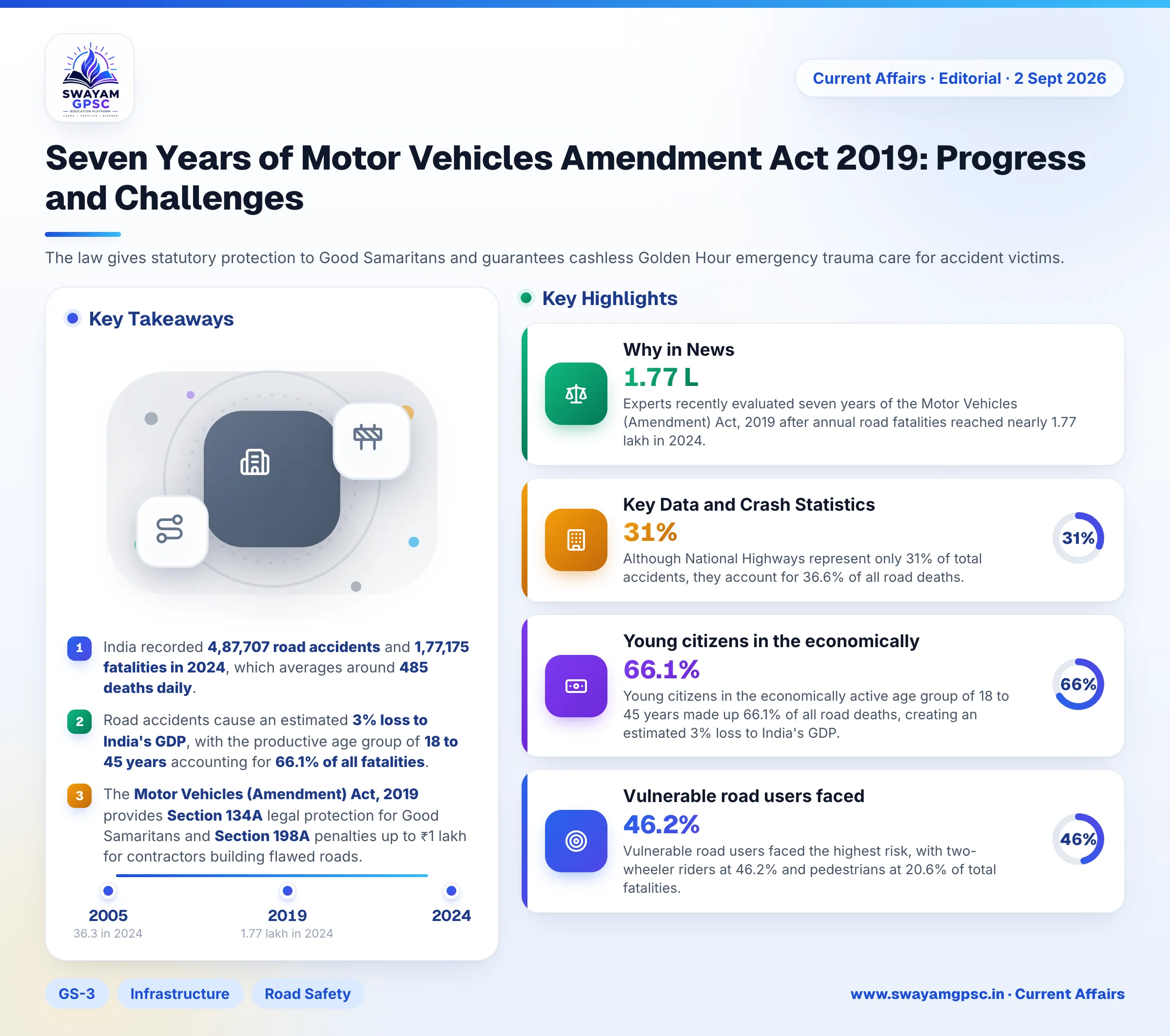
Seven Years of Motor Vehicles Amendment Act 2019: Progress and Challenges
#GS-3 #Infrastructure #Road Safety #Motor Vehicles Act #GS-2 #Governance & Social Justice
Key takeaways
- India recorded 4,87,707 road accidents and 1,77,175 fatalities in 2024, which averages around 485 deaths daily.
- Road accidents cause an estimated 3% loss to India's GDP, with the productive age group of 18 to 45 years accounting for 66.1% of all fatalities.
- The Motor Vehicles (Amendment) Act, 2019 provides Section 134A legal protection for Good Samaritans and Section 198A penalties up to ₹1 lakh for contractors building flawed roads.
- Two-wheeler riders (46.2%) and pedestrians (20.6%) account for over two-thirds of total road deaths in India.
- In 2024 alone, not wearing helmets led to 54,122 deaths, while failing to wear seatbelts resulted in 14,466 deaths.
Why in News
- Experts recently evaluated seven years of the Motor Vehicles (Amendment) Act, 2019 after annual road fatalities reached nearly 1.77 lakh in 2024.
- This review highlighted the urgent need for better road engineering, automated traffic enforcement, and positive driver behavior.
About the Motor Vehicles Amendment Act 2019
- The Motor Vehicles (Amendment) Act, 2019 updated the older Motor Vehicles Act, 1988 to overhaul India's road safety rules.
- It shifted national policy toward a Safe Systems approach that uses heavy electronic penalties to discourage traffic violations.
- The law gives statutory protection to Good Samaritans and guarantees cashless Golden Hour emergency trauma care for accident victims.
- It mandates compulsory vehicle recalls for manufacturing flaws, automated fitness checks, and holds contractors legally responsible for poor road engineering.
Key Data and Crash Statistics
- The Ministry of Road Transport and Highways (MoRTH) 2024 Report recorded 4,87,707 road accidents and 1,77,175 fatalities, which averages around 485 deaths daily.
- Accident severity increased from 21.6 deaths per 100 accidents in 2005 to 36.3 in 2024, showing that crashes are becoming deadlier.
- Although National Highways represent only 31% of total accidents, they account for 36.6% of all road deaths.
- Young citizens in the economically active age group of 18 to 45 years made up 66.1% of all road deaths, creating an estimated 3% loss to India's GDP.
- Vulnerable road users faced the highest risk, with two-wheeler riders at 46.2% and pedestrians at 20.6% of total fatalities.
- Failing to wear safety gear led to massive loss of life in 2024, causing 54,122 deaths due to missing helmets and 14,466 deaths due to unfastened seatbelts.
Core Pillars of the Amendment Act
- Section 136A raised fine amounts up to 10-fold for serious violations and mandated electronic monitoring systems on highways.
- Section 134A protects Good Samaritans who assist victims from police harassment, civil liabilities, and mandatory court appearances.
- Section 162 sets up a government scheme for cashless trauma care during the Golden Hour and increases hit-and-run death compensation to ₹2 lakh.
- Section 198A allows authorities to fine road consultants and construction companies up to ₹1 lakh for unsafe roadway designs.
- Section 110A gives the Union Government power to order mandatory recalls of defective vehicles and penalize manufacturers for safety violations.
Challenges
- State governments often diluted notified fine rates or delayed official notifications due to political pressure.
- Authorities rarely enforce child safety helmets or rear seat rules, while private school vans operate without proper safety standards.
- Poor road engineering and delayed fixes for hazardous black spots leave pedestrians and cyclists without safe, separated paths.
- Emergency trauma care facilities remain concentrated in big cities, leaving rural highway corridors with long ambulance response times.
- Drivers continue risky habits like speeding, using mobile phones, wearing substandard helmets, and ignoring rear seatbelts.
Way Forward
- Transport departments should adopt a Safe Systems approach that builds forgiving roads so human errors do not result in fatal crashes.
- Government agencies must expand Intelligent Transportation Systems (ITS) like automated speed cameras connected to the iRAD and eDAR databases.
- India needs strict national standards for child safety seats, helmet quality checks, and mandatory safety audits of all school transport vehicles.
- Authorities must fully implement the national cashless trauma scheme with dynamic GPS ambulance tracking across all primary highways.
- Officials must enforce Section 198A to penalize road engineers and construction firms whenever faulty road design or missing signboards cause accidents.
Conclusion
- Preventing over 1.7 lakh annual crash deaths requires treating road safety as a shared responsibility across all levels of government.
- Combining forgiving road infrastructure, technology-driven enforcement, and rapid trauma care is necessary to protect citizens and support national economic growth.