India's E-Waste Challenge: Turning Electronic Trash into Critical Resources
#GS-2 #Governance & Social Justice #Government Policies & Interventions #GS-3 #Environment #Environmental Pollution & Degradation #Sustainable Development #Economy #Critical Minerals #E-Waste Management
Key takeaways
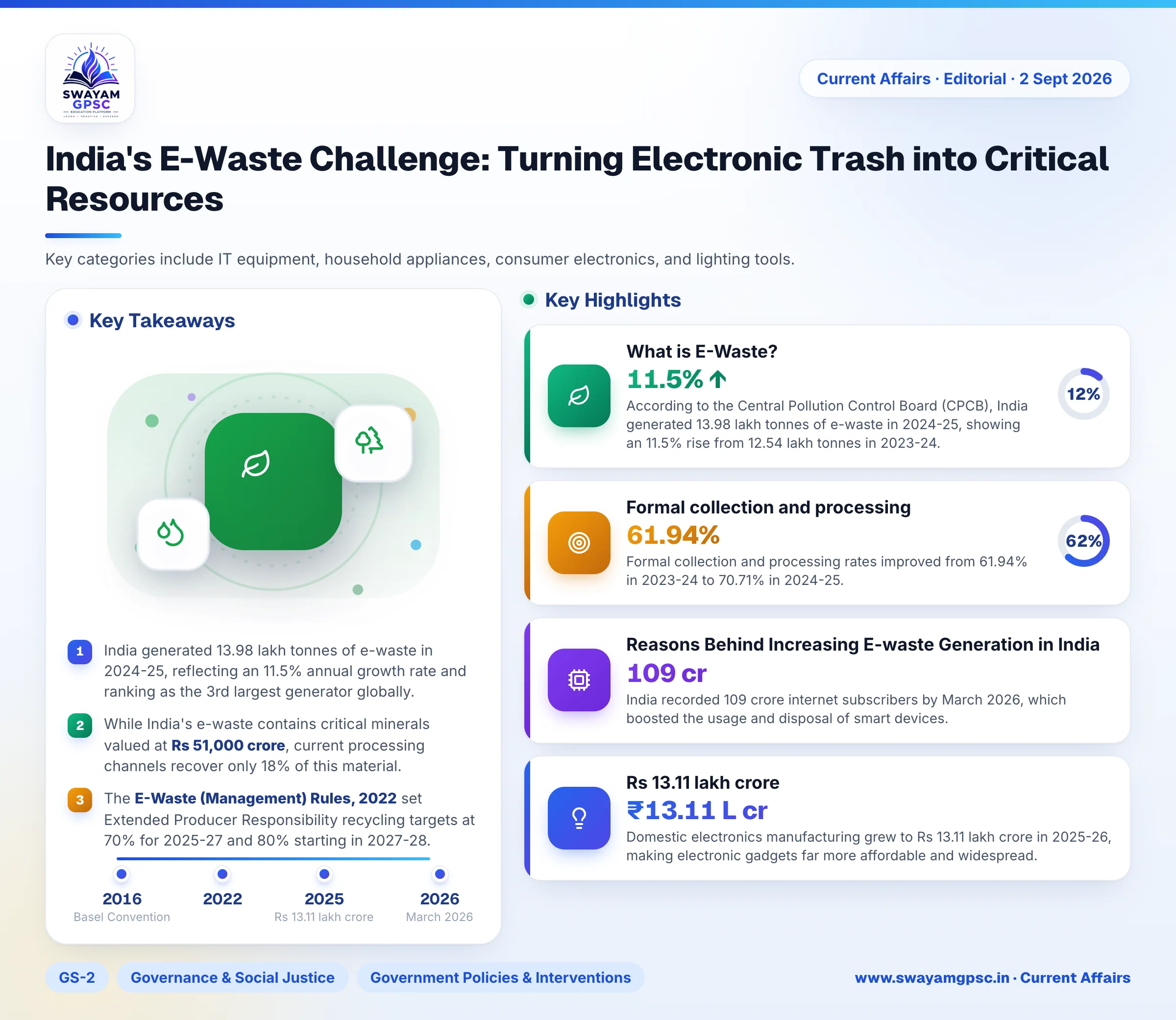
- India generated 13.98 lakh tonnes of e-waste in 2024-25, reflecting an 11.5% annual growth rate and ranking as the 3rd largest generator globally.
- While India's e-waste contains critical minerals valued at Rs 51,000 crore, current processing channels recover only 18% of this material.
- The E-Waste (Management) Rules, 2022 set Extended Producer Responsibility recycling targets at 70% for 2025-27 and 80% starting in 2027-28.
- India's domestic electronics production reached Rs 13.11 lakh crore in 2025-26, while solar capacity expanded to 165 GW, creating massive new e-waste streams.
Why in News
- Rapid digitisation and frequent replacement of IT equipment are causing massive accumulation of electronic waste across India.
- Policymakers must decide whether discarded electronics will pollute the environment through informal dumping or serve as an urban mine for critical strategic minerals.
What is E-Waste?
- E-waste refers to discarded electrical or electronic devices that are broken, obsolete, or no longer wanted by consumers.
- Key categories include IT equipment, household appliances, consumer electronics, and lighting tools.
- E-waste is a dual-natured resource because it contains valuable metals like gold, copper, and lithium alongside hazardous substances like lead, mercury, and toxic acids.
- According to the Central Pollution Control Board (CPCB), India generated 13.98 lakh tonnes of e-waste in 2024-25, showing an 11.5% rise from 12.54 lakh tonnes in 2023-24.
- India ranks as the 3rd largest e-waste generator globally, behind only China and the United States.
- E-waste generation is concentrated in urbanized states such as Maharashtra, Uttar Pradesh, and Tamil Nadu, with major IT hubs acting as primary hotspots.
- Formal collection and processing rates improved from 61.94% in 2023-24 to 70.71% in 2024-25.
Reasons Behind Increasing E-waste Generation in India
- India recorded 109 crore internet subscribers by March 2026, which boosted the usage and disposal of smart devices.
- Domestic electronics manufacturing grew to Rs 13.11 lakh crore in 2025-26, making electronic gadgets far more affordable and widespread.
- Technology upgrades like shifting from 4G to 5G lead consumers and businesses to replace working equipment early.
- Manufacturers design products with non-removable batteries and expensive spare parts, making replacement cheaper than repair.
- Rising urban incomes have expanded household ownership of major home appliances like air conditioners and refrigerators.
- Expanding green infrastructure like solar power reached 165 GW by July 2026, creating future waste streams of old panels and inverters.
- Formal reuse remains low because India had only 72 CPCB registered refurbishers as of February 2025.
- Aggressive retail promotions and festival discounts encourage a linear buy-use-discard lifestyle among consumers.
Urban Mining
- Urban mining is the process of recovering raw materials and critical minerals from discarded products rather than extracting virgin ores.
- It helps recover precious metals like gold, silver, platinum, and palladium from printed circuit boards.
- It reclaims structural metals such as copper, aluminum, and nickel from wiring and old appliances.
- It extracts key battery minerals like lithium, cobalt, and manganese from spent electric vehicle batteries.
Challenges
- Crude informal recycling releases toxic substances like lead and mercury into groundwater and soil near clusters like Seelampur and Moradabad.
- Toxic exposure causes severe damage to human nervous and respiratory systems, with the WHO warning that children in informal recycling areas face serious health risks.
- Informal scrap dealers dominate the sector, leaving India's 322 registered recycling facilities underutilized.
- India's annual e-waste holds critical minerals worth Rs 51,000 crore, but existing systems capture only 18% of this technical potential.
- Failing to recycle e-waste increases global mining demands, whereas formal recycling prevented 900 million tonnes of primary ore extraction globally in 2022.
- Discarded devices contain personal and financial records, creating privacy risks and identity theft when unscientifically resold.
- In 2025, the DGFT alerted customs officials regarding unauthorized imports of end-of-life hard drives worth Rs 800 crore, raising national security concerns.
- Damaged lithium-ion batteries can catch fire during transit and storage, releasing dangerous toxic fumes.
Government Initiatives for E-Waste Management
- The E-Waste (Management) Rules, 2022 cover 106 equipment categories and mandate safe environmental standards.
- The Extended Producer Responsibility framework requires manufacturers to meet recycling targets of 70% for 2025-27 and 80% from 2027-28.
- The Battery Waste Management Rules, 2022 mandate collection targets for EV and industrial batteries while banning landfill disposal.
- The Department of Consumer Affairs launched the Right to Repair India Portal to provide repair manuals and spare parts for consumers.
- The Hazardous and Other Wastes Rules, 2016 regulate hazardous waste transport in alignment with the international Basel Convention.
- The C-MET Centre of Excellence in Hyderabad develops indigenous technologies to recover metals from circuit boards, lithium batteries, and permanent magnets.
Way Forward
- Organize informal scrap collectors into municipal cooperatives like Pune's SWaCH model, giving them safety gear and direct access to registered recyclers.
- Verify Extended Producer Responsibility certificates using digital tracking and geo-tagged records to prevent fake paper compliance.
- Build convenient consumer drop-off points at metro stations and implement a dynamic deposit-refund system.
- Enforce a mandatory 1-10 repairability index on gadgets so buyers can choose easily repairable products.
- Invest in bioleaching technologies that use natural microbes like Acidithiobacillus ferrooxidans to extract valuable metals efficiently.
- Deploy artificial intelligence and robotics to sort and disassemble electronic components safely without bulk shredding.
- Establish local microfactories near technology parks to turn recovered plastics and glass into 3D-printing materials.
- Encourage product leasing models where companies maintain ownership and collect devices back at the end of their lifecycle.
Conclusion
- Managing e-waste effectively requires treating discarded electronics as a strategic national resource rather than simple scrap.
- India can build a resilient circular economy by integrating informal workers, scaling up urban mining, and securing domestic supplies of critical minerals.