Global Coral Reefs Face Unprecedented Destruction from Marine Heatwaves
#GS-3 #Environment #Climate Change #Biodiversity #Coral Reefs #Marine Ecosystem
Key takeaways
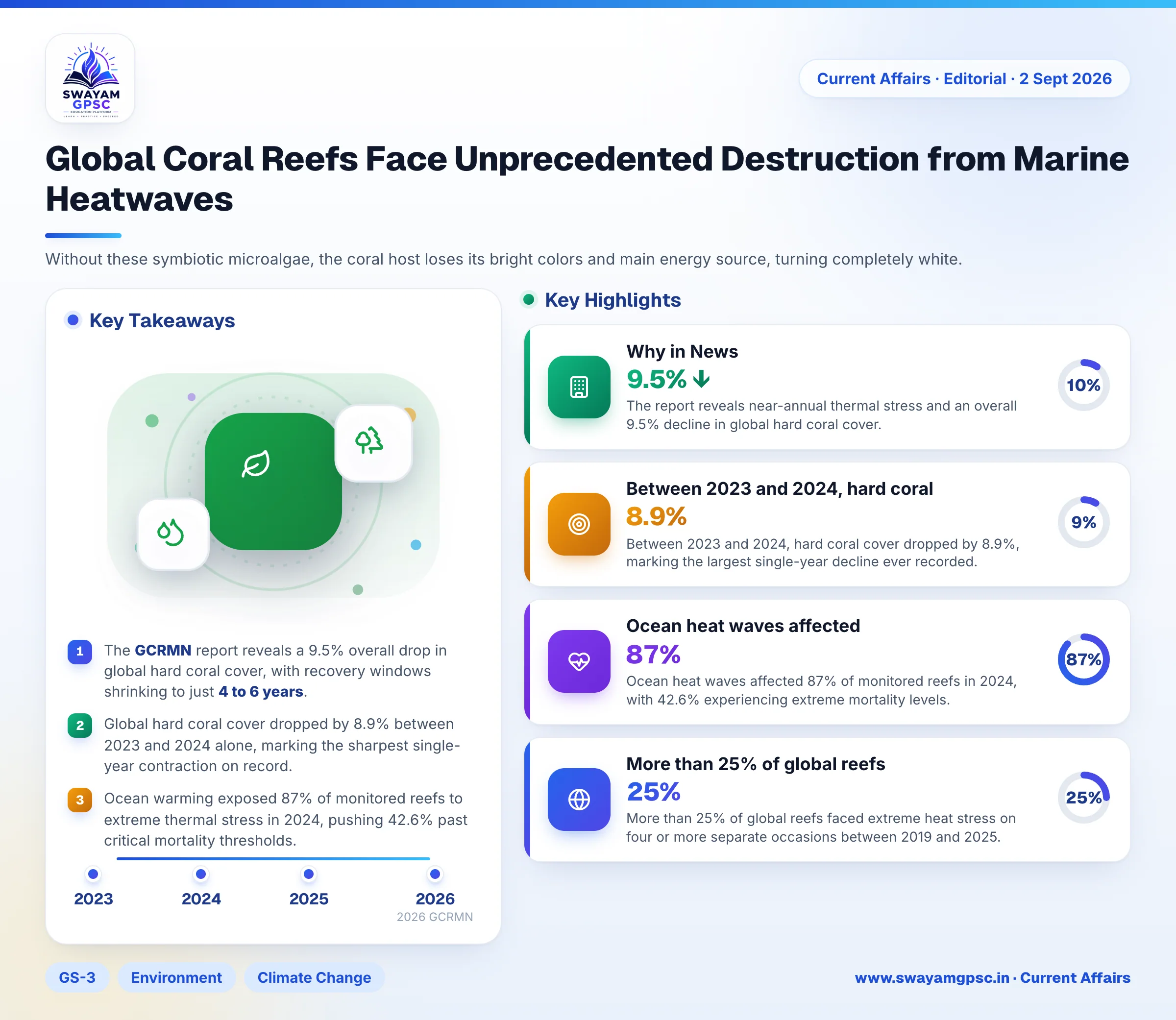
- The GCRMN report reveals a 9.5% overall drop in global hard coral cover, with recovery windows shrinking to just 4 to 6 years.
- Global hard coral cover dropped by 8.9% between 2023 and 2024 alone, marking the sharpest single-year contraction on record.
- Ocean warming exposed 87% of monitored reefs to extreme thermal stress in 2024, pushing 42.6% past critical mortality thresholds.
- Coral reefs support 25% of all marine species, but exceeding a 1.5°C global temperature increase will put over 99% of warm-water reefs at risk.
Why in News
- The Global Coral Reef Monitoring Network (GCRMN) published its 7th Status of Coral Reefs of the World report detailing severe reef degradation.
- The report reveals near-annual thermal stress and an overall 9.5% decline in global hard coral cover.
- Recovery time for damaged coral ecosystems has dramatically shrunk to just 4 to 6 years.
About Coral Bleaching
- Coral bleaching occurs when high ocean temperatures or pollution force coral polyps to expel their resident algae called Zooxanthellae.
- Without these symbiotic microalgae, the coral host loses its bright colors and main energy source, turning completely white.
- This breakdown leaves the underlying calcium carbonate skeleton vulnerable to infectious diseases and starvation.
Key Data and Statistics
- Average global hard coral cover decreased by 9.5% when compared to the 1980 to 2009 baseline level.
- Between 2023 and 2024, hard coral cover dropped by 8.9%, marking the largest single-year decline ever recorded.
- Ocean heat waves affected 87% of monitored reefs in 2024, with 42.6% experiencing extreme mortality levels.
- Mass reef disturbance events that used to happen once a decade now recur every 4 to 6 years.
- More than 25% of global reefs faced extreme heat stress on four or more separate occasions between 2019 and 2025.
- Four major global bleaching events in 1998-1999, 2010-2011, 2016-2017, and 2023-2025 each caused a 6.5% to 9.9% loss in coral cover.
Regional Hotspots and Severely Impacted Ecosystems
- Hard coral cover across the Caribbean Basin plummeted to an alarming average of just 1%.
- Reef surveys revealed a 47% coral loss in the US Virgin Islands and reduced live coral cover to under 5% across 70% of Dominican Republic reefs.
- Heat stress in the Mesoamerican Barrier Reef caused over 90% mortality among wild and restored Acropora species in Belize.
- Severe ocean warming destroyed nearly 50% of hard coral cover in the Persian Gulf and Sea of Oman between 2020 and 2024.
- The Indo-Pacific region and Australia's Great Barrier Reef suffered repeated mass bleaching, threatening key marine life hotspots in the Coral Triangle.
Key Drivers and Ecological Threats
- Average sea surface temperatures across reef regions rose by 0.81°C between 1985 and 2025, serving as the primary cause of mass bleaching.
- Coastal development, destructive fishing practices, dredging, and untreated sewage runoff weaken coral health and spur algae growth.
- Higher atmospheric carbon dioxide makes ocean water more acidic, which slows down calcium carbonate skeleton formation.
- When coral colonies die, fleshy macroalgae rapidly coat the bare limestone structure and prevent young coral larvae from settling.
- Shrinking coral cover isolates remaining colonies, which severely reduces fertilization success and genetic diversity during annual spawning.
Way Forward
- Nations must enforce strict Paris Agreement targets to cap global warming at 1.5°C, as warming past 2.0°C will destroy 99% of warm-water reefs.
- Governments should expand marine protected areas under the 30x30 Kunming-Montreal Global Biodiversity Framework to cover at least 30% of crucial coral habitats.
- Conservation teams need to expand climate-resilient coral nurseries using micro-fragmentation and selective breeding of heat-tolerant corals.
- Local authorities must enforce zero-discharge rules for coastal factories while restoring mangrove and seagrass beds to trap dangerous sediment.
- Marine authorities should use real-time satellite data to limit commercial shipping, fishing, and tourism around reefs during heatwave alerts.
Conclusion
- The 2026 GCRMN report warns that frequent marine heatwaves are pushing coral reefs toward permanent ecological decline.
- Protecting these marine ecosystems is vital because reefs support 25% of marine species, defend coasts from storms, and sustain global fisheries.
- Safeguarding coral reefs requires combining bold global climate action with local habitat conservation and biological restoration.