Strengthening India Defence Capabilities through Self Reliance and Innovation
#GS-2 #GS-3 #Governance & Social Justice #Government Policies & Interventions #Science & Technology #Defence #Current Events #National
Key takeaways
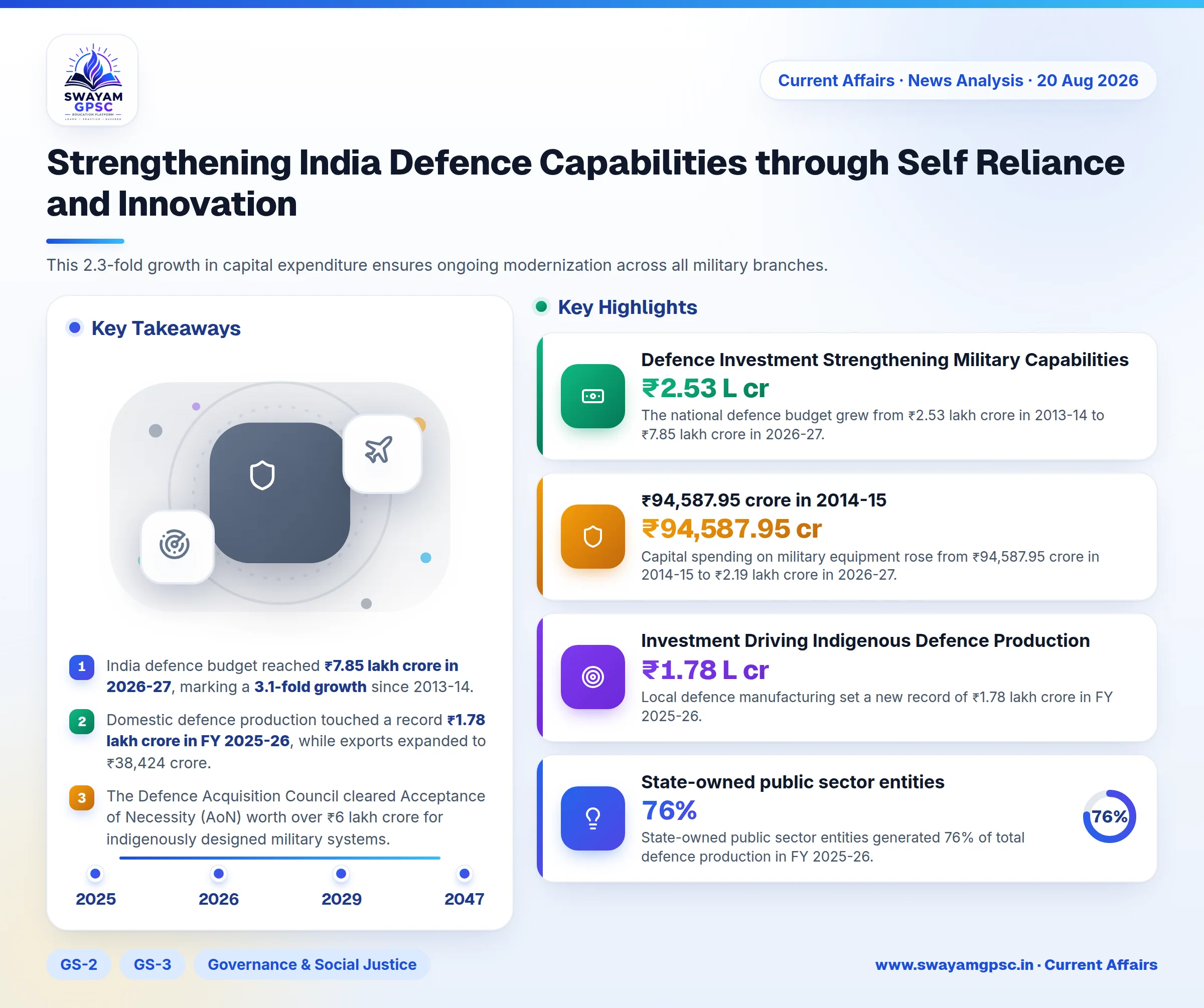
- India defence budget reached ₹7.85 lakh crore in 2026-27, marking a 3.1-fold growth since 2013-14.
- Domestic defence production touched a record ₹1.78 lakh crore in FY 2025-26, while exports expanded to ₹38,424 crore.
- The Defence Acquisition Council cleared Acceptance of Necessity (AoN) worth over ₹6 lakh crore for indigenously designed military systems.
- The Indian Army achieved 91% self-sufficiency in ammunition by indigenising 159 of 175 ammunition variants.
Why in News
- India celebrated its 80th Independence Day by highlighting the complete transformation of its national defence sector.
- The government showcased how the country built a self-reliant, technologically advanced, and globally respected military force.
Defence Investment Strengthening Military Capabilities
- The national defence budget grew from ₹2.53 lakh crore in 2013-14 to ₹7.85 lakh crore in 2026-27.
- This funding growth represents a 3.1-fold growth that gives the armed forces significantly more funds for operational readiness.
- Capital spending on military equipment rose from ₹94,587.95 crore in 2014-15 to ₹2.19 lakh crore in 2026-27.
- This 2.3-fold growth in capital expenditure ensures ongoing modernization across all military branches.
Investment Driving Indigenous Defence Production
- Local defence manufacturing set a new record of ₹1.78 lakh crore in FY 2025-26.
- This milestone reflects the rapid progress made under the Atmanirbhar Bharat initiative.
- State-owned public sector entities generated 76% of total defence production in FY 2025-26.
- Meanwhile, private defence firms contributed 24%, showing a steadily growing role for non-government businesses.
Domestic Industrial Base Expanding Defence Exports
- Military equipment sales to foreign nations jumped from ₹686 crore in FY 2013-14 to ₹38,424 crore in FY 2025-26.
- This massive increase represents a 56-fold growth in overall defence exports.
- Domestic defence manufacturers now export hardware to more than 80 countries.
- Overseas sales figures expanded by more than 5,500% over the past 12 years.
- Private companies generated ₹17,353 crore, accounting for 45.16% of defence exports in FY 2025-26.
- At the same time, Defence Public Sector Undertakings contributed ₹21,071 crore, or 54.84%.
- Policy targets set by the government aim for ₹3 lakh crore in annual defence production by 2029.
- Official goals also target achieving ₹50,000 crore in defence exports within the same timeframe.
Innovation Strengthening the Technological Foundation
- Funds allocated for defence research and development expanded from ₹13,716.14 crore in 2014-15 to ₹29,100.25 crore in 2026-27.
- This change marks an increase of more than 112% in military technology research funding.
- Starting in 2022-23, the ministry reserved 25% of the defence R&D budget for private companies, startups, and academic institutions.
- This policy encourages non-government partners to develop new indigenous defence technologies.
- Private firms and startups can access specialized equipment across 24 DRDO laboratories.
- Managed by the Ministry of Defence, the digital platform Defence Testing Portal (DTP) offers paid usage of high-end testing infrastructure.
Defence Acquisition Reforms
- The Defence Acquisition Council (DAC) acts as the top procurement body for India military services.
- It approved Acceptance of Necessity (AoN) worth over ₹6 lakh crore for buying systems designed by DRDO and manufactured locally.
- Clearances include purchasing 97 Tejas Mk-1A fighter aircraft worth ₹62,000 crore.
- Procurement plans also feature 156 LCH Prachand helicopters worth ₹62,700 crore to strengthen local aerospace production.
- The Defence Acquisition Procedure 2020 (DAP 2020) prioritized locally made goods over foreign imports.
- It opened more avenues for Indian companies in defence design, development, and manufacturing.
- The Defence Procurement Procedure 2016 (DPP 2016) simplified buying processes and boosted the Make in India initiative.
- It established essential frameworks that guided subsequent procurement reforms.
- The Defence Procurement Manual 2025 (DPM 2025) modernized approximately ₹1 lakh crore of revenue procurement.
- It speeds up administrative approvals and reduces penalties on domestic development projects.
- The draft Defence Acquisition Procedure 2026 plans to simplify purchasing categories.
- It also proposes raising mandatory local component requirements in military equipment up to 60%.
Boosting Defence Innovation through iDEX, ADITI and TDF
- Backed by an outlay of ₹498.78 crore, the iDEX scheme connected with 676 startups, MSMEs and innovators.
- By March 2026, the program resulted in 551 design and development contracts.
- The government launched the ADITI Scheme with an outlay of ₹750 crore for 2023-24 to 2025-26.
- Operating under the Defence Innovation Organisation, it offers financial support to build critical defence technologies quickly.
- Under the Technology Development Fund (TDF), innovators receive grants of up to ₹50 crore for building key tech.
- By June 2026, 80 projects worth ₹334 crore were active under TDF.
- An extra ₹500 crore corpus was sanctioned for deep-tech and emerging military technologies.
Technology Transfer and Industry Participation
- Through its Development-cum-Production Partner framework, DRDO shared lab technology with 134 partner companies.
- This framework drives deeper involvement from private manufacturers in overall defence production.
- Government agencies completed around 2,180 technology-transfer agreements.
- These deals help move experimental concepts from research laboratories directly into domestic production.
- Officials made over 2,780 DRDO intellectual property rights available for commercial development by March 2026.
- Freeing up these patents helps local companies commercialize new indigenous inventions.
Indigenisation and Domestic Manufacturing
- The defence ministry published 10 Positive Indigenisation Lists covering 5,521 items by May 2026.
- Five lists came from the Department of Military Affairs and five from the Department of Defence Production to reduce import dependence.
- Serving as a central digital storehouse, the Srijan Defence Equipment Empowerment Platform (Srijan-DEEP) simplifies local sourcing.
- By May 2026, the platform listed over 41,000 vendors and 2.7 lakh products.
- The Uttar Pradesh Defence Industrial Corridor secured ₹42,057 crore in investment commitments by April 2026.
- Out of those commitments, ₹4,409 crore had been grounded in actual operational setup.
- For the Tamil Nadu Defence Industrial Corridor, companies promised ₹32,699 crore in investment commitments.
- Around ₹6,446 crore realised so far, creating a strong southern production ecosystem.
- Construction finished on the BrahMos Integration and Testing Facility in Lucknow, which now manufactures cruise missiles.
Ease of Doing Business and Defence Trade
- Government policies extended industrial license validity from 7 years plus 3 years to 15 years plus 3 years, allowing validity of up to 18 years.
- Manufacturers can also secure lifetime licenses under the Arms Act.
- The modernized Defence Exim Portal streamlines import and export clearances for defense businesses.
- It provides automated verification, live application tracking, and integrated digital payment tools.
- Foreign direct investment limits expanded to 74% under the Automatic Route and up to 100% under the Government Route.
- Total foreign investment in defense reached ₹6,670.59 crore by March 2026.
Indigenisation Strengthening Operational Self Reliance
- Local production now covers 159 of the 175 ammunition variants used by ground forces.
- This achievement translates to a 91% self-sufficiency in ammunition for the Indian Army.
- Strategic forces successfully test-fired the Agni-4 Intermediate Range Ballistic Missile.
- They also launched the Agni-5 Long Range Surface-to-Surface Ballistic Missile to verify critical technical parameters.
- Field tests of the TARA Glide Weapon and RudraM-II air-to-surface missile proved precision-strike capabilities against ground targets.
- Defense researchers progressed work on the Kusha Long Range Air Defence Missile and Very Short-Range Air Defence System (VSHORADS).
- Engineers achieved a milestone by running a 12-minute ground test of an actively cooled scramjet combustor for future hypersonic missiles.
- Defense teams tested an integrated air-defence system that joins missile interceptors, short-range weapons, and energy lasers into one shield.
Advancing Maritime Defence and Strike Capabilities
- Naval commanders commissioned 12 warships and submarines into service.
- Key added platforms included the INS Surat, INS Nilgiri, and INS Vaghsheer.
- The stealth frigate INS Mahendragiri joined the fleet featuring more than 75% indigenous content.
- Shipyards launched SHACHI, which represents the first unit among 11 Next Generation Offshore Patrol Vessels.
- The Navy expanded operational readiness by adding INS Dunagiri, INS Sanshodhak, and INS Agray to active service.
- Inducting INS Sanshodhak marked the completion of the home-built Sandhayak-class survey fleet.
- Weapon trials confirmed the operational performance of the Naval Anti-Ship Missile-Medium Range against hostile targets.
Conclusion
- Increased budget allocations, policy reforms, and expanding private enterprise are rapidly shifting India defence sector toward total self-reliance.
- Rapid technological breakthroughs in missile shields, naval vessels, and scramjet engines demonstrate that India remains on track to become a major defence power by 2047.