Strengthening Female Economic Agency and Workforce Role in India
#GS-3 #Economy #Employment #Growth & Development #Human Resource #GS-1 #Indian Society #Women #GS-2 #Governance & Social Justice
Key takeaways
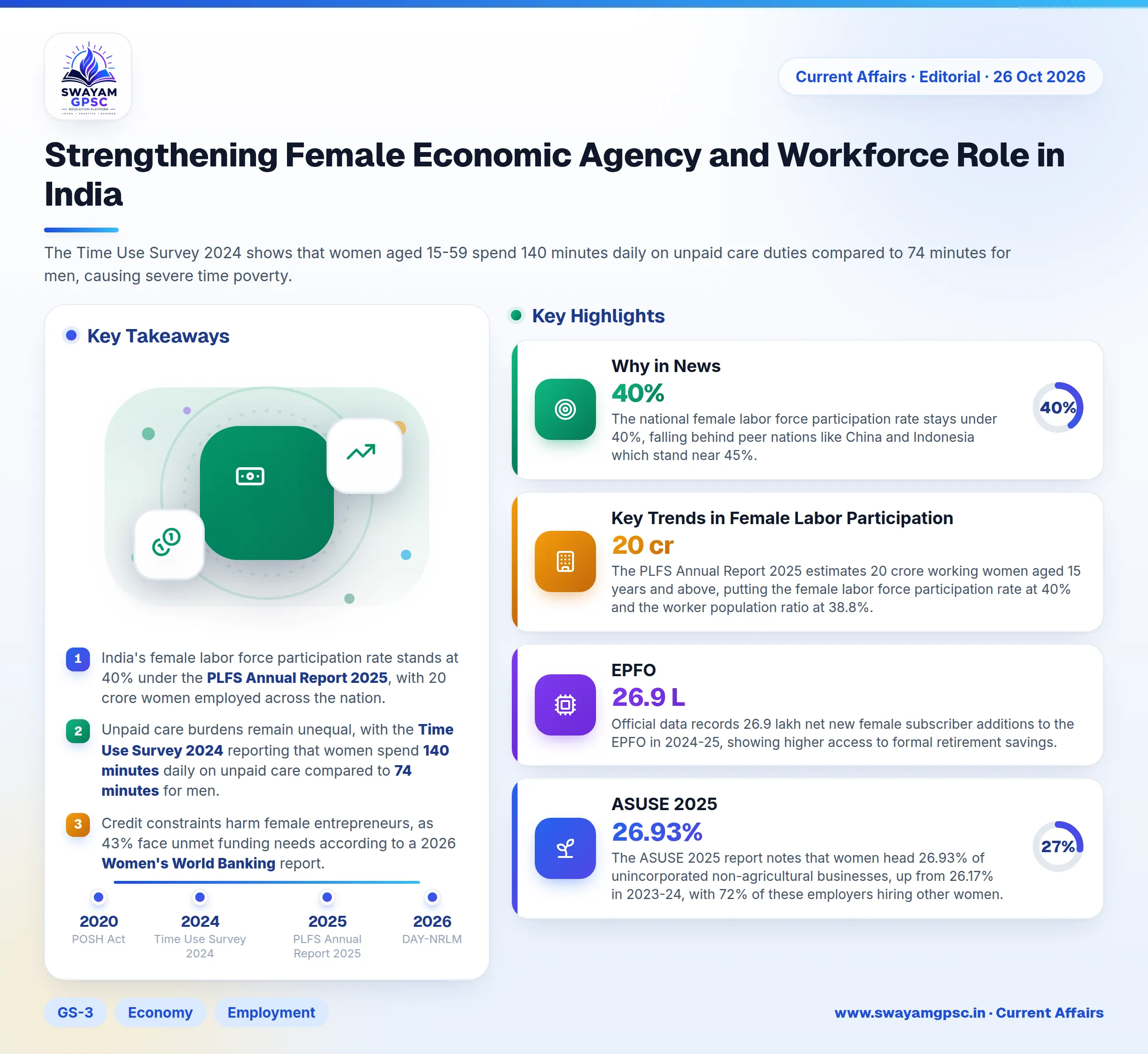
- India's female labor force participation rate stands at 40% under the PLFS Annual Report 2025, with 20 crore women employed across the nation.
- Unpaid care burdens remain unequal, with the Time Use Survey 2024 reporting that women spend 140 minutes daily on unpaid care compared to 74 minutes for men.
- Credit constraints harm female entrepreneurs, as 43% face unmet funding needs according to a 2026 Women's World Banking report.
- Over 3.46 crore self-help group members have become Lakhpati Didis under DAY-NRLM as of July 2026.
- A major skills gap persists, as PLFS 2025 reveals that only 51.4% of formally trained women secure employment compared to 83.3% of trained men.
Why in News
- India is currently at an important demographic turning point where over half of its total population is below 29 years of age.
- The national female labor force participation rate stays under 40%, falling behind peer nations like China and Indonesia which stand near 45%.
- Unlocking female economic potential needs deep policy reforms, better social security, and large-scale skill building to fix widespread informal employment and climate risks.
Key Trends in Female Labor Participation
- The PLFS Annual Report 2025 estimates 20 crore working women aged 15 years and above, putting the female labor force participation rate at 40% and the worker population ratio at 38.8%.
- Official data records 26.9 lakh net new female subscriber additions to the EPFO in 2024-25, showing higher access to formal retirement savings.
- The ASUSE 2025 report notes that women head 26.93% of unincorporated non-agricultural businesses, up from 26.17% in 2023-24, with 72% of these employers hiring other women.
- Under DAY-NRLM, over 3.46 crore self-help group members became Lakhpati Didis by July 2026, supported by grassroots initiatives like Business Correspondent Sakhis.
- Women make up nearly 70% of direct workers in mobile phone manufacturing, while the PLI Scheme for Large-Scale Electronics Manufacturing created around 90,000 female jobs by July 2026.
- Female participation in formal apprenticeships grew from 7.74% in 2016-17 to 24.95% in 2025-26, including historic entries like 27 female welders at Tata Motors under the NAPS-Kaushalya Programme in 2026.
- The four Labour Codes implemented in 2025 grant explicit working permissions for women across all sectors, including voluntary night shifts with safety measures and support through Palna and Sakhi Niwas.
Challenges Facing Working Women
- The Time Use Survey 2024 shows that women aged 15-59 spend 140 minutes daily on unpaid care duties compared to 74 minutes for men, causing severe time poverty.
- The PLFS Annual Report 2025 highlights that 32.9% of rural working women are unpaid family helpers, while only 9.3% hold regular salaried positions.
- Daily wage gaps remain high according to PLFS 2025, with non-public casual female workers earning Rs 315 per day against Rs 455 for men.
- A large skills conversion gap exists, as PLFS 2025 shows only 51.4% of formally trained women aged 15-59 gained jobs, compared to 83.3% of trained men.
- Implementation of workplace safety remains weak: although 1.61 lakh workplaces joined SHe-Box by April 2026, details for only 68,460 Internal Committees were updated.
- The 2025 Spencer Stuart India Board Index reveals that women occupy just 20.4% of board directorships among BSE 100 companies.
- A March 2026 assessment by Women's World Banking indicates that 43% of female entrepreneurs face unmet credit demand due to a lack of collateral.
- The Comprehensive Modular Survey: Telecom 2025 finds that only 48.4% of rural women aged 15 and above own a personal mobile phone, compared to 80.7% of rural men.
Way Forward
- Expand the Palna scheme under Mission Shakti's Samarthya component using the National Minimum Standards and Protocol for Crèches 2024 and guidance from the 2026 UNDP-Dalberg report.
- Enforce female employment options under the Occupational Safety, Health and Working Conditions Code 2020 alongside strict POSH Act compliance and safe transport.
- Link technical training under PMKVY 4.0 and AI Careers for Women (which features 30 hub centres and 150 spoke centres) with guaranteed industry apprenticeships.
- Strengthen female entrepreneurship by strictly enforcing the 3% public procurement sub-target for female-owned micro and small enterprises using GeM's Womaniya initiative and the Yashasvini campaign.
- Expand collateral-free enterprise credit through the Pradhan Mantri MUDRA Yojana and CGTMSE by using cash-flow metrics instead of fixed assets.
- Scale up DAY-NRLM livelihood diversification and support schemes like Namo Drone Didi with commercial booking systems and maintenance infrastructure.
- Promote formal corporate re-entry paths, drawing inspiration from public research initiatives like BioCARe, which supported 415 female scientists by 2026.
- Integrate safe public transport and housing solutions like Sakhi Niwas, mirroring the $150 million Tamil Nadu WESAFE programme approved in 2025 to support 16 lakh women.