Strengthening Canada-India Defence and High-Technology Collaboration
#GS-3 #Current Events #International #Science & Technology #Defence #Bilateral Relations #India-Canada Relations
Why in News
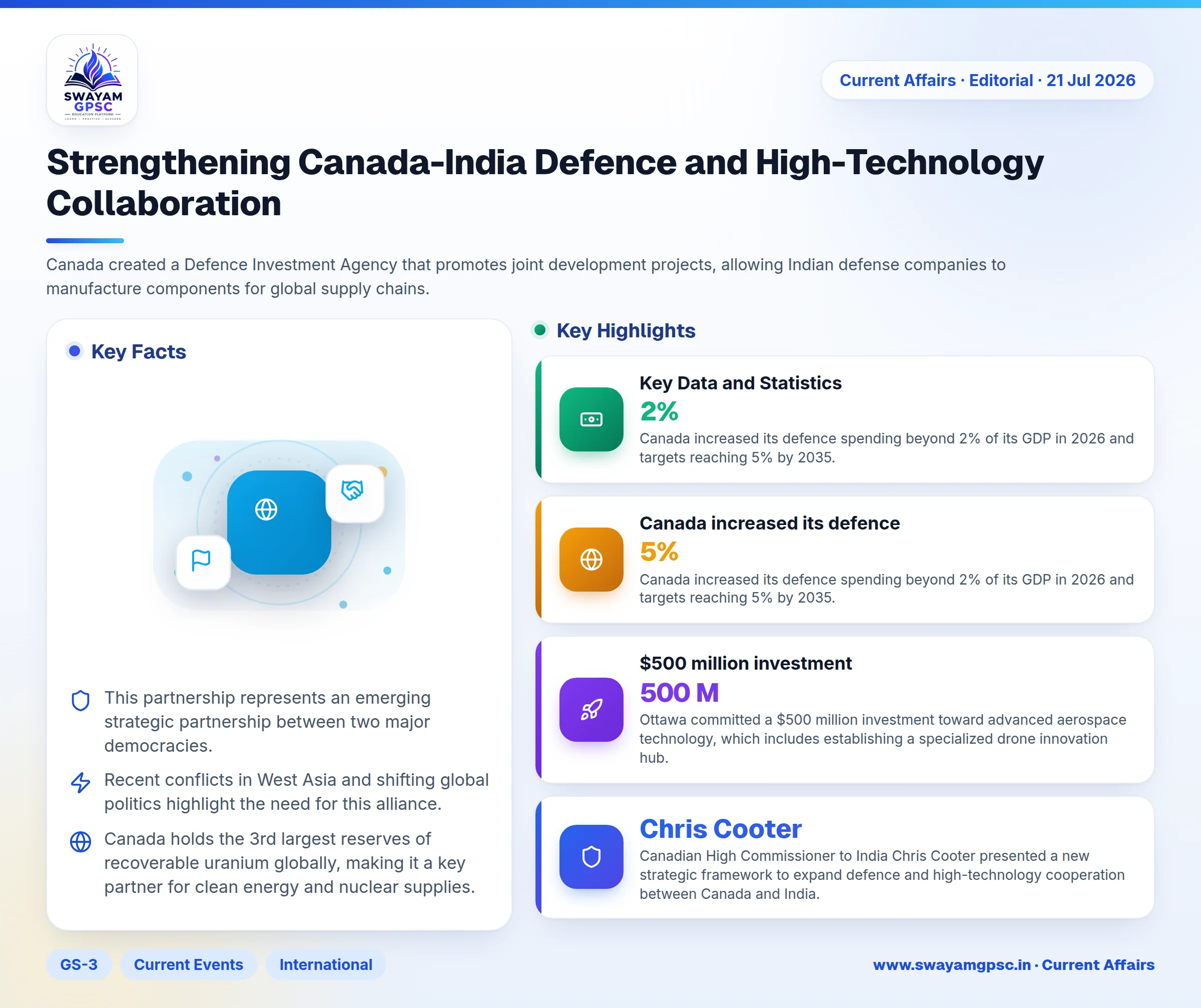
- Canadian High Commissioner to India Chris Cooter presented a new strategic framework to expand defence and high-technology cooperation between Canada and India.
About Canada-India Defence Collaboration
- This partnership represents an emerging strategic partnership between two major democracies. It aims to diversify supply chains, co-develop military platforms, and secure critical natural resources.
- Recent conflicts in West Asia and shifting global politics highlight the need for this alliance. It combines Canadian high-tech research, space robotics, and mineral reserves with Indian industrial capacity, manufacturing power, and a growing defence market.
Key Data and Statistics
- Canada increased its defence spending beyond 2% of its GDP in 2026 and targets reaching 5% by 2035.
- Canada contains reserves of 31 critical minerals, holding 5% of global tungsten reserves and the 10th largest rare earth element reserves worldwide.
- Ottawa committed a $500 million investment toward advanced aerospace technology, which includes establishing a specialized drone innovation hub.
- Canada holds the 3rd largest reserves of recoverable uranium globally, making it a key partner for clean energy and nuclear supplies.
Opportunities for Defence Collaboration
- Canada created a Defence Investment Agency that promotes joint development projects, allowing Indian defense companies to manufacture components for global supply chains.
- Merging Canada's complete aerospace industry with India's growing production hubs speeds up the joint creation of autonomous systems and drone technologies.
- Combining Canada's RADARSAT satellite network and space robotics with India's affordable space launch platforms improves naval monitoring across the Indian Ocean.
- A bilateral agreement on critical minerals ensures India receives reliable supplies of cobalt, helium, and rare earth elements for its high-tech defence sector.
- Participating together in major international naval exercises like RIMPAC and Talisman Sabre improves operational coordination between both navies in the Indo-Pacific.
Initiatives Taken So Far
- Both nations appointed dedicated Defence Advisers in Ottawa and New Delhi to improve direct communication between their military organizations.
- Top leaders established a formal Bilateral Defence Dialogue to set common security goals and align industrial production capabilities.
- A delegation from India's National Defence College visited Canada to encourage direct training exchanges between military educational institutions.
- Both countries signed a Memorandum of Understanding on critical minerals during their March 2026 summit to secure stable material supply lines.
Challenges
- Past diplomatic disagreements over diaspora activities and national sovereignty require careful management to build lasting trust.
- Joint working groups and bilateral institutions are developing slowly, so both nations must maintain steady diplomatic effort beyond signing initial agreements.
- Differing defence procurement systems, export restrictions, and regulatory rules cause delays in joint projects.
- Geopolitical conflicts in West Asia and trade route disruptions cause price volatility for imported raw materials.
- Strict intellectual property laws and technology sharing regulations complicate the transfer of advanced algorithms and satellite parts.
Way Forward
- The Canadian Drone Innovation Hub and Indian defence startups should launch co-funded research projects on autonomous aerial systems.
- Both governments need to complete a Mutual Logistics Support Agreement to allow easy port visits, refueling, and repairs for naval ships in the Indo-Pacific.
- Establishing joint testing and certification centers for critical minerals will guarantee that processed materials meet defense standards before export.
- Expanding officer exchange programs at military staff colleges and joining multi-domain war games will strengthen military cooperation.
- Concluding the ongoing Comprehensive Economic Partnership Agreement (CEPA) trade talks will protect cross-border investments in aerospace, defence, and space technologies.
Conclusion
- Shifting global security needs give Canada and India a clear opportunity to build a strong defence partnership. By combining Canadian technology and mineral wealth with Indian manufacturing power, both countries can build secure supply chains and maintain regional stability in the Indo-Pacific.