Streamlining India's R&D Funding System
#GS-3 #Science & Technology #Indigenization of Technology #GS-2 #Governance & Social Justice #Public Policy #Education #Current Events #National
Key takeaways
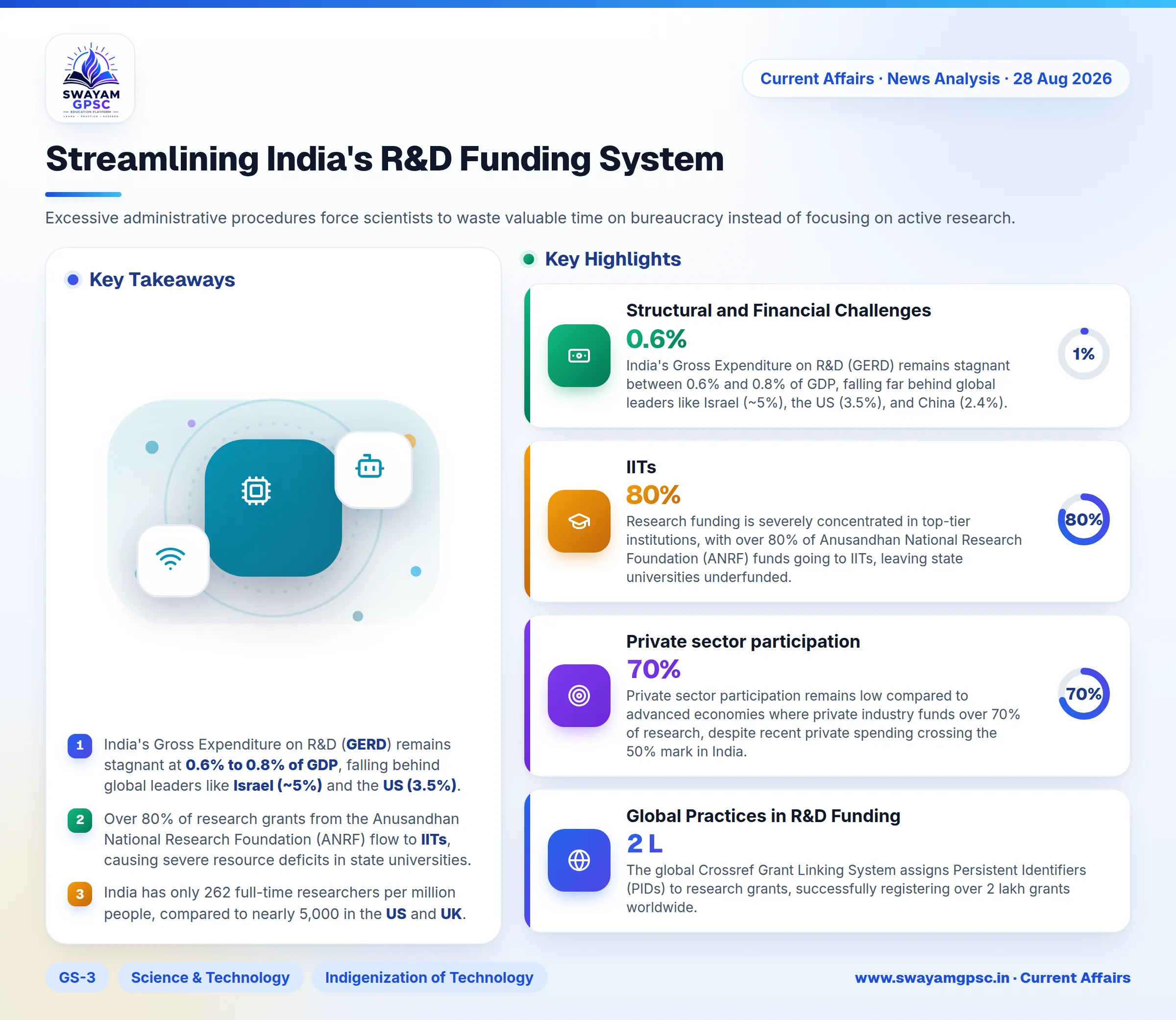
- India's Gross Expenditure on R&D (GERD) remains stagnant at 0.6% to 0.8% of GDP, falling behind global leaders like Israel (~5%) and the US (3.5%).
- Over 80% of research grants from the Anusandhan National Research Foundation (ANRF) flow to IITs, causing severe resource deficits in state universities.
- India has only 262 full-time researchers per million people, compared to nearly 5,000 in the US and UK.
- To eliminate duplicate funding and bureaucratic delays, NITI Aayog recommended launching the Unified Project Management System (UPMS) along with Persistent Digital Identifiers (PIDs).
Why in News
- A recent NITI Aayog report titled 'Ease of Doing R&D in India' has spotlighted major gaps in the country's research funding setup.
- The report emphasizes the critical need for a centralized system to track funding recipients, disbursing agencies, research goals, and existing grant overlaps.
Structural and Financial Challenges
- India's Gross Expenditure on R&D (GERD) remains stagnant between 0.6% and 0.8% of GDP, falling far behind global leaders like Israel (~5%), the US (3.5%), and China (2.4%).
- Research funding is severely concentrated in top-tier institutions, with over 80% of Anusandhan National Research Foundation (ANRF) funds going to IITs, leaving state universities underfunded.
- Private sector participation remains low compared to advanced economies where private industry funds over 70% of research, despite recent private spending crossing the 50% mark in India.
- India faces a severe human capital shortage with only 262 full-time researchers per million people, compared to nearly 5,000 in the US and UK.
- Excessive administrative procedures force scientists to waste valuable time on bureaucracy instead of focusing on active research.
Administrative and Data Bottlenecks
- Complex administrative procedures and a general trust deficit cause funding approval delays of 3 to 6 months, while strict year-end financial rules disrupt ongoing projects.
- Central funding agencies like DST, DBT, CSIR, and ICMR work in isolated silos, leading to duplicate research grants that waste thousands of crores annually.
- Dispersed grant information across unstandardized databases makes it impossible for automated systems to recognize that names like IISc, Bangalore and Indian Institute of Science, Bengaluru refer to the same entity.
- The absence of a centralized national dashboard leaves funding agencies, scholars, and the public without visibility into who receives research grants and for what purpose.
Global Practices in R&D Funding
- The European Union utilizes the CORDIS platform to centralize data on EU-funded projects, tracking publications, organization profiles, and project outcomes.
- The United Kingdom operates the Gateway to Research portal, providing public access to track national research projects and funding details.
- The global Crossref Grant Linking System assigns Persistent Identifiers (PIDs) to research grants, successfully registering over 2 lakh grants worldwide.
- Global systems use standardized IDs like Funder IDs, ROR IDs for institutions, ORCIDs for researchers, and grant DOIs to make funding data machine-readable and prevent costly duplicate grants.
Way Forward
- Assigning a unique, machine-readable Persistent Digital Identifier (PID) to every grant would connect funding records to researchers, publications, and patent outcomes.
- Implementing NITI Aayog's proposed Unified Project Management System (UPMS) would streamline research project planning, funding, monitoring, and evaluation across ministries.
- The UPMS platform needs to integrate standardized metadata and PIDs to effectively track duplicate funding and resource concentration.
- Connecting Indian funding agencies directly to global non-profit networks like Crossref will increase the international visibility of Indian scientific research.
- The government should direct the ANRF to legally reserve a fixed share of funding for state universities and colleges to balance out institutional inequality.
- Rapidly deploying the newly approved Research, Development, and Innovation (RDI) Fund can offer low-interest loans and equity to deep-tech startups, reducing risk for private investors.
- India should commit to a clear fiscal target to raise its Gross Expenditure on R&D (GERD) from 0.65% to at least 2% of GDP.
- Public initiatives like PM Fellowships and corporate research sponsorships can raise social recognition and support for young scientists.
- Enacting a statutory framework for R&D spending, similar to the FRBM framework, would guarantee stable and predictable public research funding.
Conclusion
- Transforming India's R&D ecosystem requires administrative reforms, transparent digital tracking, and decentralization rather than simply increasing spending.
- Adopting digital identifiers and flexible funding mechanisms will reduce waste, empower state universities, and link academic research directly with industry needs.
Frequently Asked Questions
- The Unified Project Management System (UPMS) is a platform proposed by NITI Aayog to unify research planning, grant allocation, and project evaluation across government bodies.
- Persistent Digital Identifiers (PIDs) are unique tags linked with standard metadata to identify research grants, funding agencies, and project durations digitally.
- Digital tools like ORCID identify individual researchers while ROR identifies research organizations, enabling seamless tracking across databases.
- The Anusandhan National Research Foundation (ANRF) aims to expand India's innovation base by channeling research support to universities beyond traditional centers.
- The Research, Development and Innovation (RDI) Fund supports deep-tech startups and innovative companies through low-cost loans and equity instruments.