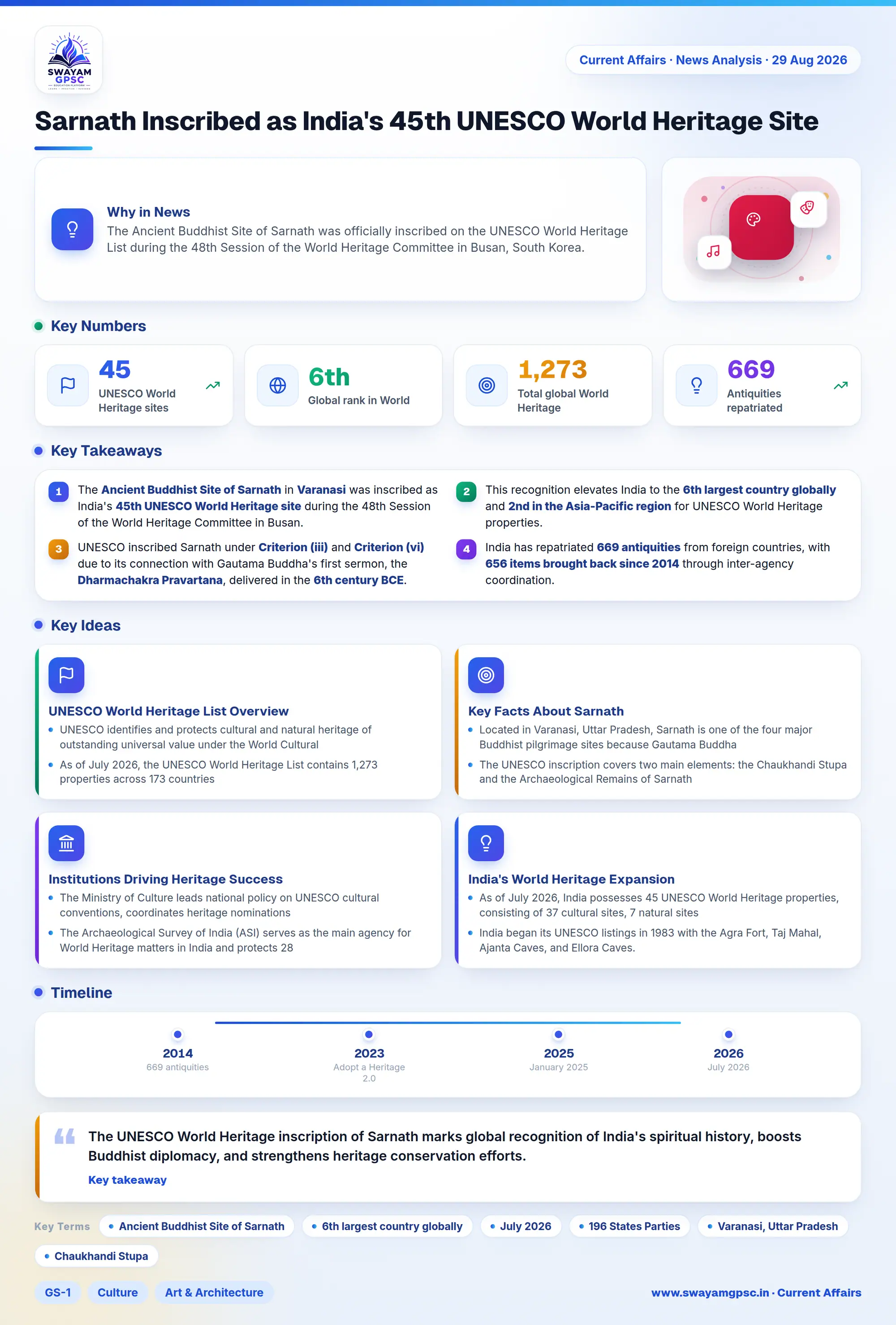
Sarnath Inscribed as India's 45th UNESCO World Heritage Site
#GS-1 #Culture #Art & Architecture #Heritage #GS-2 #Governance & Social Justice #Government Policies & Interventions #Current Events #National
Key takeaways
- The Ancient Buddhist Site of Sarnath in Varanasi was inscribed as India's 45th UNESCO World Heritage site during the 48th Session of the World Heritage Committee in Busan.
- This recognition elevates India to the 6th largest country globally and 2nd in the Asia-Pacific region for UNESCO World Heritage properties.
- UNESCO inscribed Sarnath under Criterion (iii) and Criterion (vi) due to its connection with Gautama Buddha's first sermon, the Dharmachakra Pravartana, delivered in the 6th century BCE.
- India has repatriated 669 antiquities from foreign countries, with 656 items brought back since 2014 through inter-agency coordination.
Why in News
- The Ancient Buddhist Site of Sarnath was officially inscribed on the UNESCO World Heritage List during the 48th Session of the World Heritage Committee in Busan, South Korea.
- With this new inscription, India now has 45 UNESCO World Heritage properties, placing India as the 6th largest country globally and 2nd in the Asia-Pacific region.
UNESCO World Heritage List Overview
- UNESCO identifies and protects cultural and natural heritage of outstanding universal value under the World Cultural and Natural Heritage Convention of 1972.
- As of July 2026, the UNESCO World Heritage List contains 1,273 properties across 173 countries, including 991 cultural sites, 240 natural sites, and 42 mixed sites.
- A total of 196 States Parties have ratified the convention, making it one of the most widely accepted international heritage agreements.
Key Facts About Sarnath
- Located in Varanasi, Uttar Pradesh, Sarnath is one of the four major Buddhist pilgrimage sites because Gautama Buddha gave his first sermon here after attaining enlightenment.
- The UNESCO inscription covers two main elements: the Chaukhandi Stupa and the Archaeological Remains of Sarnath, which include the Dhamek Stupa, Dharmarajika Stupa, Mulagandhakuti Vihara, and the Ashokan Pillar.
- Ancient texts record Sarnath as Rishipatana, Ishipatana, and Mrigadava, where Buddha delivered the Dharmachakra Pravartana sermon in the 6th century BCE to establish the Buddhist Sangha.
- The site displays continuous architectural growth over 16 centuries, ranging from the Pre-Mauryan period in the 4th to 3rd century BCE up to the 12th century CE.
- India added Sarnath to its Tentative List of UNESCO World Heritage Sites in 1998 and formally submitted the nomination dossier in January 2025.
- UNESCO inscribed Sarnath under Criterion (iii) for its enduring spiritual importance and Criterion (vi) for its direct link to Buddha's first sermon and meeting with his first five disciples.
- Sarnath attracts international Buddhist pilgrims from countries like Japan, Thailand, Sri Lanka, Myanmar, Vietnam, South Korea, Cambodia, and Mongolia, strengthening India's cultural diplomacy.
- With Sarnath's inclusion, three of the four major Buddhist pilgrimage sites are now UNESCO properties, joining Lumbini in Nepal and the Mahabodhi Temple in Bodh Gaya.
Institutions Driving Heritage Success
- The Ministry of Culture leads national policy on UNESCO cultural conventions, coordinates heritage nominations, and promotes international cultural diplomacy.
- The Archaeological Survey of India (ASI) serves as the main agency for World Heritage matters in India and protects 28 UNESCO World Heritage properties.
- Legal protection relies on the Ancient Monuments and Archaeological Sites and Remains Act, 1958 and the Antiquities and Art Treasures Act, 1972.
India's World Heritage Expansion
- As of July 2026, India possesses 45 UNESCO World Heritage properties, consisting of 37 cultural sites, 7 natural sites, and 1 mixed site.
- India began its UNESCO listings in 1983 with the Agra Fort, Taj Mahal, Ajanta Caves, and Ellora Caves.
- Recent additions include the Maratha Military Landscapes of India at the 47th Session in Paris and Sarnath at the 48th Session in Busan.
- India maintains 69 properties on its Tentative List, which forms the foundation for future UNESCO nominations.
Government Initiatives for Cultural Heritage
- The government has successfully repatriated 669 antiquities from abroad, including 656 items returned since 2014, such as the Chola-period Shiva Nataraja.
- The Adopt a Heritage 2.0 Programme, updated in 2023, partners with private businesses and public sector units to enhance visitor facilities at national monuments using CSR funding.
- The Gyan Bharatam Mission, launched in 2025, preserves manuscript heritage, identifying over 1.19 crore manuscripts in 2026 and publishing 4.40 lakh digitised manuscripts online.
- The National Archives of India digitises historical documents for public access on the Abhilekh Patal portal.
- The National Mission on Monuments and Antiquities (NMMA) operates under the ASI to maintain a national database of monuments and antiquities for conservation planning.
Conclusion
- The UNESCO World Heritage inscription of Sarnath marks global recognition of India's spiritual history, boosts Buddhist diplomacy, and strengthens heritage conservation efforts.