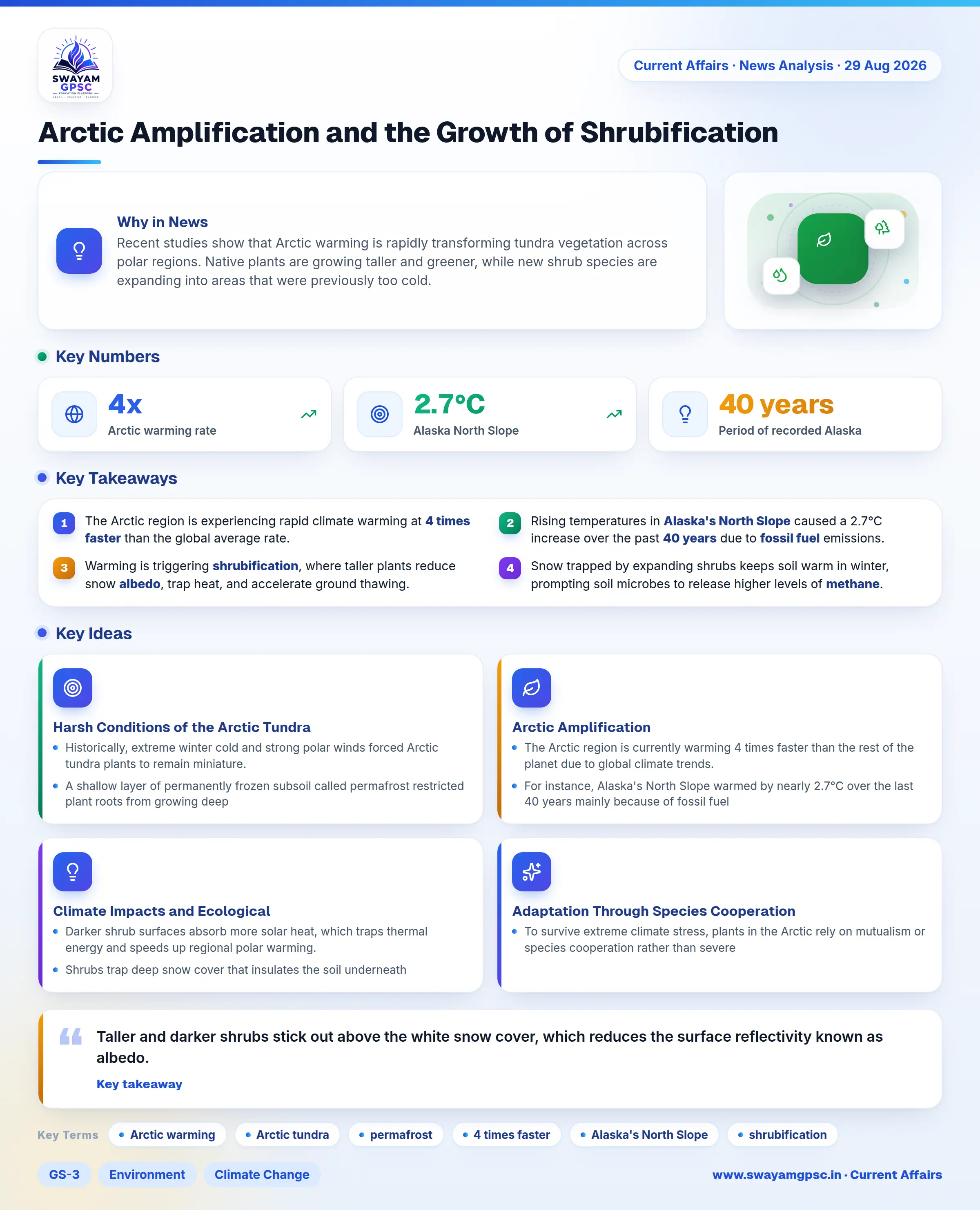
Arctic Amplification and the Growth of Shrubification
#GS-3 #Environment #Climate Change #Arctic Amplification #Shrubification #Permafrost
Key takeaways
- The Arctic region is experiencing rapid climate warming at 4 times faster than the global average rate.
- Rising temperatures in Alaska's North Slope caused a 2.7°C increase over the past 40 years due to fossil fuel emissions.
- Warming is triggering shrubification, where taller plants reduce snow albedo, trap heat, and accelerate ground thawing.
- Snow trapped by expanding shrubs keeps soil warm in winter, prompting soil microbes to release higher levels of methane.
- Arctic plant species are adapting to extreme climate stress through mutualism rather than competitive survival tactics.
Why in News
- Recent studies show that Arctic warming is rapidly transforming tundra vegetation across polar regions.
- Native plants are growing taller and greener, while new shrub species are expanding into areas that were previously too cold.
Harsh Conditions of the Arctic Tundra
- Historically, extreme winter cold and strong polar winds forced Arctic tundra plants to remain miniature.
- A shallow layer of permanently frozen subsoil called permafrost restricted plant roots from growing deep into the ground.
Arctic Amplification and Shrubification
- The Arctic region is currently warming 4 times faster than the rest of the planet due to global climate trends.
- For instance, Alaska's North Slope warmed by nearly 2.7°C over the last 40 years mainly because of fossil fuel emissions.
- Rising temperatures allow existing tundra plants to grow taller and permit new shrub species to move in, a process called shrubification.
Climate Impacts and Ecological Disruptions
- Taller and darker shrubs stick out above the white snow cover, which reduces the surface reflectivity known as albedo.
- Darker shrub surfaces absorb more solar heat, which traps thermal energy and speeds up regional polar warming.
- Shrubs trap deep snow cover that insulates the soil underneath, enabling soil microbes to stay active in winter and release methane.
- Extra plant foliage absorbs more Carbon Dioxide (CO2), but this natural carbon sink benefit is offset by methane releases and lower albedo.
- The spread of shrub species like willows shades streams, which severely disturbs local habitats for native fish, insects, and birds.
Adaptation Through Species Cooperation
- To survive extreme climate stress, plants in the Arctic rely on mutualism or species cooperation rather than severe competition.