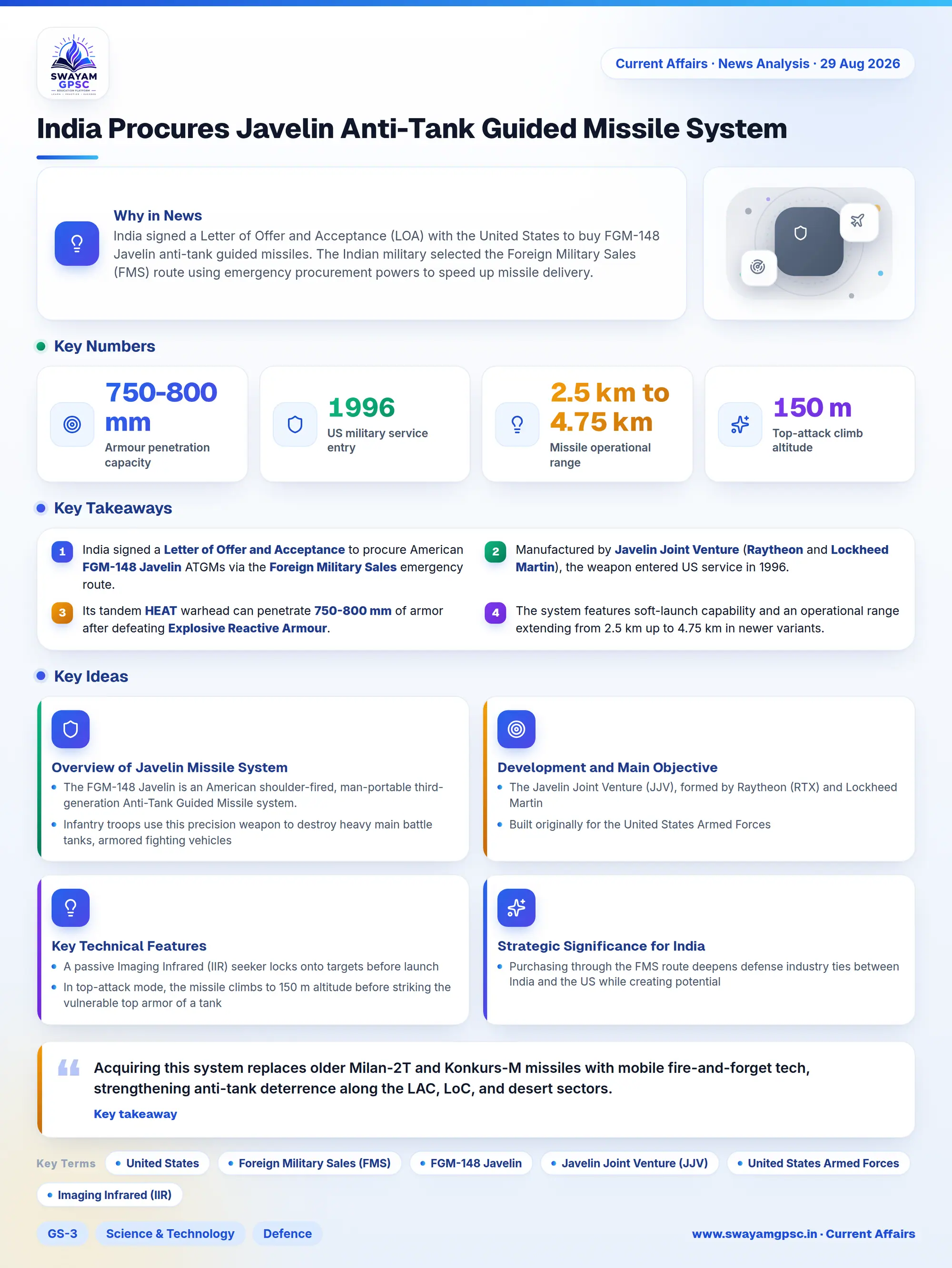
India Procures Javelin Anti-Tank Guided Missile System
#GS-3 #Science & Technology #Defence #GS-2 #Current Events #National #International #Anti-Tank Guided Missile
Key takeaways
- India signed a Letter of Offer and Acceptance to procure American FGM-148 Javelin ATGMs via the Foreign Military Sales emergency route.
- Manufactured by Javelin Joint Venture (Raytheon and Lockheed Martin), the weapon entered US service in 1996.
- Its tandem HEAT warhead can penetrate 750-800 mm of armor after defeating Explosive Reactive Armour.
- The system features soft-launch capability and an operational range extending from 2.5 km up to 4.75 km in newer variants.
- Procurement will replace aging Milan-2T and Konkurs-M systems, boosting Indian firepower along the LAC and LoC.
Why in News
- India signed a Letter of Offer and Acceptance (LOA) with the United States to buy FGM-148 Javelin anti-tank guided missiles.
- The Indian military selected the Foreign Military Sales (FMS) route using emergency procurement powers to speed up missile delivery.
Overview of Javelin Missile System
- The FGM-148 Javelin is an American shoulder-fired, man-portable third-generation Anti-Tank Guided Missile system.
- Infantry troops use this precision weapon to destroy heavy main battle tanks, armored fighting vehicles, fortified bunkers, and low-flying helicopters.
Development and Main Objective
- The Javelin Joint Venture (JJV), formed by Raytheon (RTX) and Lockheed Martin, manufactures this advanced missile system.
- Built originally for the United States Armed Forces, it entered service in 1996 and has proven its firepower in global combat operations.
- The weapon gives light infantry units a lightweight point-and-shoot tool to defeat modern armor and bunkers without exposing soldiers to counterfire.
Key Technical Features
- A passive Imaging Infrared (IIR) seeker locks onto targets before launch, giving the weapon a true fire-and-forget capability so soldiers can quickly move to cover.
- In top-attack mode, the missile climbs to 150 m altitude before striking the vulnerable top armor of a tank, while direct-attack mode hits bunkers, buildings, and helicopters.
- The tandem-charge HEAT warhead fires a precursor charge to clear Explosive Reactive Armour (ERA), allowing the main charge to penetrate 750-800 mm of Rolled Homogeneous Armour.
- Soft-launch technology ejects the missile out of the launch tube before the main rocket motor ignites, reducing backblast and letting soldiers fire safely from inside rooms or bunkers.
- Soldiers aim using a reusable Command Launch Unit (CLU) with day and thermal sights, giving the missile a standard range of 2.5 km that reaches 4-4.75 km in newer variants.
Strategic Significance for India
- Acquiring this system replaces older Milan-2T and Konkurs-M missiles with mobile fire-and-forget tech, strengthening anti-tank deterrence along the LAC, LoC, and desert sectors.
- Purchasing through the FMS route deepens defense industry ties between India and the US while creating potential for technology transfer and joint production.