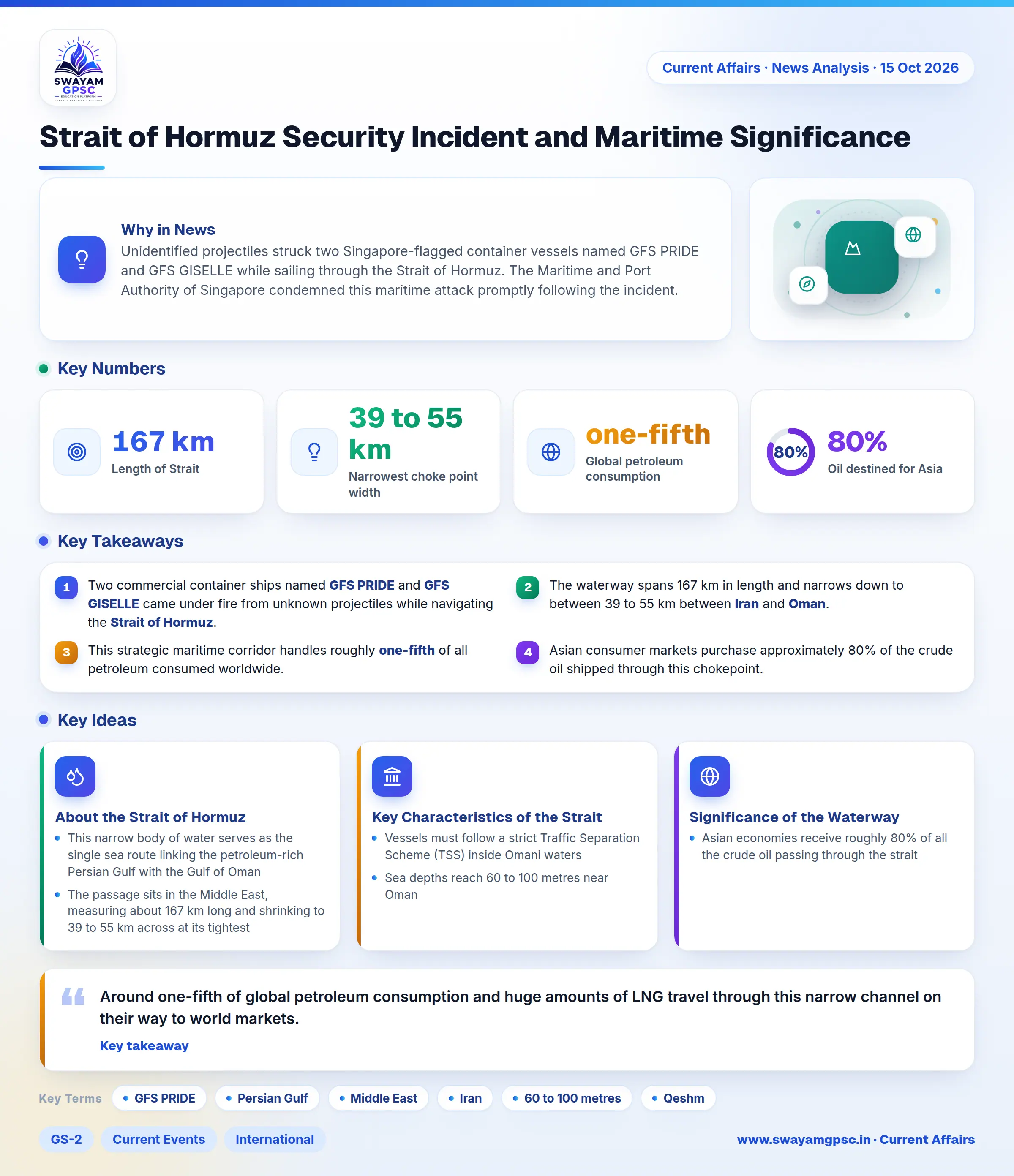
Strait of Hormuz Security Incident and Maritime Significance
#GS-2 #Current Events #International #GS-3 #Geography #Resources #Physical Geography #Strait of Hormuz #Maritime Security
Key takeaways
- Two commercial container ships named GFS PRIDE and GFS GISELLE came under fire from unknown projectiles while navigating the Strait of Hormuz.
- The waterway spans 167 km in length and narrows down to between 39 to 55 km between Iran and Oman.
- This strategic maritime corridor handles roughly one-fifth of all petroleum consumed worldwide.
- Asian consumer markets purchase approximately 80% of the crude oil shipped through this chokepoint.
Why in News
- Unidentified projectiles struck two Singapore-flagged container vessels named GFS PRIDE and GFS GISELLE while sailing through the Strait of Hormuz.
- The Maritime and Port Authority of Singapore condemned this maritime attack promptly following the incident.
About the Strait of Hormuz
- This narrow body of water serves as the single sea route linking the petroleum-rich Persian Gulf with the Gulf of Oman and the Arabian Sea.
- The passage sits in the Middle East, measuring about 167 km long and shrinking to 39 to 55 km across at its tightest point.
- The waterway lies directly between two coastal countries, Iran to the north and Oman through its northern Musandam Peninsula enclave to the south.
Key Characteristics of the Strait
- Vessels must follow a strict Traffic Separation Scheme (TSS) inside Omani waters, with two-mile-wide inbound and outbound shipping lanes separated by a two-mile buffer.
- Sea depths reach 60 to 100 metres near Oman, allowing fully loaded giant tankers and Very Large Crude Carriers (VLCCs) to navigate safely.
- Several vital islands sit along the waterway, including Qeshm, Hormuz, Larak, Hengam, as well as Abu Musa, Greater Tunb, and Lesser Tunb, which are held by Iran but claimed by the UAE.
- Harsh local weather patterns like intense summer heat, high humidity, dust storms, and heavy sea fog frequently lower visibility for ship crews.
- The passage operates under the UNCLOS international transit passage framework, allowing commercial ships and aircraft safe and continuous transit through these waters.
Significance of the Waterway
- Around one-fifth of global petroleum consumption and huge amounts of LNG travel through this narrow channel on their way to world markets.
- Asian economies receive roughly 80% of all the crude oil passing through the strait, making the route essential for regional energy supplies.