State of the World's Forests 2026: Restoration Deficit and India's Leadership
#GS-3 #Environment #Climate Change #Biodiversity #Sustainable Development #Forestry #SOFO 2026 #FAO
Key takeaways
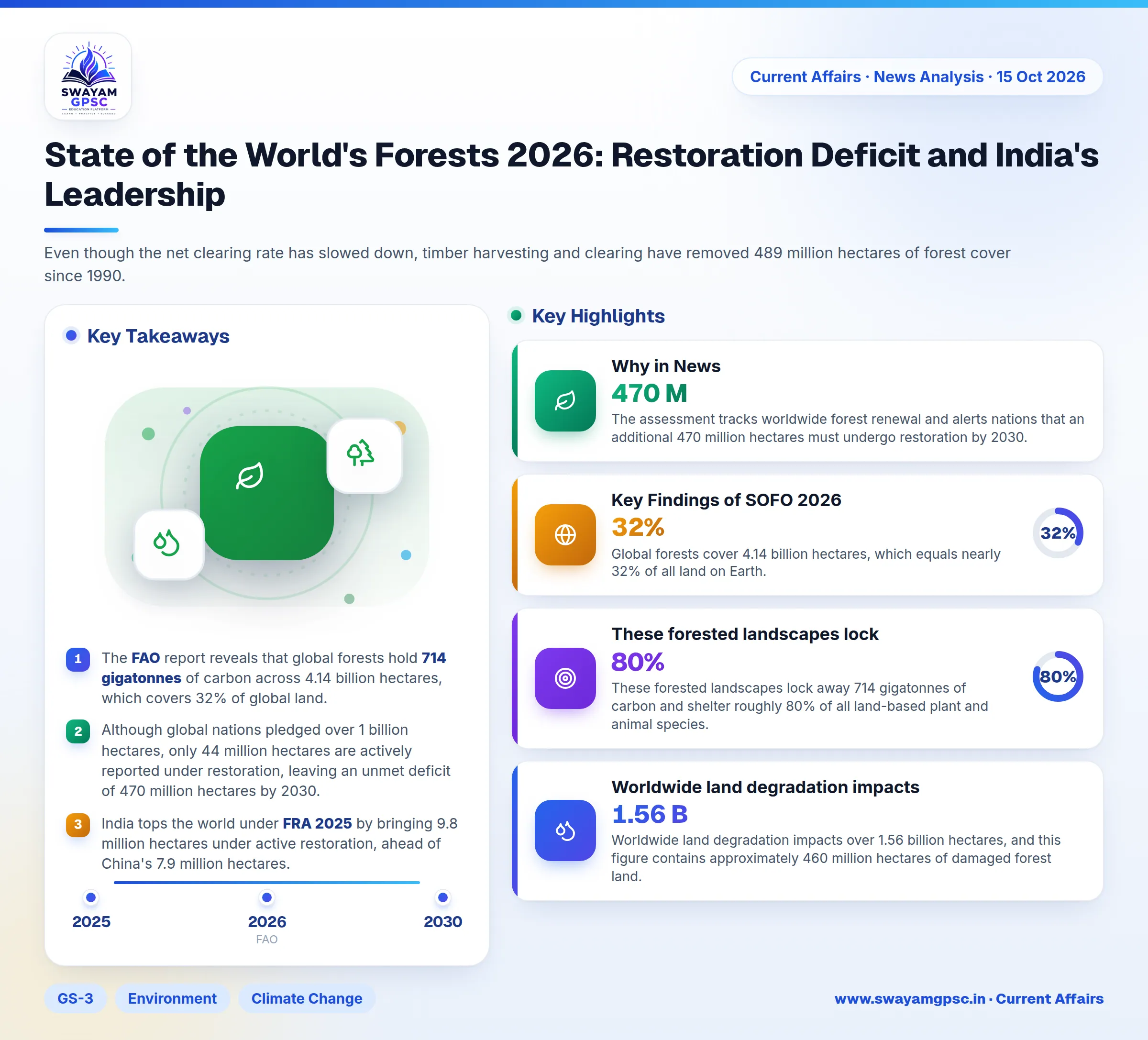
- The FAO report reveals that global forests hold 714 gigatonnes of carbon across 4.14 billion hectares, which covers 32% of global land.
- Although global nations pledged over 1 billion hectares, only 44 million hectares are actively reported under restoration, leaving an unmet deficit of 470 million hectares by 2030.
- India tops the world under FRA 2025 by bringing 9.8 million hectares under active restoration, ahead of China's 7.9 million hectares.
- Under KMGBF Target 2, India registered 18.9 million hectares of restored landscapes, placing it second globally behind China's 127.4 million hectares.
- Restoring degraded ecosystems offers an exceptional economic return of up to $30 for every $1 invested, while intact nature sustains over 50% of world GDP.
Why in News
- The FAO recently unveiled its State of the World’s Forests (SOFO) 2026 report.
- The assessment tracks worldwide forest renewal and alerts nations that an additional 470 million hectares must undergo restoration by 2030.
About the SOFO 2026 Report
- The SOFO 2026 functions as a biennial flagship survey from the FAO to evaluate the health, scale, governance, and economic value of global forest ecosystems.
- This edition emphasizes Forest and Landscape Restoration (FLR) by combining numbers from the Global Forest Resources Assessment 2025 (FRA 2025) and national filings under the Kunming-Montreal Global Biodiversity Framework (KMGBF).
- The main objective is moving forest management away from isolated tree plantations toward complete, multi-purpose landscape rejuvenation.
Key Findings of SOFO 2026
- Global forests cover 4.14 billion hectares, which equals nearly 32% of all land on Earth.
- These forested landscapes lock away 714 gigatonnes of carbon and shelter roughly 80% of all land-based plant and animal species.
- Worldwide land degradation impacts over 1.56 billion hectares, and this figure contains approximately 460 million hectares of damaged forest land.
- Even though the net clearing rate has slowed down, timber harvesting and clearing have removed 489 million hectares of forest cover since 1990.
- Naturally regenerating woodlands make up nearly 92% of Earth's total forests, yet they shrank by 324 million hectares between 1990 and 2025.
- Wildfires rage across roughly 127 million hectares each year, while insects, blights, and harsh climate shocks harm another 50 million hectares annually.
- Global pledges promise over 1 billion hectares of renewed land, yet the FRA 2025 records only about 44 million hectares under active work, leaving a shortfall of 470 million hectares by 2030.
- Investing in landscape restoration can yield up to $30 for every $1 invested, which matters greatly because healthy natural ecosystems underpin more than 50% of global economic output.
India's Performance in Global Forest Restoration
- India secures the first worldwide position for active forest restoration reported under FRA 2025 by registering 9.8 million hectares.
- India outpaces other major contributors such as China at 7.9 million hectares and Ethiopia at 5.0 million hectares.
- Five countries, namely India, China, Ethiopia, Indonesia, and Türkiye, make up nearly 70% of the entire global restoration area tracked by the FRA 2025.
- Under KMGBF Target 2 reported via the 7th National Report to the CBD, India documented 18.9 million hectares under restoration, finishing second only to China's 127.4 million hectares.
- India belongs to a small cluster of Asian countries that achieved steady net increases in green canopy from 1990 to 2025 through farm forestry, compensatory plantation drives, and joint forest committees.
Challenges
- Heavily forested, megadiverse nations often lack uniform tracking tools, leaving significant ecosystems excluded from official international databases.
- Most monitoring setups obsess over gross planted surface area while overlooking actual ecosystem health, species balance, and local community gains.
- Conflicting state subsidies encourage unsustainable land clearing, while unclear local property deeds prevent villagers from investing in multi-year land stewardship.
- Governments regularly announce massive political restoration targets but fail to provide stable multi-year budgets for maintaining saplings after planting.
Way Forward
- Policymakers must roll out four enabling pathways to make ecological recovery permanent.
- Under the People Pathway, governments must secure indigenous land ownership through Free, Prior, and Informed Consent (FPIC).
- Under the Land Pathway, authorities should design multi-functional spatial maps that balance wild conservation with commercial tree farming.
- Under the Finance Pathway, institutions should combine private and public capital while redirecting harmful farming subsidies toward long-term eco-restoration.
- Under the Policy and Law Pathway, states need to eliminate conflicting guidelines across agriculture, infrastructure, and forestry bodies.
- Every restoration project must follow the ten universal yardsticks established by the UN Decade on Ecosystem Restoration to guarantee environmental quality.
- Agencies must move past simple land counts by adopting satellite and biological tracking through the Framework for Ecosystem Restoration Monitoring (FERM).
- Promoting certified green timber, sustainable non-timber forest products, and agroforestry models will create reliable incomes for local smallholders.
Conclusion
- The SOFO 2026 assessment proves that forest restoration is no longer an optional conservation choice but an urgent economic necessity.
- India holds a commendable lead with 9.8 million hectares under restoration, yet fixing the global 470-million-hectare gap by 2030 requires much more than simply planting trees.
- Securing local land ownership, arranging blended private finance, and managing shared rural landscapes are necessary steps to fulfill climate targets and support village livelihoods.