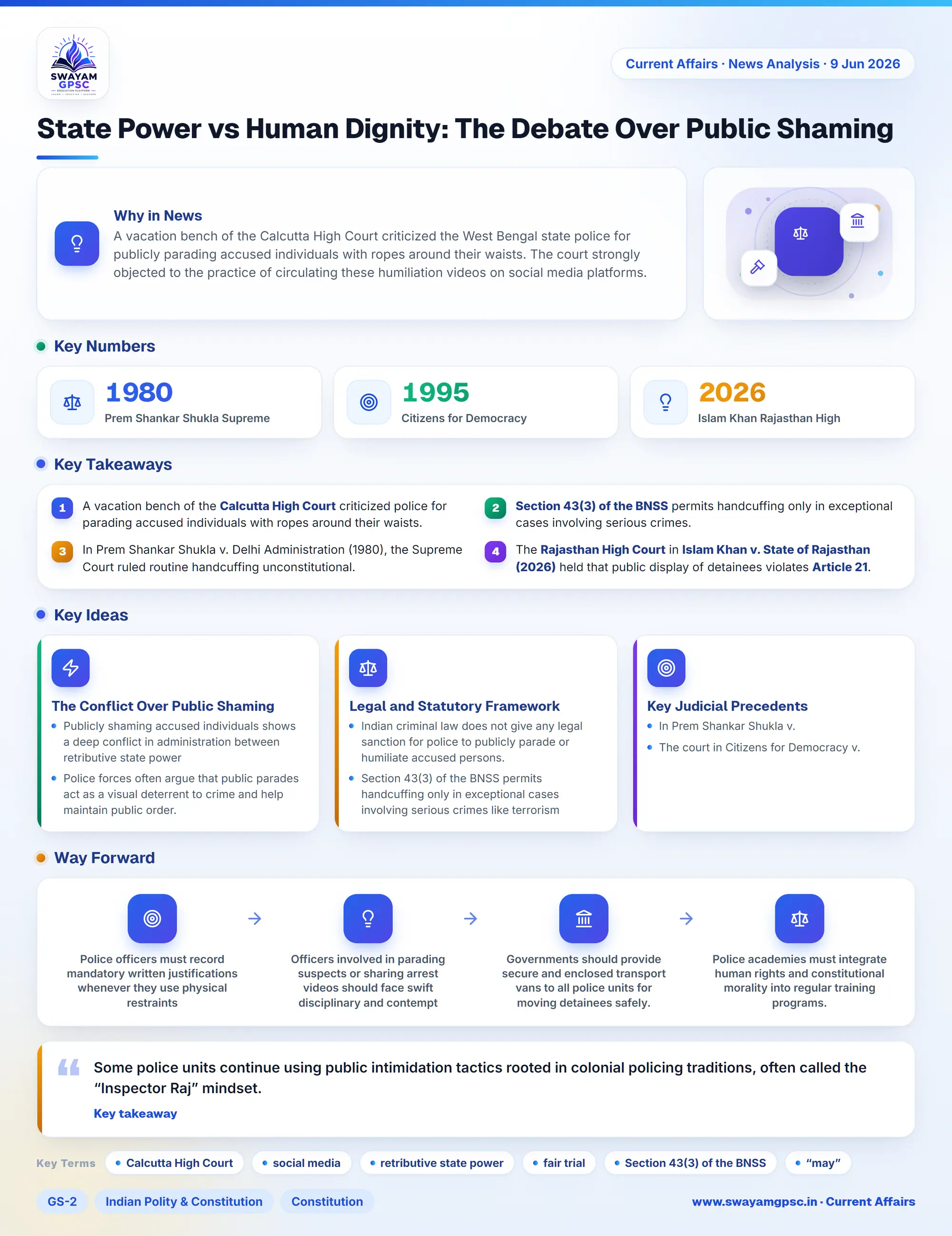
State Power vs Human Dignity: The Debate Over Public Shaming
#GS-2 #Indian Polity & Constitution #Constitution #Governance & Social Justice #Good Governance #Human Rights #Judiciary #Current Events #National
Key takeaways
- A vacation bench of the Calcutta High Court criticized police for parading accused individuals with ropes around their waists.
- Section 43(3) of the BNSS permits handcuffing only in exceptional cases involving serious crimes.
- In Prem Shankar Shukla v. Delhi Administration (1980), the Supreme Court ruled routine handcuffing unconstitutional.
- The Rajasthan High Court in Islam Khan v. State of Rajasthan (2026) held that public display of detainees violates Article 21.
Why in News
- A vacation bench of the Calcutta High Court criticized the West Bengal state police for publicly parading accused individuals with ropes around their waists.
- The court strongly objected to the practice of circulating these humiliation videos on social media platforms.
The Conflict Over Public Shaming
- Publicly shaming accused individuals shows a deep conflict in administration between retributive state power and constitutional morality.
- Police forces often argue that public parades act as a visual deterrent to crime and help maintain public order.
- However, ethics and law guarantee a fair trial and the presumption of innocence until guilt is proven.
- Public shaming replaces the rule of law with informal and state-sponsored public humiliation.
Legal and Statutory Framework Governing Restraints
- Indian criminal law does not give any legal sanction for police to publicly parade or humiliate accused persons.
- Section 43(3) of the BNSS permits handcuffing only in exceptional cases involving serious crimes like terrorism, organized crime, or habitual offenders.
- The law uses the word “may” instead of “shall”, meaning handcuffs are discretionary rather than mandatory for police.
- Section 9(2)(e) of the Prisoners Act Framework empowers states to frame rules for safe prisoner transport for security purposes only, not for public degradation.
Key Judicial Precedents
- In Prem Shankar Shukla v. Delhi Administration (1980), the Supreme Court held that routine handcuffing is arbitrary and unconstitutional.
- The court in Citizens for Democracy v. State of Assam (1995) prohibited indiscriminate chaining of prisoners to protect human dignity.
- The Rajasthan High Court in Islam Khan v. State of Rajasthan (2026) ruled that publicly displaying detainees for photographs violates Article 21.
- The Madhya Pradesh High Court held in Sangram Singh Rajoot v. State of Madhya Pradesh (2026) that marching an accused without justification causes unconstitutional humiliation.
Ethical Theories in Penal Administration
- Kantian Deontological Ethics states that every individual has inherent dignity and must never be treated merely as a means.
- The Ethic of Care stresses that the state must protect vulnerable detainees under its custody from abuse.
- Rawlsian Justice argues that a just society protects equal basic liberties and prevents social punishment before legal guilt is established.
Challenges to Institutional Integrity
- Some police units continue using public intimidation tactics rooted in colonial policing traditions, often called the “Inspector Raj” mindset.
- Arrest videos spread instantly on social media, causing irreversible reputational damage even if the person is later acquitted.
- Violations of arrest guidelines rarely result in prompt disciplinary action due to weak accountability mechanisms.
- Many police stations lack secure transport vehicles in rural areas, forcing officers to transport detainees publicly and risk rights violations.
Way Forward
- Police officers must record mandatory written justifications whenever they use physical restraints on detainees.
- Officers involved in parading suspects or sharing arrest videos should face swift disciplinary and contempt proceedings.
- Governments should provide secure and enclosed transport vans to all police units for moving detainees safely.
- Police academies must integrate human rights and constitutional morality into regular training programs.
- Police departments should be prohibited from publishing unblurred images or videos of under-trials to protect privacy rights.