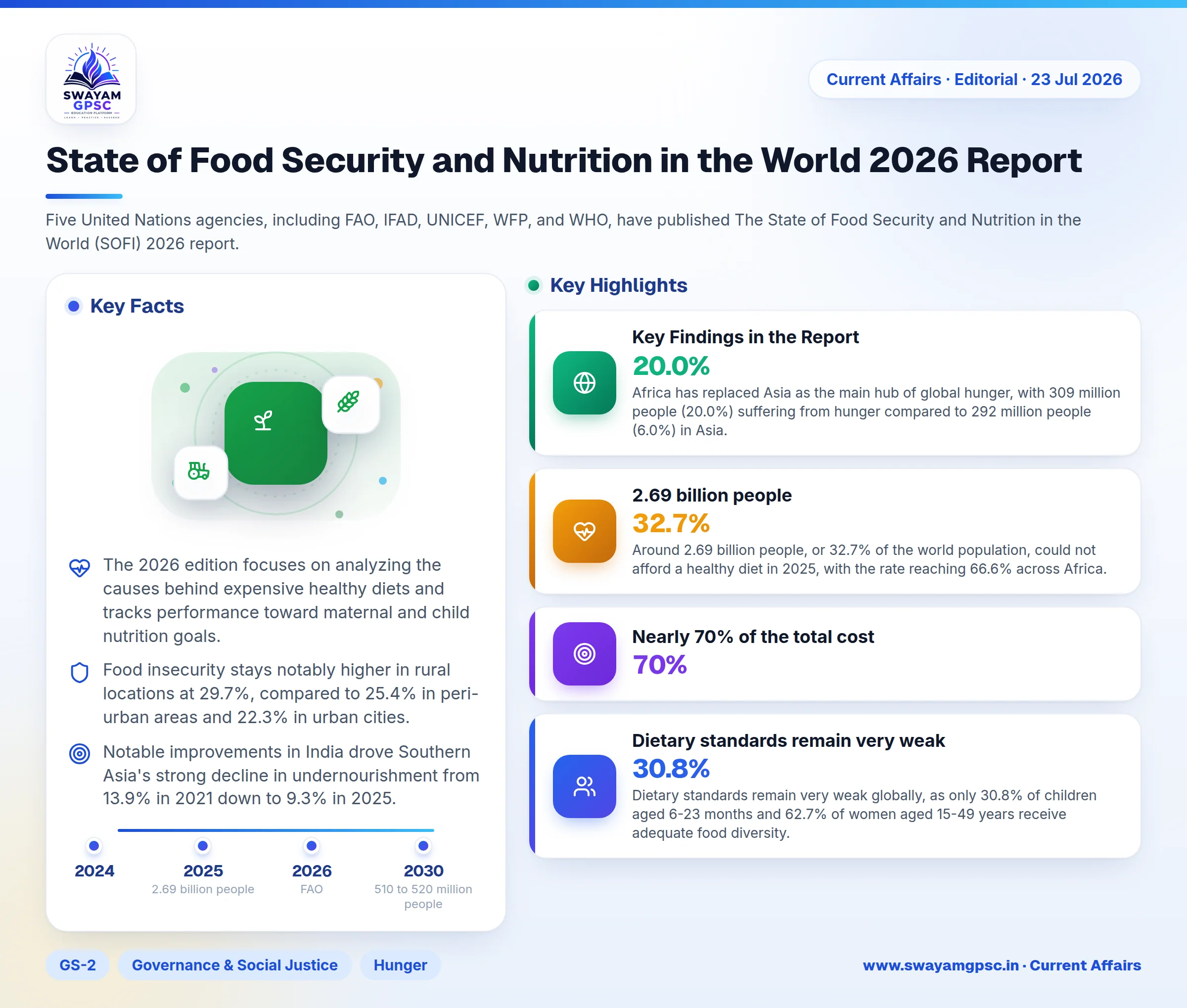
State of Food Security and Nutrition in the World 2026 Report
#GS-2 #Governance & Social Justice #Hunger #Poverty #Health #GS-3 #Economy #Agriculture #Food Security #Sustainable Development #Current Events #International
Why in News
- Five United Nations agencies, including FAO, IFAD, UNICEF, WFP, and WHO, have published The State of Food Security and Nutrition in the World (SOFI) 2026 report.
About SOFI 2026 Report
- The SOFI report serves as the primary annual assessment of the United Nations to monitor global progress toward eliminating hunger under SDG Target 2.1 and ending malnutrition under SDG Target 2.2.
- The 2026 edition focuses on analyzing the causes behind expensive healthy diets and tracks performance toward maternal and child nutrition goals.
Key Findings in the Report
- Africa has replaced Asia as the main hub of global hunger, with 309 million people (20.0%) suffering from hunger compared to 292 million people (6.0%) in Asia.
- Around 2.69 billion people, or 32.7% of the world population, could not afford a healthy diet in 2025, with the rate reaching 66.6% across Africa.
- Animal products, fruits, and vegetables makeup nearly 70% of the total cost of a healthy diet, whereas starchy staple foods supply half of all calories for just one-sixth of the cost.
- Dietary standards remain very weak globally, as only 30.8% of children aged 6-23 months and 62.7% of women aged 15-49 years receive adequate food diversity.
- The world will miss the 2030 Zero Hunger target, as projections show that 510 to 520 million people will remain chronically hungry, with 56% living in Africa.
- Health indicators among women are worsening, with anaemia in women aged 15 to 49 rising to 30.7%, while global adult obesity grew from 12.1% in 2012 to 16.2% in 2024.
- Food insecurity stays notably higher in rural locations at 29.7%, compared to 25.4% in peri-urban areas and 22.3% in urban cities.
India and Report Findings
- Notable improvements in India drove Southern Asia's strong decline in undernourishment from 13.9% in 2021 down to 9.3% in 2025.
- India shapes lower-middle-income regional trends heavily, because excluding India turns the regional trend from a reduction in healthy diet unaffordability into an increase.
- India aligns with regional trends toward meeting the 2030 goals for reducing child stunting and halting child overweight.
- India still struggles to meet the target of cutting anaemia by half among women of reproductive age, following broader global trends.
- Case studies demonstrate that price spikes in non-staple goods like vegetables and fruits significantly raise daily diet costs in South Asian markets.
Challenges
- Conflict in West Asia during 2026 disrupted global energy and fertilizer supply networks, raising farming costs and driving up food inflation.
- High post-harvest logistics, transport, and processing steps generate 70% to 75% of consumer food costs, creating steep price markups on fresh food.
- Governments assign roughly 70% of global government agricultural support to staple grains and sugar, ignoring nutrient-rich fruits and pulses.
- Severe weather combined with inadequate cold storage networks and poor rural roads leads to heavy crop losses and seasonal price spikes.
- Cuts in foreign aid funding hinder the capacity of international emergency food programs operating in regional crisis zones.
Way Forward
- Governments should shift agricultural subsidies and purchasing programs toward nutrient-rich fruits, vegetables, and legumes to make healthy foods cheaper.
- Public investments must build better cold storage, rural roads, processing plants, and clean logistics to reduce food waste along the supply chain.
- Agricultural research should focus on high-value non-staple crops to enhance output levels and adapt to climate change challenges.
- Authorities need to track healthy diet costs continuously and expand targeted cash support programs for vulnerable families.
Conclusion
- Achieving zero hunger by 2030 requires urgent systemic changes in global farming, subsidy structures, supply chains, and social safety programs.