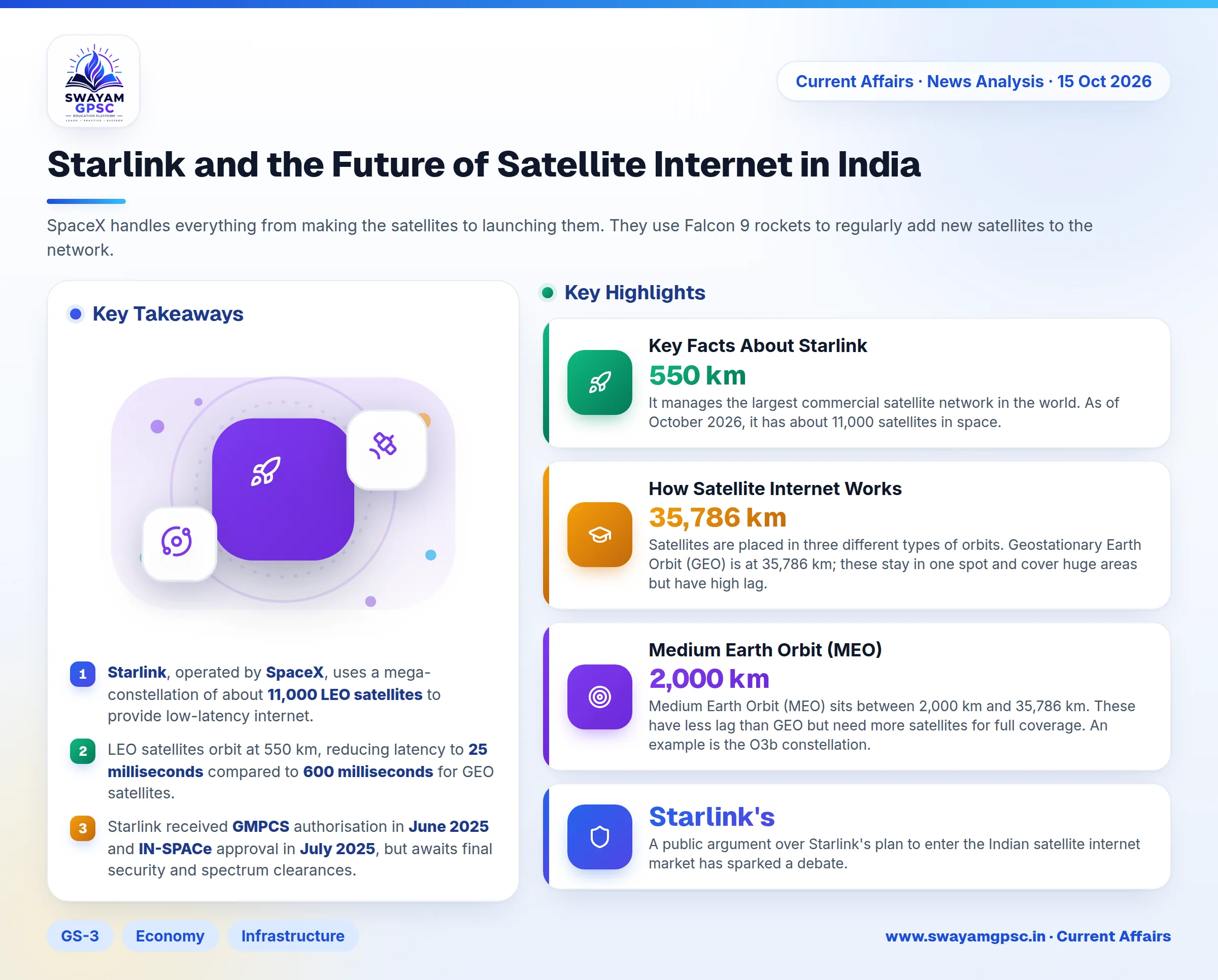
Starlink and the Future of Satellite Internet in India
#GS-3 #Economy #Infrastructure #Science & Technology #Space #Current Events #National
Key takeaways
- Starlink, operated by SpaceX, uses a mega-constellation of about 11,000 LEO satellites to provide low-latency internet.
- LEO satellites orbit at 550 km, reducing latency to 25 milliseconds compared to 600 milliseconds for GEO satellites.
- Starlink received GMPCS authorisation in June 2025 and IN-SPACe approval in July 2025, but awaits final security and spectrum clearances.
- The technology supports critical areas like telemedicine, precision agriculture, and disaster management in remote regions.
Why in News
- A public argument over Starlink's plan to enter the Indian satellite internet market has sparked a debate. This discussion focuses on market competition, national security, regulatory approvals, and whether the service will be affordable for consumers.
Key Facts About Starlink
- Starlink is a high-speed broadband service created by SpaceX. It uses a network of Low Earth Orbit (LEO) satellites to bring internet to remote areas where cables cannot reach.
- It manages the largest commercial satellite network in the world. As of October 2026, it has about 11,000 satellites in space. These fly at an altitude of 550 km, which is much lower than the 35,786 km height of geostationary satellites.
- The system uses cutting-edge tech like optical inter-satellite links (space lasers), phased-array antennas, and argon-powered ion thrusters. These tools help in fast data transfer and moving satellites in orbit.
- Because the satellites are closer to Earth, the lag or latency is very low. Under good conditions, it is about 25 milliseconds. Traditional geostationary satellites have a much higher lag of 600 milliseconds or more, making them slower for gaming or video calls.
- SpaceX handles everything from making the satellites to launching them. They use Falcon 9 rockets to regularly add new satellites to the network.
- The service is vital for providing internet during disasters, in war zones, or in deep rural areas where normal mobile towers do not work.
- SpaceX also created Starshield, which is a specific version of this technology designed only for the US government and national security needs.
Status of Starlink's Licence in India
- In June 2025, the Department of Telecommunications (DoT) gave Starlink a Unified Licence with Global Mobile Personal Communication by Satellite (GMPCS) authorisation.
- By July 2025, the Indian National Space Promotion and Authorisation Centre (IN-SPACe) also gave its official approval for the satellite constellation.
- Even with these two approvals, Starlink has not started selling services in India. This is because it still needs final security clearances and the official assignment of spectrum.
- In March 2025, SpaceX signed deals with Jio Platforms and Bharti Airtel to look into how they could distribute Starlink services across India, pending government rules.
- To put it plainly, Starlink has the basic permits but cannot start business until the government clears the remaining security and frequency (spectrum) hurdles.
How Satellite Internet Works
- Satellite internet provides broadband by using satellites in space. It is the best option for sparsely populated or disaster-hit areas where laying underground cables is too expensive or impossible.
- The system works using two main parts. First is the Space Segment, which includes satellites that receive and send signals. Second is the Ground Segment, which includes the user's antenna, modem, and the main ground stations connected to the internet backbone.
- Satellites are placed in three different types of orbits. Geostationary Earth Orbit (GEO) is at 35,786 km; these stay in one spot and cover huge areas but have high lag. An example is Inmarsat Global Xpress (GX).
- Medium Earth Orbit (MEO) sits between 2,000 km and 35,786 km. These have less lag than GEO but need more satellites for full coverage. An example is the O3b constellation.
- Low Earth Orbit (LEO) is below 2,000 km. These provide the fastest speeds and lowest lag, but because they cover small areas, a huge 'mega-constellation' is needed. Starlink is a prime example.
- Modern LEO systems use onboard signal processing and space lasers to let satellites talk to each other. This ensures the internet connection stays seamless as satellites move quickly across the sky.
- This technology is useful for disaster management, telemedicine, precision agriculture, shipping, aviation, and military use.
- However, there are problems. The equipment and monthly fees are often high. There are also risks like orbital congestion, space debris, and cybersecurity threats.