Special Intensive Revision (SIR) of Electoral Rolls in India
#GS-2 #Indian Polity & Constitution #Governance & Social Justice #Current Events #Constitution #Executive #Constitutional Bodies #National #Electoral Reforms #Voter Registration
Key takeaways
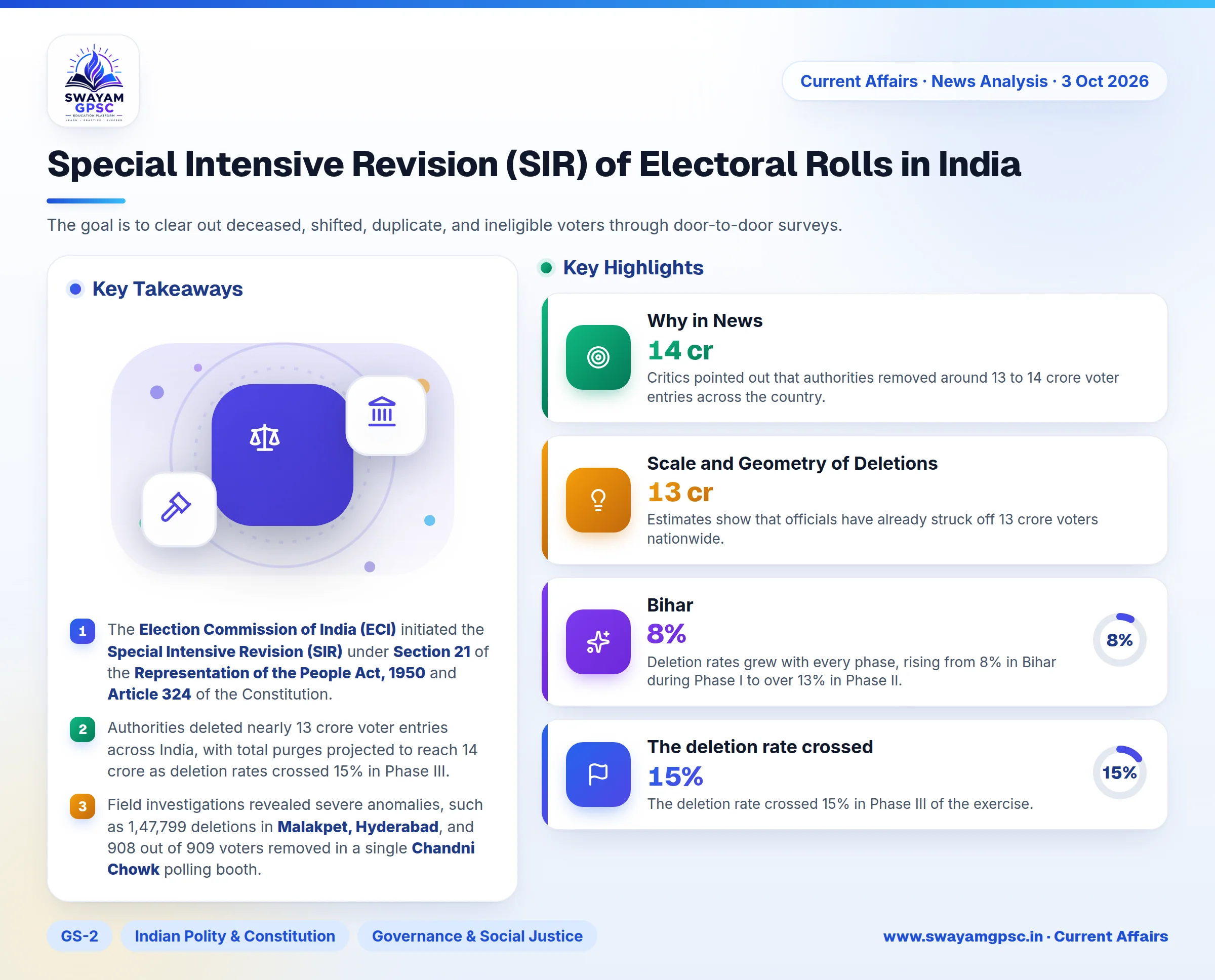
- The Election Commission of India (ECI) initiated the Special Intensive Revision (SIR) under Section 21 of the Representation of the People Act, 1950 and Article 324 of the Constitution.
- Authorities deleted nearly 13 crore voter entries across India, with total purges projected to reach 14 crore as deletion rates crossed 15% in Phase III.
- Field investigations revealed severe anomalies, such as 1,47,799 deletions in Malakpet, Hyderabad, and 908 out of 909 voters removed in a single Chandni Chowk polling booth.
- Strict documentary proofs, such as linking to 2002-2004 legacy rolls or proving citizenship prior to July 1, 1987, disproportionately disenfranchise poor workers and 98% of the 15-crore Nomadic Tribes population.
- To protect universal adult franchise under Article 326, expert groups recommend mandatory pre-deletion notices, open Gram Sabha audits, and automated inter-state voter portability.
Why in News
- A recent critique of the Special Intensive Revision (SIR) of electoral rolls raised serious concerns.
- Critics pointed out that authorities removed around 13 to 14 crore voter entries across the country.
- This massive deletion threatens the voting rights of marginalized and vulnerable communities.
About Special Intensive Revision (SIR)
- The Election Commission of India (ECI) started this voter roll verification and re-enumeration drive.
- The goal is to clear out deceased, shifted, duplicate, and ineligible voters through door-to-door surveys.
- This exercise rests on legal grounds under Section 21 of the Representation of the People Act, 1950 and the Registration of Electors Rules, 1960.
- The ECI also uses its plenary constitutional powers under Article 324 to conduct this revision.
The 2002 Comparison Contention
- The ECI calls this drive a periodic repeat of the 2002 revision exercise.
- However, critics highlight key differences between the two processes.
- In 2002, officials verified voter lists openly in Gram Sabhas and ward committees against baseline mother lists.
- In contrast, the current SIR relies heavily on centralized legacy mapping and automated software.
Scale and Geometry of Deletions
- Estimates show that officials have already struck off 13 crore voters nationwide.
- Total deletions may reach 14 crore once the ongoing phases finish.
- Deletion rates grew with every phase, rising from 8% in Bihar during Phase I to over 13% in Phase II.
- The deletion rate crossed 15% in Phase III of the exercise.
- In Malakpet, Hyderabad, authorities deleted 1,47,799 names, which exceeds the 1,32,024 total votes polled in the 2023 Assembly election.
- In Yakutpura, Hyderabad, officials removed 1,54,982 names compared to 1,40,434 votes polled in 2023.
- At Polling Booth 33 in Chandni Chowk, Delhi, authorities removed 908 out of 909 total voters.
Sociopolitical Critique of Deletions
- Deletions disproportionately impact religious minorities like Muslims and Christians, along with Dalits, Adivasis, and migrant laborers.
- Among De-notified and Nomadic Tribes, 98% of an estimated 15-crore population remains excluded from voter rolls.
- Removing citizens from voter lists strips them of their political voice and economic priority.
- This practice creates two tiers of citizens: those who can vote and those who cannot.
- Claims about foreign infiltrators in Bihar proved mostly false.
- Out of 1,087 objections against suspected foreign infiltrators in Bihar, officials accepted 390 for verification.
- Ultimately, authorities identified only 3 individuals as actual non-citizens.
Procedural and Administrative Irregularities
- Field investigations showed thousands of living citizens marked as dead or shifted without any prior notice.
- Meanwhile, thousands of fake addresses remained untouched on the cleaned voter lists.
- Workers relocating for seasonal jobs lost their voting rights in home constituencies without automatic addition at new locations.
- Forms required voters to show paper links to 2002-2004 legacy rolls or prove parental citizenship before July 1, 1987 under the Citizenship Act.
- These strict documentary barriers exclude poor and unorganized workers who lack historical paper records.
- In ADR v. ECI, the Supreme Court ordered the ECI to refer suspected non-citizens to statutory tribunals within 4 weeks.
- Despite this court order, transparent public lists of flagged voters remain unpublished.
Challenges in Roll Sanctity and Inclusivity
- Cleaning voter lists is vital for fair elections, but aggressive deadlines lead to widespread administrative errors.
- Underpaid and overworked Booth Level Officers (BLOs) make arbitrary entries or skip households during door-to-door surveys.
- Centralized software systems lack simple mechanisms for local Electoral Registration Officers (EROs) to restore wrongly deleted names.
- Because state welfare schemes use voter lists for identity checks, voters removed from rolls also lose crucial public benefits like healthcare.
Way Forward
- Authorities must issue strict statutory notices and hold physical hearings before removing any name from voter lists.
- Local panchayats and ward offices must publish provisional deletion lists for public review.
- The government should mandate open verification of draft lists in Gram Sabhas with political party agents present, similar to the 2002 model.
- The ECI needs an automated inter-state migration system so moving workers switch constituencies without losing their vote.
- Independent academic bodies should conduct statistical audits of deletion patterns to ensure fairness and transparency.
Conclusion
- The SIR controversy shows the tough balance between purifying voter rolls and protecting universal adult suffrage.
- High deletion rates among poor and migrant populations hurt public trust in Indian democracy.
- To honor Article 326 of the Constitution, India needs accurate ground surveys, clear procedures, and accessible appeal systems.