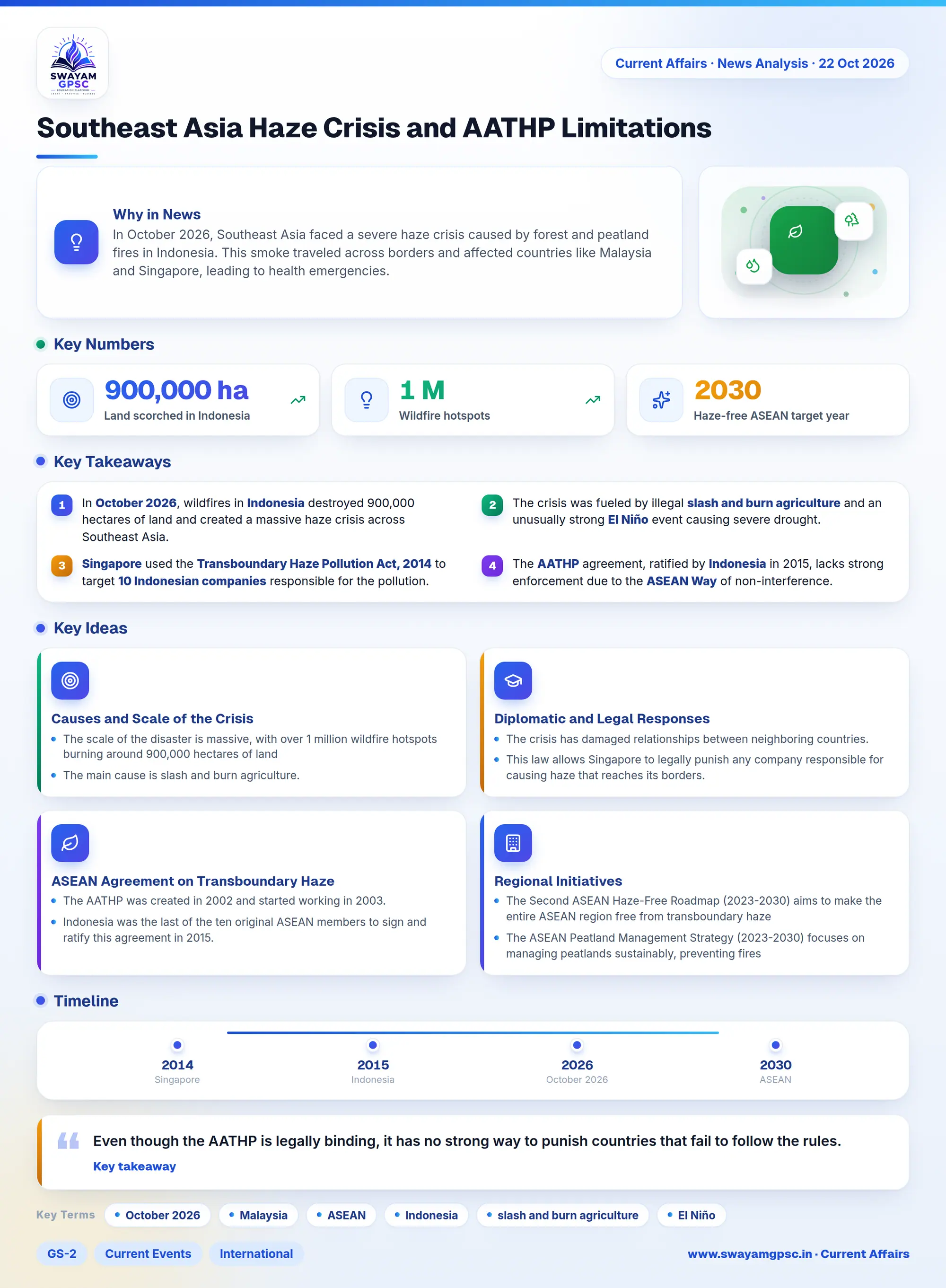
Southeast Asia Haze Crisis and AATHP Limitations
#GS-2 #Current Events #International #GS-3 #Environment #Climate Change #ASEAN
Key takeaways
- In October 2026, wildfires in Indonesia destroyed 900,000 hectares of land and created a massive haze crisis across Southeast Asia.
- The crisis was fueled by illegal slash and burn agriculture and an unusually strong El Niño event causing severe drought.
- Singapore used the Transboundary Haze Pollution Act, 2014 to target 10 Indonesian companies responsible for the pollution.
- The AATHP agreement, ratified by Indonesia in 2015, lacks strong enforcement due to the ASEAN Way of non-interference.
- The Second ASEAN Haze-Free Roadmap sets a target to eliminate transboundary haze in the region by 2030.
Why in News
- In October 2026, Southeast Asia faced a severe haze crisis caused by forest and peatland fires in Indonesia.
- This smoke traveled across borders and affected countries like Malaysia and Singapore, leading to health emergencies.
- The situation has caused diplomatic friction among ASEAN nations and exposed the weaknesses of the ASEAN Agreement on Transboundary Haze Pollution (AATHP).
Causes and Scale of the Crisis
- The scale of the disaster is massive, with over 1 million wildfire hotspots burning around 900,000 hectares of land in Indonesia, mostly in Sumatra and Kalimantan.
- The main cause is slash and burn agriculture. This is an illegal practice where farmers use fire as a cheap way to clear forests for farming.
- Fires in drained peatlands are especially dangerous because they burn underground for a long time. This releases greenhouse gases and fine particles known as PM2.5, which are hard to stop.
- A very strong El Niño event has made the dry season worse this year. This climate phenomenon creates extreme drought, making it nearly impossible to put out the fires.
Diplomatic and Legal Responses
- The crisis has damaged relationships between neighboring countries. For example, Singapore took action against 10 Indonesian companies using its Transboundary Haze Pollution Act, 2014.
- This law allows Singapore to legally punish any company responsible for causing haze that reaches its borders.
- The President of Indonesia called these slash-and-burn activities ecological terrorism and cancelled the licences of 26 companies.
- Meanwhile, local civil society groups have asked the government to declare a national disaster.
ASEAN Agreement on Transboundary Haze Pollution (AATHP)
- The AATHP was created in 2002 and started working in 2003. It is a legally binding regional deal to stop and monitor haze from forest fires through teamwork.
- Indonesia was the last of the ten original ASEAN members to sign and ratify this agreement in 2015.
- To make this work, the ASEAN Coordinating Centre for Transboundary Haze Pollution Control (ACC THPC) was set up. It helps countries share information and coordinate fire management.
Regional Initiatives
- The Second ASEAN Haze-Free Roadmap (2023-2030) aims to make the entire ASEAN region free from transboundary haze by 2030 through better monitoring and cooperation.
- The ASEAN Peatland Management Strategy (2023-2030) focuses on managing peatlands sustainably, preventing fires, and fixing damaged peatlands.
Challenges
- Even though the AATHP is legally binding, it has no strong way to punish countries that fail to follow the rules.
- The ASEAN Way is a big obstacle. This approach values national sovereignty, consensus, and non-interference, which prevents the group from holding members strictly accountable.