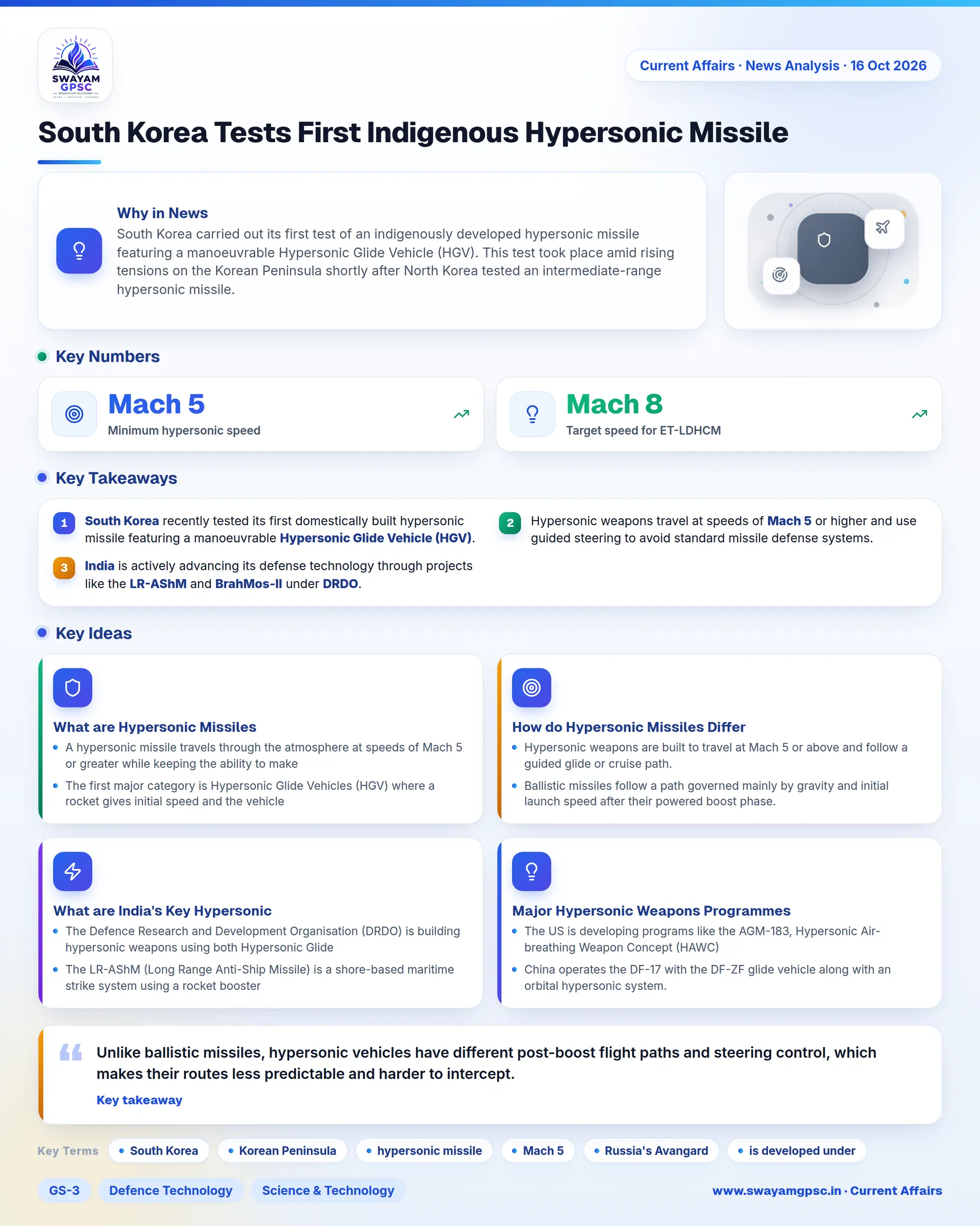
South Korea Tests First Indigenous Hypersonic Missile
#GS-3 #Defence Technology #Science & Technology #Current Events #National
Key takeaways
- South Korea recently tested its first domestically built hypersonic missile featuring a manoeuvrable Hypersonic Glide Vehicle (HGV).
- Hypersonic weapons travel at speeds of Mach 5 or higher and use guided steering to avoid standard missile defense systems.
- India is actively advancing its defense technology through projects like the LR-AShM and BrahMos-II under DRDO.
Why in News
- South Korea carried out its first test of an indigenously developed hypersonic missile featuring a manoeuvrable Hypersonic Glide Vehicle (HGV).
- This test took place amid rising tensions on the Korean Peninsula shortly after North Korea tested an intermediate-range hypersonic missile.
What are Hypersonic Missiles
- A hypersonic missile travels through the atmosphere at speeds of Mach 5 or greater while keeping the ability to make guided turns during flight.
- The first major category is Hypersonic Glide Vehicles (HGV) where a rocket gives initial speed and the vehicle then glides without ongoing engine power.
- The second major category is Hypersonic Cruise Missiles (HCM) which use an air-breathing engine like a supersonic combustion ramjet (scramjet) to keep powered flight going.
- Unlike ballistic missiles, hypersonic vehicles have different post-boost flight paths and steering control, which makes their routes less predictable and harder to intercept.
How do Hypersonic Missiles Differ from Ballistic Missiles
- Hypersonic weapons are built to travel at Mach 5 or above and follow a guided glide or cruise path.
- Ballistic missiles follow a path governed mainly by gravity and initial launch speed after their powered boost phase.
- Hypersonic weapons use low-altitude, steerable flight paths that reduce warning time and complicate defense systems.
- Ballistic missiles often travel high into space before re-entering, allowing earlier detection by radar systems.
- Examples of hypersonic glide and cruise weapons include Russia's Avangard, while India's Agni-V and the US Minuteman III are ballistic missiles.
What are India's Key Hypersonic Milestones
- The Defence Research and Development Organisation (DRDO) is building hypersonic weapons using both Hypersonic Glide Vehicles (HGVs) and scramjet-powered hypersonic cruise missiles.
- The LR-AShM (Long Range Anti-Ship Missile) is a shore-based maritime strike system using a rocket booster and a hypersonic glide phase to target enemy warships.
- The ET-LDHCM (Extended Trajectory-Long Duration Hypersonic Cruise Missile) is developed under Project Vishnu to reach speeds higher than Mach 8.
- DRDO successfully demonstrated a full-scale, actively cooled scramjet combustor to advance sustained hypersonic engine technology.
- BrahMos-II is a planned hypersonic cruise missile designed to hit speeds of about Mach 7.
Major Hypersonic Weapons Programmes Around the World
- The US is developing programs like the AGM-183, Hypersonic Air-breathing Weapon Concept (HAWC), and the Conventional Prompt Strike missile.
- China operates the DF-17 with the DF-ZF glide vehicle along with an orbital hypersonic system.
- Russia fields operational hypersonic weapons including the Kinzhal and Tsirkon systems.
- France is advancing its hypersonic capabilities through the V-MaX program.
- Australia and the US are collaborating on the Southern Cross hypersonic project, while Japan is developing a glide projectile.