South Africa's Living Biofilter: Cleaning Water Through Nature
#GS-2 #Governance & Social Justice #Good Governance #GS-3 #Environment #Pollution #Sustainable Development #Science & Technology #Current Events #International
Key takeaways
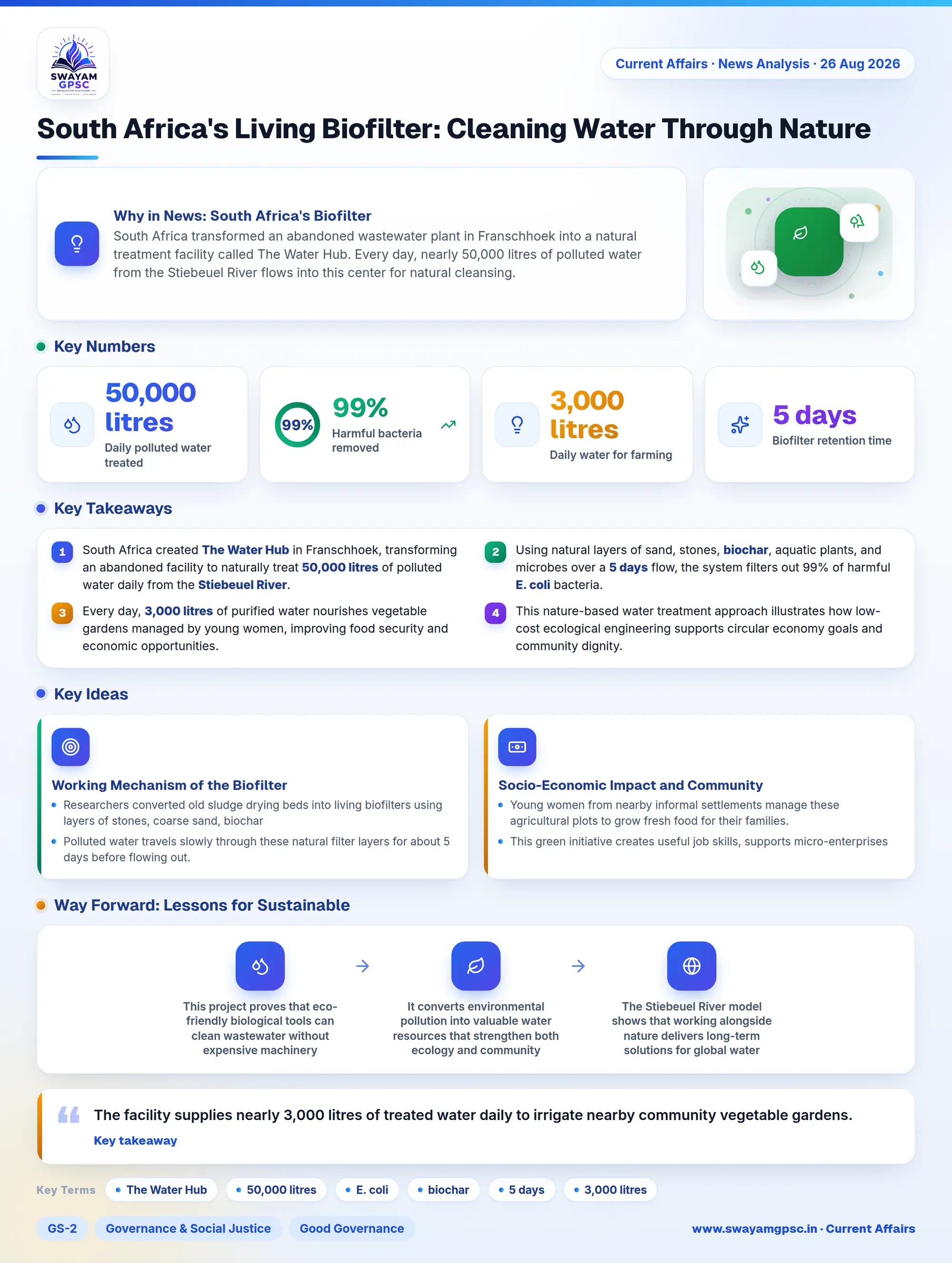
- South Africa created The Water Hub in Franschhoek, transforming an abandoned facility to naturally treat 50,000 litres of polluted water daily from the Stiebeuel River.
- Using natural layers of sand, stones, biochar, aquatic plants, and microbes over a 5 days flow, the system filters out 99% of harmful E. coli bacteria.
- Every day, 3,000 litres of purified water nourishes vegetable gardens managed by young women, improving food security and economic opportunities.
- This nature-based water treatment approach illustrates how low-cost ecological engineering supports circular economy goals and community dignity.
Why in News: South Africa's Biofilter Project
- South Africa transformed an abandoned wastewater plant in Franschhoek into a natural treatment facility called The Water Hub.
- Every day, nearly 50,000 litres of polluted water from the Stiebeuel River flows into this center for natural cleansing.
- The river carries heavy toxic pollution including untreated sewage, E. coli bacteria, excess nutrients, microplastics, and medical drug residues.
Working Mechanism of the Biofilter System
- Researchers converted old sludge drying beds into living biofilters using layers of stones, coarse sand, biochar, plants, and microbes.
- Polluted water travels slowly through these natural filter layers for about 5 days before flowing out.
- This natural process eliminates 99% of dangerous bacteria while drastically reducing phosphate and ammonia levels in the water.
- The system successfully replicates the natural water purification work that healthy wetland ecosystems perform naturally.
Socio-Economic Impact and Community Benefits
- The facility supplies nearly 3,000 litres of treated water daily to irrigate nearby community vegetable gardens.
- Young women from nearby informal settlements manage these agricultural plots to grow fresh food for their families.
- This green initiative creates useful job skills, supports micro-enterprises, and improves local food security and dignity.
Way Forward: Lessons for Sustainable Development
- This project proves that eco-friendly biological tools can clean wastewater without expensive machinery or heavy chemical inputs.
- It converts environmental pollution into valuable water resources that strengthen both ecology and community livelihoods.
- The Stiebeuel River model shows that working alongside nature delivers long-term solutions for global water pollution challenges.