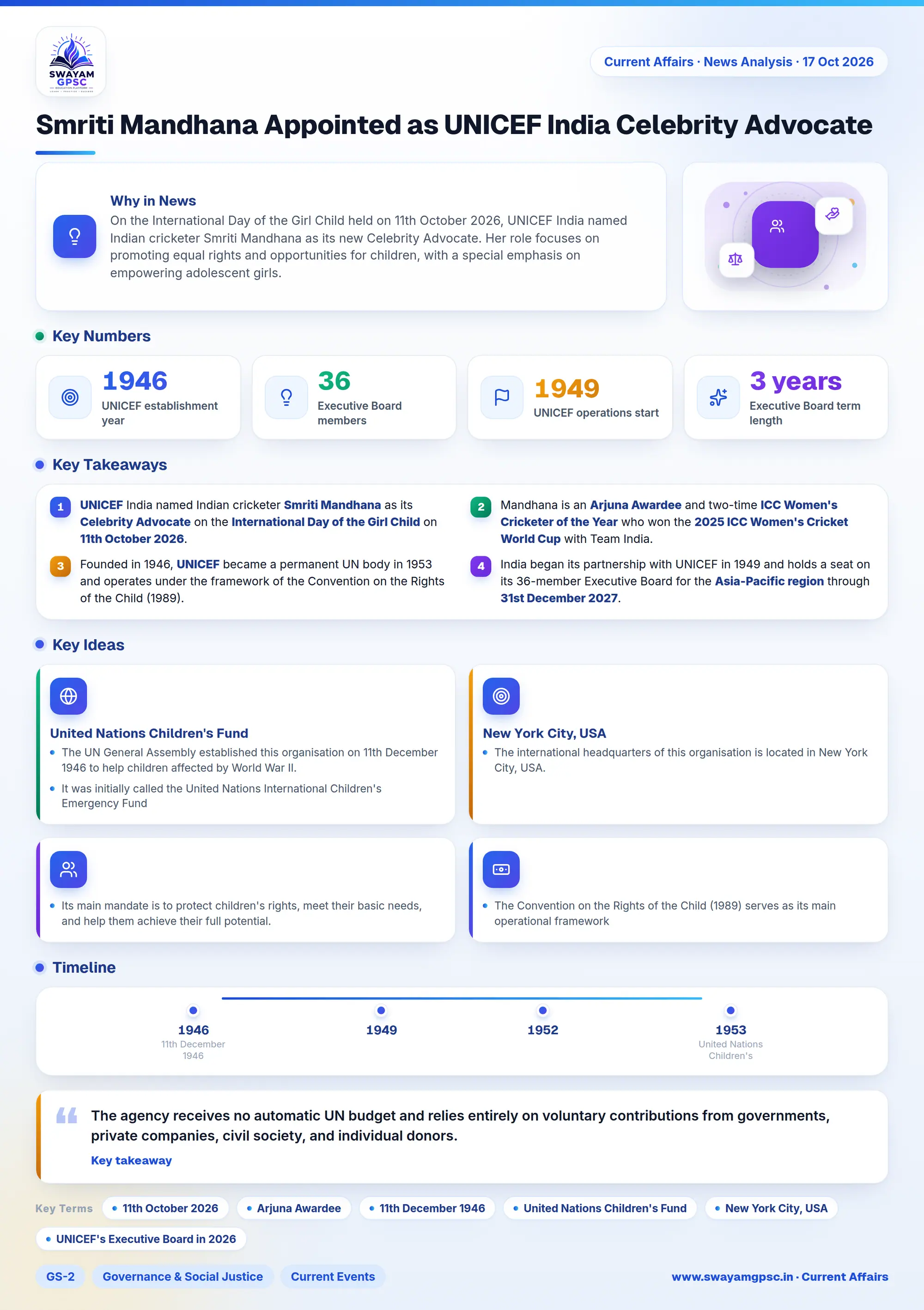
Smriti Mandhana Appointed as UNICEF India Celebrity Advocate
#GS-2 #Governance & Social Justice #Current Events #International #Vulnerable Sections #Women #Important International Institutions #Groupings & Agreements Involving India and/or Affecting India's Interests
Key takeaways
- UNICEF India named Indian cricketer Smriti Mandhana as its Celebrity Advocate on the International Day of the Girl Child on 11th October 2026.
- Mandhana is an Arjuna Awardee and two-time ICC Women's Cricketer of the Year who won the 2025 ICC Women's Cricket World Cup with Team India.
- Founded in 1946, UNICEF became a permanent UN body in 1953 and operates under the framework of the Convention on the Rights of the Child (1989).
- India began its partnership with UNICEF in 1949 and holds a seat on its 36-member Executive Board for the Asia-Pacific region through 31st December 2027.
Why in News
- On the International Day of the Girl Child held on 11th October 2026, UNICEF India named Indian cricketer Smriti Mandhana as its new Celebrity Advocate.
- Her role focuses on promoting equal rights and opportunities for children, with a special emphasis on empowering adolescent girls.
- Mandhana is an Arjuna Awardee and has won the ICC Women's Cricketer of the Year award twice.
- She was a key member of the Indian team that won the 2025 ICC Women's Cricket World Cup.
- She has earlier worked on UNICEF-International Cricket Council (ICC) campaigns about gender equality and life skills, along with UNICEF's Promise to Children campaign.
United Nations Children's Fund (UNICEF)
- The UN General Assembly established this organisation on 11th December 1946 to help children affected by World War II.
- It was initially called the United Nations International Children's Emergency Fund, but in 1953 it became a permanent UN agency and took the name United Nations Children's Fund.
- The international headquarters of this organisation is located in New York City, USA.
- Its main mandate is to protect children's rights, meet their basic needs, and help them achieve their full potential.
- The Convention on the Rights of the Child (1989) serves as its main operational framework, recognizing children's civil, political, economic, social, and cultural rights.
- A 36-member Executive Board governs the organisation, with members elected by the UN Economic and Social Council (ECOSOC) for 3-year terms.
- The agency receives no automatic UN budget and relies entirely on voluntary contributions from governments, private companies, civil society, and individual donors.
- UNICEF started its operations in India in 1949 and set up its main Delhi office in 1952.
- India serves on UNICEF's Executive Board in 2026 representing the Asia-Pacific region, with its term running until 31st December 2027.